Aufgabe HT 2 - 4 · Abitur NRW Englisch GK · Haupttermin · Weiterbildungskolleg 2021
Thema: Sprachmittlung Deutsch → Englisch (Mediation) · Aus der Prüfung GK · Haupttermin · Weiterbildungskolleg (2021)
Aufgabenstellung
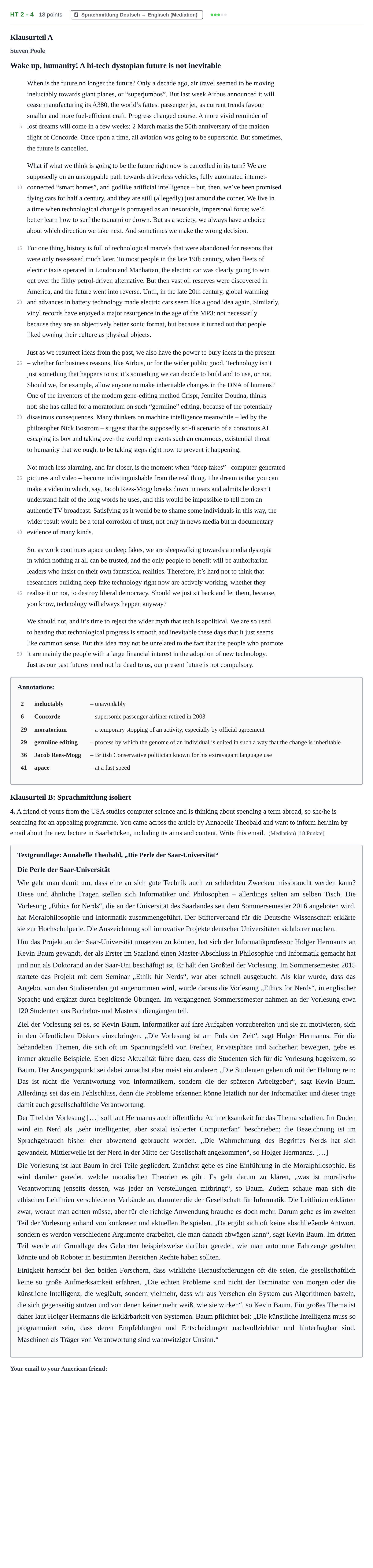
Klausurteil A
Steven Poole
Wake up, humanity! A hi-tech dystopian future is not inevitable
When is the future no longer the future? Only a decade ago, air travel seemed to be moving
ineluctably towards giant planes, or “superjumbos”. But last week Airbus announced it will
cease manufacturing its A380, the world’s fattest passenger jet, as current trends favour
smaller and more fuel-efficient craft. Progress changed course. A more vivid reminder of
5 lost dreams will come in a few weeks: 2 March marks the 50th anniversary of the maiden
flight of Concorde. Once upon a time, all aviation was going to be supersonic. But sometimes,
the future is cancelled.
What if what we think is going to be the future right now is cancelled in its turn? We are
supposedly on an unstoppable path towards driverless vehicles, fully automated internet-
10 connected “smart homes”, and godlike artificial intelligence – but, then, we’ve been promised
flying cars for half a century, and they are still (allegedly) just around the corner. We live in
a time when technological change is portrayed as an inexorable, impersonal force: we’d
better learn how to surf the tsunami or drown. But as a society, we always have a choice
about which direction we take next. And sometimes we make the wrong decision.
15 For one thing, history is full of technological marvels that were abandoned for reasons that
were only reassessed much later. To most people in the late 19th century, when fleets of
electric taxis operated in London and Manhattan, the electric car was clearly going to win
out over the filthy petrol-driven alternative. But then vast oil reserves were discovered in
America, and the future went into reverse. Until, in the late 20th century, global warming
20 and advances in battery technology made electric cars seem like a good idea again. Similarly,
vinyl records have enjoyed a major resurgence in the age of the MP3: not necessarily
because they are an objectively better sonic format, but because it turned out that people
liked owning their culture as physical objects.
Just as we resurrect ideas from the past, we also have the power to bury ideas in the present
25 – whether for business reasons, like Airbus, or for the wider public good. Technology isn’t
just something that happens to us; it’s something we can decide to build and to use, or not.
Should we, for example, allow anyone to make inheritable changes in the DNA of humans?
One of the inventors of the modern gene-editing method Crispr, Jennifer Doudna, thinks
not: she has called for a moratorium on such “germline” editing, because of the potentially
30 disastrous consequences. Many thinkers on machine intelligence meanwhile – led by the
philosopher Nick Bostrom – suggest that the supposedly sci-fi scenario of a conscious AI
escaping its box and taking over the world represents such an enormous, existential threat
to humanity that we ought to be taking steps right now to prevent it happening.
Not much less alarming, and far closer, is the moment when “deep fakes”– computer-generated
35 pictures and video – become indistinguishable from the real thing. The dream is that you can
make a video in which, say, Jacob Rees-Mogg breaks down in tears and admits he doesn’t
understand half of the long words he uses, and this would be impossible to tell from an
authentic TV broadcast. Satisfying as it would be to shame some individuals in this way, the
wider result would be a total corrosion of trust, not only in news media but in documentary
40 evidence of many kinds.
So, as work continues apace on deep fakes, we are sleepwalking towards a media dystopia
in which nothing at all can be trusted, and the only people to benefit will be authoritarian
leaders who insist on their own fantastical realities. Therefore, it’s hard not to think that
researchers building deep-fake technology right now are actively working, whether they
45 realise it or not, to destroy liberal democracy. Should we just sit back and let them, because,
you know, technology will always happen anyway?
We should not, and it’s time to reject the wider myth that tech is apolitical. We are so used
to hearing that technological progress is smooth and inevitable these days that it just seems
like common sense. But this idea may not be unrelated to the fact that the people who promote
50 it are mainly the people with a large financial interest in the adoption of new technology.
Just as our past futures need not be dead to us, our present future is not compulsory.
Annotations:
2 · ineluctably · – unavoidably
6 · Concorde · – supersonic passenger airliner retired in 2003
29 · moratorium · – a temporary stopping of an activity, especially by official agreement
29 · germline editing · – process by which the genome of an individual is edited in such a way that the change is inheritable
36 · Jacob Rees-Mogg · – British Conservative politician known for his extravagant language use
41 · apace · – at a fast speed
Klausurteil B: Sprachmittlung isoliert
4. A friend of yours from the USA studies computer science and is thinking about spending a term abroad, so she/he is searching for an appealing programme. You came across the article by Annabelle Theobald and want to inform her/him by email about the new lecture in Saarbrücken, including its aims and content. Write this email. (Mediation) [18 Punkte]
Textgrundlage: Annabelle Theobald, „Die Perle der Saar-Universität“
Die Perle der Saar-Universität
Wie geht man damit um, dass eine an sich gute Technik auch zu schlechten Zwecken missbraucht werden kann? Diese und ähnliche Fragen stellen sich Informatiker und Philosophen – allerdings selten am selben Tisch. Die Vorlesung „Ethics for Nerds“, die an der Universität des Saarlandes seit dem Sommersemester 2016 angeboten wird, hat Moralphilosophie und Informatik zusammengeführt. Der Stifterverband für die Deutsche Wissenschaft erklärte sie zur Hochschulperle. Die Auszeichnung soll innovative Projekte deutscher Universitäten sichtbarer machen.
Um das Projekt an der Saar-Universität umsetzen zu können, hat sich der Informatikprofessor Holger Hermanns an Kevin Baum gewandt, der als Erster im Saarland einen Master-Abschluss in Philosophie und Informatik gemacht hat und nun als Doktorand an der Saar-Uni beschäftigt ist. Er hält den Großteil der Vorlesung. Im Sommersemester 2015 startete das Projekt mit dem Seminar „Ethik für Nerds“, war aber schnell ausgebucht. Als klar wurde, dass das Angebot von den Studierenden gut angenommen wird, wurde daraus die Vorlesung „Ethics for Nerds“, in englischer Sprache und ergänzt durch begleitende Übungen. Im vergangenen Sommersemester nahmen an der Vorlesung etwa 120 Studenten aus Bachelor- und Masterstudiengängen teil.
Ziel der Vorlesung sei es, so Kevin Baum, Informatiker auf ihre Aufgaben vorzubereiten und sie zu motivieren, sich in den öffentlichen Diskurs einzubringen. „Die Vorlesung ist am Puls der Zeit“, sagt Holger Hermanns. Für die behandelten Themen, die sich oft im Spannungsfeld von Freiheit, Privatsphäre und Sicherheit bewegten, gebe es immer aktuelle Beispiele. Eben diese Aktualität führe dazu, dass die Studenten sich für die Vorlesung begeistern, so Baum. Der Ausgangspunkt sei dabei zunächst aber meist ein anderer: „Die Studenten gehen oft mit der Haltung rein: Das ist nicht die Verantwortung von Informatikern, sondern die der späteren Arbeitgeber“, sagt Kevin Baum. Allerdings sei das ein Fehlschluss, denn die Probleme erkennen könne letztlich nur der Informatiker und dieser trage damit auch gesellschaftliche Verantwortung.
Der Titel der Vorlesung […] soll laut Hermanns auch öffentliche Aufmerksamkeit für das Thema schaffen. Im Duden wird ein Nerd als „sehr intelligenter, aber sozial isolierter Computerfan“ beschrieben; die Bezeichnung ist im Sprachgebrauch bisher eher abwertend gebraucht worden. „Die Wahrnehmung des Begriffes Nerds hat sich gewandelt. Mittlerweile ist der Nerd in der Mitte der Gesellschaft angekommen“, so Holger Hermanns. […]
Die Vorlesung ist laut Baum in drei Teile gegliedert. Zunächst gebe es eine Einführung in die Moralphilosophie. Es wird darüber geredet, welche moralischen Theorien es gibt. Es geht darum zu klären, „was ist moralische Verantwortung jenseits dessen, was jeder an Vorstellungen mitbringt“, so Baum. Zudem schaue man sich die ethischen Leitlinien verschiedener Verbände an, darunter die der Gesellschaft für Informatik. Die Leitlinien erklärten zwar, worauf man achten müsse, aber für die richtige Anwendung brauche es doch mehr. Darum gehe es im zweiten Teil der Vorlesung anhand von konkreten und aktuellen Beispielen. „Da ergibt sich oft keine abschließende Antwort, sondern es werden verschiedene Argumente erarbeitet, die man danach abwägen kann“, sagt Kevin Baum. Im dritten Teil werde auf Grundlage des Gelernten beispielsweise darüber geredet, wie man autonome Fahrzeuge gestalten könnte und ob Roboter in bestimmten Bereichen Rechte haben sollten.
Einigkeit herrscht bei den beiden Forschern, dass wirkliche Herausforderungen oft die seien, die gesellschaftlich keine so große Aufmerksamkeit erfahren. „Die echten Probleme sind nicht der Terminator von morgen oder die künstliche Intelligenz, die wegläuft, sondern vielmehr, dass wir aus Versehen ein System aus Algorithmen basteln, die sich gegenseitig stützen und von denen keiner mehr weiß, wie sie wirken“, so Kevin Baum. Ein großes Thema ist daher laut Holger Hermanns die Erklärbarkeit von Systemen. Baum pflichtet bei: „Die künstliche Intelligenz muss so programmiert sein, dass deren Empfehlungen und Entscheidungen nachvollziehbar und hinterfragbar sind. Maschinen als Träger von Verantwortung sind wahnwitziger Unsinn.“
Lösung
Nach den offiziellen Korrekturhinweisen
4. A friend of yours from the USA studies computer science and is thinking about spending a term abroad, so she/he is searching for an appealing programme. You came across the article by Annabelle Theobald and want to inform her/him by email about the new lecture in Saarbrücken, including its aims and content. Write this email.
Lösung: Sample email: Subject: Check out this great computer science ethics lecture in Saarbrücken! Hi [Name], Hope you're doing well! I remember you mentioned looking for exciting courses for your term abroad, and I just came across an article about a really innovative course called "Ethics for Nerds" at Saarland University (Saarbrücken). Here are some key details about the format: - It's offered by Saarland University and has even been recognized as an outstanding innovative project ("Hochschulperle"). - The course is held in English, includes accompanying practical tutorials/exercises, and is open to both Bachelor's and Master's students in computer science. Goals of the course: - It aims to bring together computer science and moral philosophy, an essential combination that rarely happens. - It prepares computer scientists for ethical dilemmas in their future careers, showing that social responsibility lies with the programmers, not just later employers. - It motivates and equips students to participate actively in public and societal discussions on technology. Course contents: - Part 1: An introduction to moral philosophy, theoretical frameworks, and existing ethical codes/guidelines (e.g., from computer science associations). - Part 2: Critical examination and application of ethical dilemmas to current real-world case studies through debate and weighing arguments. - Part 3: Concrete applications such as autonomous vehicles, robot rights, algorithmic systems, and the explainability/transparency of artificial intelligence. I think this would be a fantastic fit for your study abroad semester! Let me know what you think. Best, [Your Name]
Die ausführliche Erklärung Schritt für Schritt (mit KI) gibt es mit Premium. Premium
Löse sie direkt hier: automatische Korrektur, Hinweise und Lösung Schritt für Schritt.
‹ Aufgabe HT 1 - 4 · GK · Haupttermin · Weiterbildungskolleg 2021 · Aufgabe HT 3 - 4 · GK · Haupttermin · Weiterbildungskolleg 2021 ›
Mehr Aufgaben zu Sprachmittlung Deutsch → Englisch (Mediation)
- Aufgabe 1 · GK · Borowski: Wenn Grundschülern die Wo 2021
- Aufgabe HT 1 - Aufgabe 4 · GK · Haupttermin 2021
- Aufgabe HT 2 - Aufgabe 4 · GK · Haupttermin 2021
- Aufgabe HT 3 - Aufgabe 4 · GK · Haupttermin 2021
- Aufgabe HT 1 - 4 · GK · Haupttermin · Weiterbildungskolleg 2021
- Aufgabe HT 3 - 4 · GK · Haupttermin · Weiterbildungskolleg 2021
- Aufgabe HT 1 - Aufgabe 4 · GK · Haupttermin · Weiterbildungskolleg 2021
- Aufgabe HT 2 - Aufgabe 4 · GK · Haupttermin · Weiterbildungskolleg 2021
- Aufgabe HT 3 - Aufgabe 4 · GK · Haupttermin · Weiterbildungskolleg 2021
- Aufgabe NT 1 - Teilaufgabe 4 · GK · Nachtermin 2021