Aufgabe HT 1 - Aufgabe 4 · Abitur NRW Englisch GK · Haupttermin 2021
Thema: Sprachmittlung Deutsch → Englisch (Mediation) · Aus der Prüfung GK · Haupttermin (2021)
Aufgabenstellung
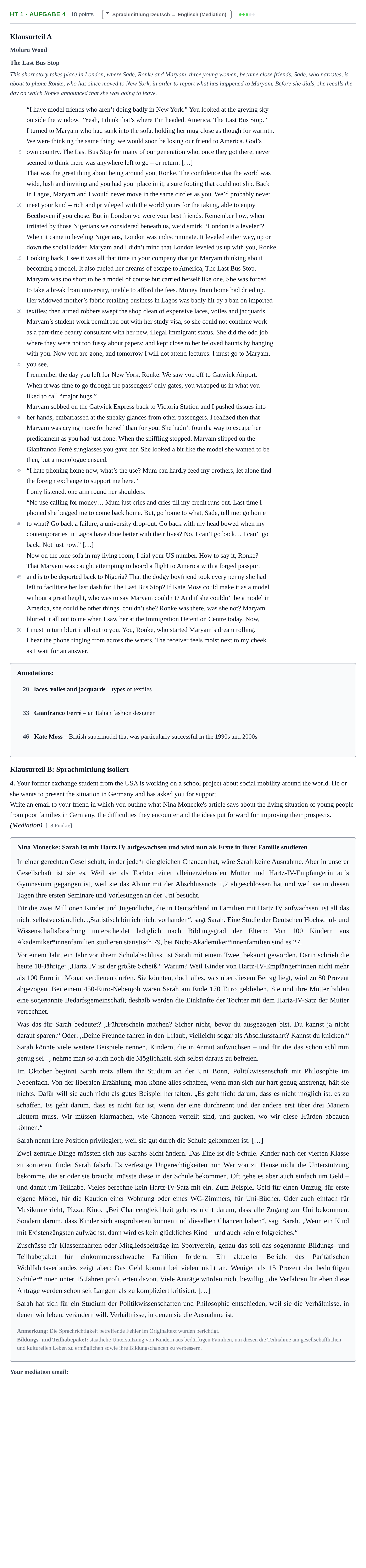
Klausurteil A
Molara Wood
The Last Bus Stop
This short story takes place in London, where Sade, Ronke and Maryam, three young women, became close friends. Sade, who narrates, is about to phone Ronke, who has since moved to New York, in order to report what has happened to Maryam. Before she dials, she recalls the day on which Ronke announced that she was going to leave.
“I have model friends who aren’t doing badly in New York.” You looked at the greying sky
outside the window. “Yeah, I think that’s where I’m headed. America. The Last Bus Stop.”
I turned to Maryam who had sunk into the sofa, holding her mug close as though for warmth.
We were thinking the same thing: we would soon be losing our friend to America. God’s
5 own country. The Last Bus Stop for many of our generation who, once they got there, never
seemed to think there was anywhere left to go – or return. […]
That was the great thing about being around you, Ronke. The confidence that the world was
wide, lush and inviting and you had your place in it, a sure footing that could not slip. Back
in Lagos, Maryam and I would never move in the same circles as you. We’d probably never
10 meet your kind – rich and privileged with the world yours for the taking, able to enjoy
Beethoven if you chose. But in London we were your best friends. Remember how, when
irritated by those Nigerians we considered beneath us, we’d smirk, ‘London is a leveler’?
When it came to leveling Nigerians, London was indiscriminate. It leveled either way, up or
down the social ladder. Maryam and I didn’t mind that London leveled us up with you, Ronke.
15 Looking back, I see it was all that time in your company that got Maryam thinking about
becoming a model. It also fueled her dreams of escape to America, The Last Bus Stop.
Maryam was too short to be a model of course but carried herself like one. She was forced
to take a break from university, unable to afford the fees. Money from home had dried up.
Her widowed mother’s fabric retailing business in Lagos was badly hit by a ban on imported
20 textiles; then armed robbers swept the shop clean of expensive laces, voiles and jacquards.
Maryam’s student work permit ran out with her study visa, so she could not continue work
as a part-time beauty consultant with her new, illegal immigrant status. She did the odd job
where they were not too fussy about papers; and kept close to her beloved haunts by hanging
with you. Now you are gone, and tomorrow I will not attend lectures. I must go to Maryam,
25 you see.
I remember the day you left for New York, Ronke. We saw you off to Gatwick Airport.
When it was time to go through the passengers’ only gates, you wrapped us in what you
liked to call “major hugs.”
Maryam sobbed on the Gatwick Express back to Victoria Station and I pushed tissues into
30 her hands, embarrassed at the sneaky glances from other passengers. I realized then that
Maryam was crying more for herself than for you. She hadn’t found a way to escape her
predicament as you had just done. When the sniffling stopped, Maryam slipped on the
Gianfranco Ferré sunglasses you gave her. She looked a bit like the model she wanted to be
then, but a monologue ensued.
35 “I hate phoning home now, what’s the use? Mum can hardly feed my brothers, let alone find
the foreign exchange to support me here.”
I only listened, one arm round her shoulders.
“No use calling for money… Mum just cries and cries till my credit runs out. Last time I
phoned she begged me to come back home. But, go home to what, Sade, tell me; go home
40 to what? Go back a failure, a university drop-out. Go back with my head bowed when my
contemporaries in Lagos have done better with their lives? No. I can’t go back… I can’t go
back. Not just now.” […]
Now on the lone sofa in my living room, I dial your US number. How to say it, Ronke?
That Maryam was caught attempting to board a flight to America with a forged passport
45 and is to be deported back to Nigeria? That the dodgy boyfriend took every penny she had
left to facilitate her last dash for The Last Bus Stop? If Kate Moss could make it as a model
without a great height, who was to say Maryam couldn’t? And if she couldn’t be a model in
America, she could be other things, couldn’t she? Ronke was there, was she not? Maryam
blurted it all out to me when I saw her at the Immigration Detention Centre today. Now,
50 I must in turn blurt it all out to you. You, Ronke, who started Maryam’s dream rolling.
I hear the phone ringing from across the waters. The receiver feels moist next to my cheek
as I wait for an answer.
Annotations:
20 laces, voiles and jacquards – types of textiles
33 Gianfranco Ferré – an Italian fashion designer
46 Kate Moss – British supermodel that was particularly successful in the 1990s and 2000s
Klausurteil B: Sprachmittlung isoliert
4. Your former exchange student from the USA is working on a school project about social mobility around the world. He or she wants to present the situation in Germany and has asked you for support.
Write an email to your friend in which you outline what Nina Monecke's article says about the living situation of young people from poor families in Germany, the difficulties they encounter and the ideas put forward for improving their prospects. (Mediation) [18 Punkte]
Nina Monecke: Sarah ist mit Hartz IV aufgewachsen und wird nun als Erste in ihrer Familie studieren
In einer gerechten Gesellschaft, in der jede*r die gleichen Chancen hat, wäre Sarah keine Ausnahme. Aber in unserer Gesellschaft ist sie es. Weil sie als Tochter einer alleinerziehenden Mutter und Hartz-IV-Empfängerin aufs Gymnasium gegangen ist, weil sie das Abitur mit der Abschlussnote 1,2 abgeschlossen hat und weil sie in diesen Tagen ihre ersten Seminare und Vorlesungen an der Uni besucht.
Für die zwei Millionen Kinder und Jugendliche, die in Deutschland in Familien mit Hartz IV aufwachsen, ist all das nicht selbstverständlich. „Statistisch bin ich nicht vorhanden“, sagt Sarah. Eine Studie der Deutschen Hochschul- und Wissenschaftsforschung unterscheidet lediglich nach Bildungsgrad der Eltern: Von 100 Kindern aus Akademiker*innenfamilien studieren statistisch 79, bei Nicht-Akademiker*innenfamilien sind es 27.
Vor einem Jahr, ein Jahr vor ihrem Schulabschluss, ist Sarah mit einem Tweet bekannt geworden. Darin schrieb die heute 18-Jährige: „Hartz IV ist der größte Scheiß.“ Warum? Weil Kinder von Hartz-IV-Empfänger*innen nicht mehr als 100 Euro im Monat verdienen dürfen. Sie könnten, doch alles, was über diesem Betrag liegt, wird zu 80 Prozent abgezogen. Bei einem 450-Euro-Nebenjob wären Sarah am Ende 170 Euro geblieben. Sie und ihre Mutter bilden eine sogenannte Bedarfsgemeinschaft, deshalb werden die Einkünfte der Tochter mit dem Hartz-IV-Satz der Mutter verrechnet.
Was das für Sarah bedeutet? „Führerschein machen? Sicher nicht, bevor du ausgezogen bist. Du kannst ja nicht darauf sparen.“ Oder: „Deine Freunde fahren in den Urlaub, vielleicht sogar als Abschlussfahrt? Kannst du knicken.“ Sarah könnte viele weitere Beispiele nennen. Kindern, die in Armut aufwuchsen – und für die das schon schlimm genug sei –, nehme man so auch noch die Möglichkeit, sich selbst daraus zu befreien.
Im Oktober beginnt Sarah trotz allem ihr Studium an der Uni Bonn, Politikwissenschaft mit Philosophie im Nebenfach. Von der liberalen Erzählung, man könne alles schaffen, wenn man sich nur hart genug anstrengt, hält sie nichts. Dafür will sie auch nicht als gutes Beispiel herhalten. „Es geht nicht darum, dass es nicht möglich ist, es zu schaffen. Es geht darum, dass es nicht fair ist, wenn der eine durchrennt und der andere erst über drei Mauern klettern muss. Wir müssen klarmachen, wie Chancen verteilt sind, und gucken, wo wir diese Hürden abbauen können.“
Sarah nennt ihre Position privilegiert, weil sie gut durch die Schule gekommen ist. […]
Zwei zentrale Dinge müssten sich aus Sarahs Sicht ändern. Das Eine ist die Schule. Kinder nach der vierten Klasse zu sortieren, findet Sarah falsch. Es verfestige Ungerechtigkeiten nur. Wer von zu Hause nicht die Unterstützung bekomme, die er oder sie braucht, müsste diese in der Schule bekommen. Oft gehe es aber auch einfach um Geld – und damit um Teilhabe. Vieles berechne kein Hartz-IV-Satz mit ein. Zum Beispiel Geld für einen Umzug, für erste eigene Möbel, für die Kaution einer Wohnung oder eines WG-Zimmers, für Uni-Bücher. Oder auch einfach für Musikunterricht, Pizza, Kino. „Bei Chancengleichheit geht es nicht darum, dass alle Zugang zur Uni bekommen. Sondern darum, dass Kinder sich ausprobieren können und dieselben Chancen haben“, sagt Sarah. „Wenn ein Kind mit Existenzängsten aufwächst, dann wird es kein glückliches Kind – und auch kein erfolgreiches.“
Zuschüsse für Klassenfahrten oder Mitgliedsbeiträge im Sportverein, genau das soll das sogenannte Bildungs- und Teilhabepaket für einkommensschwache Familien fördern. Ein aktueller Bericht des Paritätischen Wohlfahrtsverbandes zeigt aber: Das Geld kommt bei vielen nicht an. Weniger als 15 Prozent der bedürftigen Schüler*innen unter 15 Jahren profitierten davon. Viele Anträge würden nicht bewilligt, die Verfahren für eben diese Anträge werden schon seit Langem als zu kompliziert kritisiert. […]
Sarah hat sich für ein Studium der Politikwissenschaften und Philosophie entschieden, weil sie die Verhältnisse, in denen wir leben, verändern will. Verhältnisse, in denen sie die Ausnahme ist.
Anmerkung: Die Sprachrichtigkeit betreffende Fehler im Originaltext wurden berichtigt.
Bildungs- und Teilhabepaket: staatliche Unterstützung von Kindern aus bedürftigen Familien, um diesen die Teilnahme am gesellschaftlichen und kulturellen Leben zu ermöglichen sowie ihre Bildungschancen zu verbessern.
Lösung
Nach den offiziellen Korrekturhinweisen
Write an email to your friend in which you outline what Nina Monecke's article says about the living situation of young people from poor families in Germany, the difficulties they encounter and the ideas put forward for improving their prospects.
Lösung: An email to the former exchange student covering: - Email format with informal salutation, reference to the friend's request/project, and sign-off. - Situation of children from low-income families: basic financial state support (Hartz IV); high deduction rate on own income (money earned beyond a low threshold is mostly deducted from welfare payments); low proportion of children from non-academic backgrounds attending university. - Problems/hardships: inability to build own savings (e.g. for a driver's licence or school trips); restricted participation in education, cultural activities, and social life; reduced chances for social mobility and overcoming poverty. - Suggestions for improvement: more individual support in schools instead of early sorting/tracking after primary school; unbureaucratic, comprehensive financial support to enable social participation and independent living (criticism of the complicated and ineffective 'Bildungs- und Teilhabepaket').
Die ausführliche Erklärung Schritt für Schritt (mit KI) gibt es mit Premium. Premium
Löse sie direkt hier: automatische Korrektur, Hinweise und Lösung Schritt für Schritt.
‹ Aufgabe 1 · GK · Borowski: Wenn Grundschülern die Wo 2021 · Aufgabe HT 2 - Aufgabe 4 · GK · Haupttermin 2021 ›
Mehr Aufgaben zu Sprachmittlung Deutsch → Englisch (Mediation)
- Aufgabe NT 3 - Aufgabe 4 · LK · Nachtermin 2022
- Aufgabe · LK · Nolte: Wertevermittlung in der Schu 2022
- Aufgabe 1 · LK · Scholz/Schnabel: Handschrift: Die A 2022
- Aufgabe · GK · Allmann: Raus aus der Metropole 2021
- Aufgabe 1 · GK · Borowski: Wenn Grundschülern die Wo 2021
- Aufgabe HT 2 - Aufgabe 4 · GK · Haupttermin 2021
- Aufgabe HT 3 - Aufgabe 4 · GK · Haupttermin 2021
- Aufgabe HT 1 - 4 · GK · Haupttermin · Weiterbildungskolleg 2021
- Aufgabe HT 2 - 4 · GK · Haupttermin · Weiterbildungskolleg 2021
- Aufgabe HT 3 - 4 · GK · Haupttermin · Weiterbildungskolleg 2021