Aufgabe HT 3 - Aufgabe 4 · Abitur NRW Englisch GK · Haupttermin 2021
Thema: Sprachmittlung Deutsch → Englisch (Mediation) · Aus der Prüfung GK · Haupttermin (2021)
Aufgabenstellung
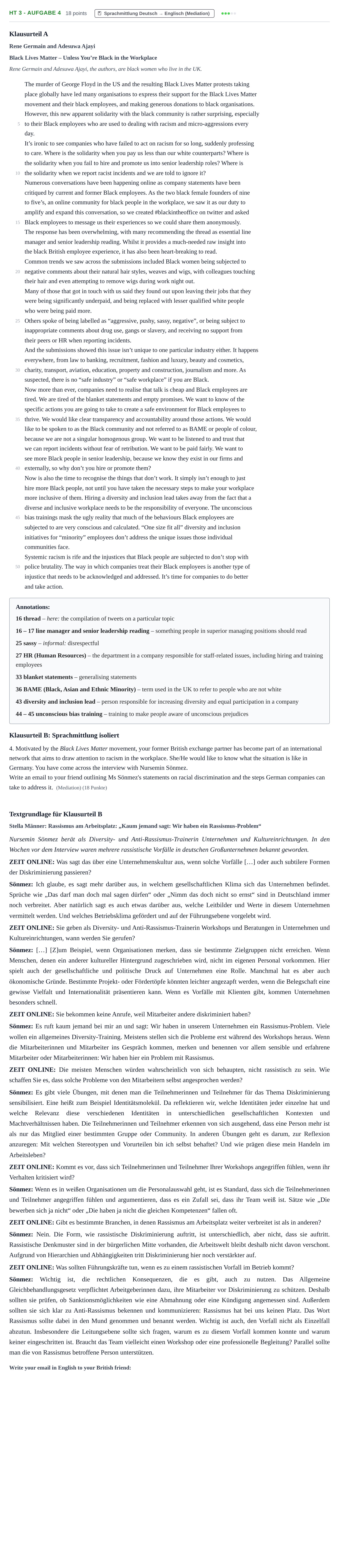
Klausurteil A
Rene Germain and Adesuwa Ajayi
Black Lives Matter – Unless You’re Black in the Workplace
Rene Germain and Adesuwa Ajayi, the authors, are black women who live in the UK.
The murder of George Floyd in the US and the resulting Black Lives Matter protests taking
place globally have led many organisations to express their support for the Black Lives Matter
movement and their black employees, and making generous donations to black organisations.
However, this new apparent solidarity with the black community is rather surprising, especially
5 to their Black employees who are used to dealing with racism and micro-aggressions every
day.
It’s ironic to see companies who have failed to act on racism for so long, suddenly professing
to care. Where is the solidarity when you pay us less than our white counterparts? Where is
the solidarity when you fail to hire and promote us into senior leadership roles? Where is
10 the solidarity when we report racist incidents and we are told to ignore it?
Numerous conversations have been happening online as company statements have been
critiqued by current and former Black employees. As the two black female founders of nine
to five’s, an online community for black people in the workplace, we saw it as our duty to
amplify and expand this conversation, so we created #blackintheoffice on twitter and asked
15 Black employees to message us their experiences so we could share them anonymously.
The response has been overwhelming, with many recommending the thread as essential line
manager and senior leadership reading. Whilst it provides a much-needed raw insight into
the black British employee experience, it has also been heart-breaking to read.
Common trends we saw across the submissions included Black women being subjected to
20 negative comments about their natural hair styles, weaves and wigs, with colleagues touching
their hair and even attempting to remove wigs during work night out.
Many of those that got in touch with us said they found out upon leaving their jobs that they
were being significantly underpaid, and being replaced with lesser qualified white people
who were being paid more.
25 Others spoke of being labelled as “aggressive, pushy, sassy, negative”, or being subject to
inappropriate comments about drug use, gangs or slavery, and receiving no support from
their peers or HR when reporting incidents.
And the submissions showed this issue isn’t unique to one particular industry either. It happens
everywhere, from law to banking, recruitment, fashion and luxury, beauty and cosmetics,
30 charity, transport, aviation, education, property and construction, journalism and more. As
suspected, there is no “safe industry” or “safe workplace” if you are Black.
Now more than ever, companies need to realise that talk is cheap and Black employees are
tired. We are tired of the blanket statements and empty promises. We want to know of the
specific actions you are going to take to create a safe environment for Black employees to
35 thrive. We would like clear transparency and accountability around those actions. We would
like to be spoken to as the Black community and not referred to as BAME or people of colour,
because we are not a singular homogenous group. We want to be listened to and trust that
we can report incidents without fear of retribution. We want to be paid fairly. We want to
see more Black people in senior leadership, because we know they exist in our firms and
40 externally, so why don’t you hire or promote them?
Now is also the time to recognise the things that don’t work. It simply isn’t enough to just
hire more Black people, not until you have taken the necessary steps to make your workplace
more inclusive of them. Hiring a diversity and inclusion lead takes away from the fact that a
diverse and inclusive workplace needs to be the responsibility of everyone. The unconscious
45 bias trainings mask the ugly reality that much of the behaviours Black employees are
subjected to are very conscious and calculated. “One size fit all” diversity and inclusion
initiatives for “minority” employees don’t address the unique issues those individual
communities face.
Systemic racism is rife and the injustices that Black people are subjected to don’t stop with
50 police brutality. The way in which companies treat their Black employees is another type of
injustice that needs to be acknowledged and addressed. It’s time for companies to do better
and take action.
Annotations:
16 thread – here: the compilation of tweets on a particular topic
16 – 17 line manager and senior leadership reading – something people in superior managing positions should read
25 sassy – informal: disrespectful
27 HR (Human Resources) – the department in a company responsible for staff-related issues, including hiring and training employees
33 blanket statements – generalising statements
36 BAME (Black, Asian and Ethnic Minority) – term used in the UK to refer to people who are not white
43 diversity and inclusion lead – person responsible for increasing diversity and equal participation in a company
44 – 45 unconscious bias training – training to make people aware of unconscious prejudices
Klausurteil B: Sprachmittlung isoliert
4. Motivated by the Black Lives Matter movement, your former British exchange partner has become part of an international network that aims to draw attention to racism in the workplace. She/He would like to know what the situation is like in Germany. You have come across the interview with Nursemin Sönmez.
Write an email to your friend outlining Ms Sönmez's statements on racial discrimination and the steps German companies can take to address it. (Mediation) (18 Punkte)
Textgrundlage für Klausurteil B
Stella Männer: Rassismus am Arbeitsplatz: „Kaum jemand sagt: Wir haben ein Rassismus-Problem“
Nursemin Sönmez berät als Diversity- und Anti-Rassismus-Trainerin Unternehmen und Kultureinrichtungen. In den Wochen vor dem Interview waren mehrere rassistische Vorfälle in deutschen Großunternehmen bekannt geworden.
ZEIT ONLINE: Was sagt das über eine Unternehmenskultur aus, wenn solche Vorfälle […] oder auch subtilere Formen der Diskriminierung passieren?
Sönmez: Ich glaube, es sagt mehr darüber aus, in welchem gesellschaftlichen Klima sich das Unternehmen befindet. Sprüche wie „Das darf man doch mal sagen dürfen“ oder „Nimm das doch nicht so ernst“ sind in Deutschland immer noch verbreitet. Aber natürlich sagt es auch etwas darüber aus, welche Leitbilder und Werte in diesem Unternehmen vermittelt werden. Und welches Betriebsklima gefördert und auf der Führungsebene vorgelebt wird.
ZEIT ONLINE: Sie geben als Diversity- und Anti-Rassismus-Trainerin Workshops und Beratungen in Unternehmen und Kultureinrichtungen, wann werden Sie gerufen?
Sönmez: […] [Z]um Beispiel, wenn Organisationen merken, dass sie bestimmte Zielgruppen nicht erreichen. Wenn Menschen, denen ein anderer kultureller Hintergrund zugeschrieben wird, nicht im eigenen Personal vorkommen. Hier spielt auch der gesellschaftliche und politische Druck auf Unternehmen eine Rolle. Manchmal hat es aber auch ökonomische Gründe. Bestimmte Projekt- oder Fördertöpfe könnten leichter angezapft werden, wenn die Belegschaft eine gewisse Vielfalt und Internationalität präsentieren kann. Wenn es Vorfälle mit Klienten gibt, kommen Unternehmen besonders schnell.
ZEIT ONLINE: Sie bekommen keine Anrufe, weil Mitarbeiter andere diskriminiert haben?
Sönmez: Es ruft kaum jemand bei mir an und sagt: Wir haben in unserem Unternehmen ein Rassismus-Problem. Viele wollen ein allgemeines Diversity-Training. Meistens stellen sich die Probleme erst während des Workshops heraus. Wenn die Mitarbeiterinnen und Mitarbeiter ins Gespräch kommen, merken und benennen vor allem sensible und erfahrene Mitarbeiter oder Mitarbeiterinnen: Wir haben hier ein Problem mit Rassismus.
ZEIT ONLINE: Die meisten Menschen würden wahrscheinlich von sich behaupten, nicht rassistisch zu sein. Wie schaffen Sie es, dass solche Probleme von den Mitarbeitern selbst angesprochen werden?
Sönmez: Es gibt viele Übungen, mit denen man die Teilnehmerinnen und Teilnehmer für das Thema Diskriminierung sensibilisiert. Eine heißt zum Beispiel Identitätsmolekül. Da reflektieren wir, welche Identitäten jeder einzelne hat und welche Relevanz diese verschiedenen Identitäten in unterschiedlichen gesellschaftlichen Kontexten und Machtverhältnissen haben. Die Teilnehmerinnen und Teilnehmer erkennen von sich ausgehend, dass eine Person mehr ist als nur das Mitglied einer bestimmten Gruppe oder Community. In anderen Übungen geht es darum, zur Reflexion anzuregen: Mit welchen Stereotypen und Vorurteilen bin ich selbst behaftet? Und wie prägen diese mein Handeln im Arbeitsleben?
ZEIT ONLINE: Kommt es vor, dass sich Teilnehmerinnen und Teilnehmer Ihrer Workshops angegriffen fühlen, wenn ihr Verhalten kritisiert wird?
Sönmez: Wenn es in weißen Organisationen um die Personalauswahl geht, ist es Standard, dass sich die Teilnehmerinnen und Teilnehmer angegriffen fühlen und argumentieren, dass es ein Zufall sei, dass ihr Team weiß ist. Sätze wie „Die bewerben sich ja nicht“ oder „Die haben ja nicht die gleichen Kompetenzen“ fallen oft.
ZEIT ONLINE: Gibt es bestimmte Branchen, in denen Rassismus am Arbeitsplatz weiter verbreitet ist als in anderen?
Sönmez: Nein. Die Form, wie rassistische Diskriminierung auftritt, ist unterschiedlich, aber nicht, dass sie auftritt. Rassistische Denkmuster sind in der bürgerlichen Mitte vorhanden, die Arbeitswelt bleibt deshalb nicht davon verschont. Aufgrund von Hierarchien und Abhängigkeiten tritt Diskriminierung hier noch verstärkter auf.
ZEIT ONLINE: Was sollten Führungskräfte tun, wenn es zu einem rassistischen Vorfall im Betrieb kommt?
Sönmez: Wichtig ist, die rechtlichen Konsequenzen, die es gibt, auch zu nutzen. Das Allgemeine Gleichbehandlungsgesetz verpflichtet Arbeitgeberinnen dazu, ihre Mitarbeiter vor Diskriminierung zu schützen. Deshalb sollten sie prüfen, ob Sanktionsmöglichkeiten wie eine Abmahnung oder eine Kündigung angemessen sind. Außerdem sollten sie sich klar zu Anti-Rassismus bekennen und kommunizieren: Rassismus hat bei uns keinen Platz. Das Wort Rassismus sollte dabei in den Mund genommen und benannt werden. Wichtig ist auch, den Vorfall nicht als Einzelfall abzutun. Insbesondere die Leitungsebene sollte sich fragen, warum es zu diesem Vorfall kommen konnte und warum keiner eingeschritten ist. Braucht das Team vielleicht einen Workshop oder eine professionelle Begleitung? Parallel sollte man die von Rassismus betroffene Person unterstützen.
Lösung
Nach den offiziellen Korrekturhinweisen
Write an email to your friend outlining Ms Sönmez's statements on racial discrimination and the steps German companies can take to address it.
Lösung: Subject: Racism in the workplace in Germany / Insights from an interview Dear [Friend's Name], I hope you are doing well! It's fantastic to hear that you have joined an international network to raise awareness of racism at work following the Black Lives Matter movement. Since you asked about the situation over here in Germany, I recently read an insightful interview in *ZEIT ONLINE* with Nursemin Sönmez, who works as a diversity and anti-racism trainer for companies and cultural institutions. According to Sönmez, racial discrimination is a widespread issue across all sectors in Germany, deeply rooted in mainstream society and middle-class thinking. Often, people harbor unconscious racial prejudices and lack sensitivity, downplaying harmful remarks with excuses like "one should be allowed to say that" or "don't take it so seriously." Within companies, hierarchical structures and workplace dependencies exacerbate these issues. Many organizations only call in trainers for economic reasons (such as securing diversity-linked project funds) or public pressure, and rarely admit openly to having a "racism problem" until workshops bring hidden grievances to light. To tackle racism effectively, Sönmez outlines several measures that German companies and executives should implement: - Take legal and disciplinary action: Under the General Act on Equal Treatment (*Allgemeines Gleichbehandlungsgesetz*), employers are legally obligated to protect employees from discrimination and should not hesitate to issue formal warnings (*Abmahnung*) or terminate contracts (*Kündigung*) when necessary. - Take a clear anti-racist stance: Management must openly and explicitly communicate that racism has no place in the company, using the word "racism" directly without euphemisms. - Raise awareness of implicit bias: Companies should organize workshops to help staff reflect on their own stereotypes, power relations, and privilege. - Investigate root causes instead of dismissing incidents: Never treat racist incidents as isolated, harmless events. Instead, examine why nobody intervened and whether structural changes or professional guidance are required. - Support victims: Companies must offer active and parallel support to those affected by racial discrimination. I hope this gives you a helpful overview of the current debate in Germany for your network's discussions. Let me know what you think! Best wishes, [Your Name]
Die ausführliche Erklärung Schritt für Schritt (mit KI) gibt es mit Premium. Premium
Löse sie direkt hier: automatische Korrektur, Hinweise und Lösung Schritt für Schritt.
‹ Aufgabe HT 2 - Aufgabe 4 · GK · Haupttermin 2021 · Aufgabe HT 1 - 4 · GK · Haupttermin · Weiterbildungskolleg 2021 ›
Mehr Aufgaben zu Sprachmittlung Deutsch → Englisch (Mediation)
- Aufgabe 1 · LK · Scholz/Schnabel: Handschrift: Die A 2022
- Aufgabe · GK · Allmann: Raus aus der Metropole 2021
- Aufgabe 1 · GK · Borowski: Wenn Grundschülern die Wo 2021
- Aufgabe HT 1 - Aufgabe 4 · GK · Haupttermin 2021
- Aufgabe HT 2 - Aufgabe 4 · GK · Haupttermin 2021
- Aufgabe HT 1 - 4 · GK · Haupttermin · Weiterbildungskolleg 2021
- Aufgabe HT 2 - 4 · GK · Haupttermin · Weiterbildungskolleg 2021
- Aufgabe HT 3 - 4 · GK · Haupttermin · Weiterbildungskolleg 2021
- Aufgabe HT 1 - Aufgabe 4 · GK · Haupttermin · Weiterbildungskolleg 2021
- Aufgabe HT 2 - Aufgabe 4 · GK · Haupttermin · Weiterbildungskolleg 2021