Aufgabe HT 2 - Aufgabe 4 · Abitur NRW Englisch GK · Haupttermin · Weiterbildungskolleg 2021
Thema: Sprachmittlung Deutsch → Englisch (Mediation) · Aus der Prüfung GK · Haupttermin · Weiterbildungskolleg (Kolleg) (2021)
Aufgabenstellung
Klausurteil B: Isolierte Sprachmittlung
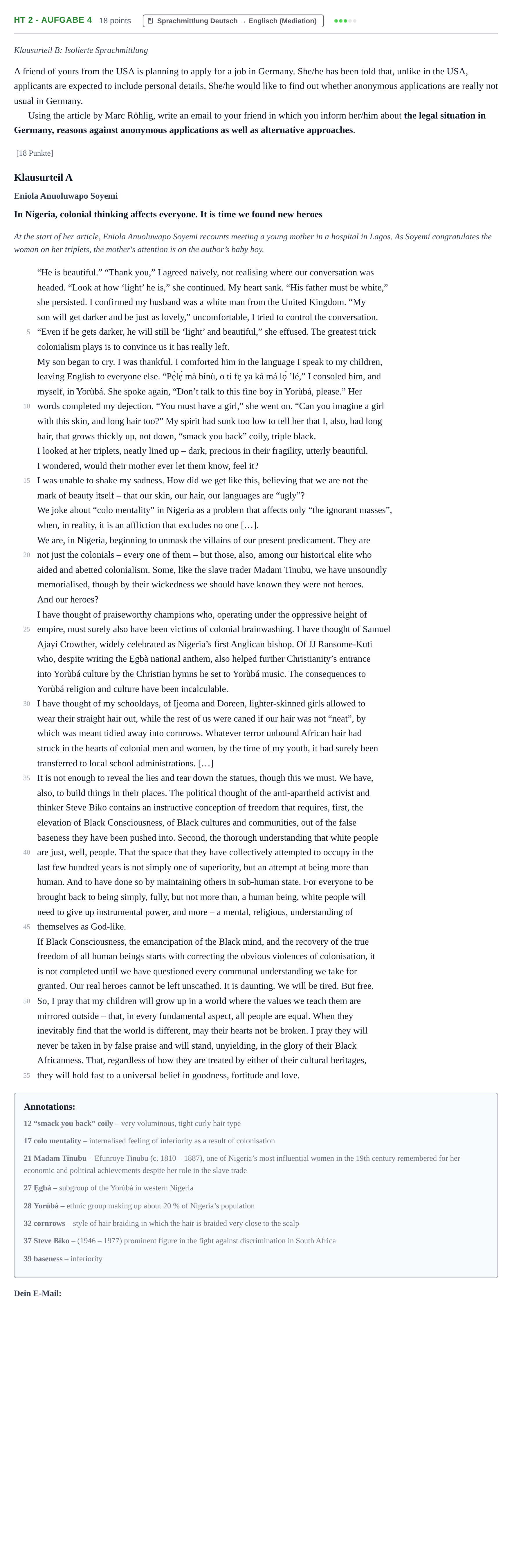
A friend of yours from the USA is planning to apply for a job in Germany. She/he has been told that, unlike in the USA, applicants are expected to include personal details. She/he would like to find out whether anonymous applications are really not usual in Germany.
Using the article by Marc Röhlig, write an email to your friend in which you inform her/him about the legal situation in Germany, reasons against anonymous applications as well as alternative approaches.
[18 Punkte]
Klausurteil A
Eniola Anuoluwapo Soyemi
In Nigeria, colonial thinking affects everyone. It is time we found new heroes
At the start of her article, Eniola Anuoluwapo Soyemi recounts meeting a young mother in a hospital in Lagos. As Soyemi congratulates the woman on her triplets, the mother's attention is on the author’s baby boy.
“He is beautiful.” “Thank you,” I agreed naively, not realising where our conversation was
headed. “Look at how ‘light’ he is,” she continued. My heart sank. “His father must be white,”
she persisted. I confirmed my husband was a white man from the United Kingdom. “My
son will get darker and be just as lovely,” uncomfortable, I tried to control the conversation.
5 “Even if he gets darker, he will still be ‘light’ and beautiful,” she effused. The greatest trick
colonialism plays is to convince us it has really left.
My son began to cry. I was thankful. I comforted him in the language I speak to my children,
leaving English to everyone else. “Pẹ̀lẹ́ mà bínù, o ti fẹ ya ká má lọ́ ’lé,” I consoled him, and
myself, in Yorùbá. She spoke again, “Don’t talk to this fine boy in Yorùbá, please.” Her
10 words completed my dejection. “You must have a girl,” she went on. “Can you imagine a girl
with this skin, and long hair too?” My spirit had sunk too low to tell her that I, also, had long
hair, that grows thickly up, not down, “smack you back” coily, triple black.
I looked at her triplets, neatly lined up – dark, precious in their fragility, utterly beautiful.
I wondered, would their mother ever let them know, feel it?
15 I was unable to shake my sadness. How did we get like this, believing that we are not the
mark of beauty itself – that our skin, our hair, our languages are “ugly”?
We joke about “colo mentality” in Nigeria as a problem that affects only “the ignorant masses”,
when, in reality, it is an affliction that excludes no one […].
We are, in Nigeria, beginning to unmask the villains of our present predicament. They are
20 not just the colonials – every one of them – but those, also, among our historical elite who
aided and abetted colonialism. Some, like the slave trader Madam Tinubu, we have unsoundly
memorialised, though by their wickedness we should have known they were not heroes.
And our heroes?
I have thought of praiseworthy champions who, operating under the oppressive height of
25 empire, must surely also have been victims of colonial brainwashing. I have thought of Samuel
Ajayi Crowther, widely celebrated as Nigeria’s first Anglican bishop. Of JJ Ransome-Kuti
who, despite writing the Ẹgbà national anthem, also helped further Christianity’s entrance
into Yorùbá culture by the Christian hymns he set to Yorùbá music. The consequences to
Yorùbá religion and culture have been incalculable.
30 I have thought of my schooldays, of Ijeoma and Doreen, lighter-skinned girls allowed to
wear their straight hair out, while the rest of us were caned if our hair was not “neat”, by
which was meant tidied away into cornrows. Whatever terror unbound African hair had
struck in the hearts of colonial men and women, by the time of my youth, it had surely been
transferred to local school administrations. […]
35 It is not enough to reveal the lies and tear down the statues, though this we must. We have,
also, to build things in their places. The political thought of the anti-apartheid activist and
thinker Steve Biko contains an instructive conception of freedom that requires, first, the
elevation of Black Consciousness, of Black cultures and communities, out of the false
baseness they have been pushed into. Second, the thorough understanding that white people
40 are just, well, people. That the space that they have collectively attempted to occupy in the
last few hundred years is not simply one of superiority, but an attempt at being more than
human. And to have done so by maintaining others in sub-human state. For everyone to be
brought back to being simply, fully, but not more than, a human being, white people will
need to give up instrumental power, and more – a mental, religious, understanding of
45 themselves as God-like.
If Black Consciousness, the emancipation of the Black mind, and the recovery of the true
freedom of all human beings starts with correcting the obvious violences of colonisation, it
is not completed until we have questioned every communal understanding we take for
granted. Our real heroes cannot be left unscathed. It is daunting. We will be tired. But free.
50 So, I pray that my children will grow up in a world where the values we teach them are
mirrored outside – that, in every fundamental aspect, all people are equal. When they
inevitably find that the world is different, may their hearts not be broken. I pray they will
never be taken in by false praise and will stand, unyielding, in the glory of their Black
Africanness. That, regardless of how they are treated by either of their cultural heritages,
55 they will hold fast to a universal belief in goodness, fortitude and love.
Annotations:
12 “smack you back” coily – very voluminous, tight curly hair type
17 colo mentality – internalised feeling of inferiority as a result of colonisation
21 Madam Tinubu – Efunroye Tinubu (c. 1810 – 1887), one of Nigeria’s most influential women in the 19th century remembered for her economic and political achievements despite her role in the slave trade
27 Ẹgbà – subgroup of the Yorùbá in western Nigeria
28 Yorùbá – ethnic group making up about 20 % of Nigeria’s population
32 cornrows – style of hair braiding in which the hair is braided very close to the scalp
37 Steve Biko – (1946 – 1977) prominent figure in the fight against discrimination in South Africa
39 baseness – inferiority
Lösung
Nach den offiziellen Korrekturhinweisen
Using the article by Marc Röhlig, write an email to your friend in which you inform her/him about the legal situation in Germany, reasons against anonymous applications as well as alternative approaches.
Lösung: An email that covers: (1) the legal situation – there is no binding law requiring anonymous applications in Germany; several regions and a federal pilot project have only tested the method, and the government merely recommends trying it voluntarily; (2) the disadvantages of the procedure – prejudice among employers persists and is not actually reduced, clearly positive effects on hiring people with a migration background have not materialised, and the procedure can reinforce feelings of discrimination among applicants, who feel forced to hide their identity; (3) further approaches being developed – the development of bias-aware ('culturally sensitive') application procedures under scientific supervision (e.g. by the Freie Universität Berlin, based on the DIN 33430 norm), and job advertisements that explicitly invite applications from people with a migration background ('Ermutigungsklausel').
Die ausführliche Erklärung Schritt für Schritt (mit KI) gibt es mit Premium. Premium
Löse sie direkt hier: automatische Korrektur, Hinweise und Lösung Schritt für Schritt.
‹ Aufgabe HT 1 - Aufgabe 4 · GK · Haupttermin · Weiterbildungskolleg 2021 · Aufgabe HT 3 - Aufgabe 4 · GK · Haupttermin · Weiterbildungskolleg 2021 ›
Mehr Aufgaben zu Sprachmittlung Deutsch → Englisch (Mediation)
- Aufgabe HT 3 - Aufgabe 4 · GK · Haupttermin 2021
- Aufgabe HT 1 - 4 · GK · Haupttermin · Weiterbildungskolleg 2021
- Aufgabe HT 2 - 4 · GK · Haupttermin · Weiterbildungskolleg 2021
- Aufgabe HT 3 - 4 · GK · Haupttermin · Weiterbildungskolleg 2021
- Aufgabe HT 1 - Aufgabe 4 · GK · Haupttermin · Weiterbildungskolleg 2021
- Aufgabe HT 3 - Aufgabe 4 · GK · Haupttermin · Weiterbildungskolleg 2021
- Aufgabe NT 1 - Teilaufgabe 4 · GK · Nachtermin 2021
- Aufgabe NT 2 - Teilaufgabe 4 · GK · Nachtermin 2021
- Aufgabe NT 3 - Teilaufgabe 4 · GK · Nachtermin 2021
- Aufgabe NT 1 - Aufgabe 4 · GK · Nachtermin · Weiterbildungskolleg 2021