Aufgabe 3 - Teilaufgabe 2: Nervenzelle: Membranpo… · Abitur NRW Biologie GK · Haupttermin · bilingual Englisch 2023
Thema: Nervenzelle: Membranpotenziale und Erregungsleitung · Aus der Prüfung GK · Haupttermin · bilingual Englisch (2023)
Aufgabenstellung
Material A: Overwintering of Burgundy Snails
The Burgundy snail¹ ( Helix pomatia) overwinters from October until the beginning of May. During this period, it lives withdrawn into its shell, which is tightly sealed by a calcareous lid², and is buried under leaves in the soil. When temperatures fall below 8° Celsius, their metabolism switches to a cold-induced torpor. The snails do not feed during the cold-induced torpor. Their metabolic rate, their oxygen consumption, their heart rate and the activity of their nervous systems are reduced. During this time, the Burgundy snail lives on nutrients it stored while feeding. Starting in May, Burgundy snails actively start looking for food if enough moisture is present. They feed on soft, wilting plant parts and algae.
¹ Weinbergschnecke
² Kalkdeckel
Material B: Signal Conduction in the Burgundy Snail
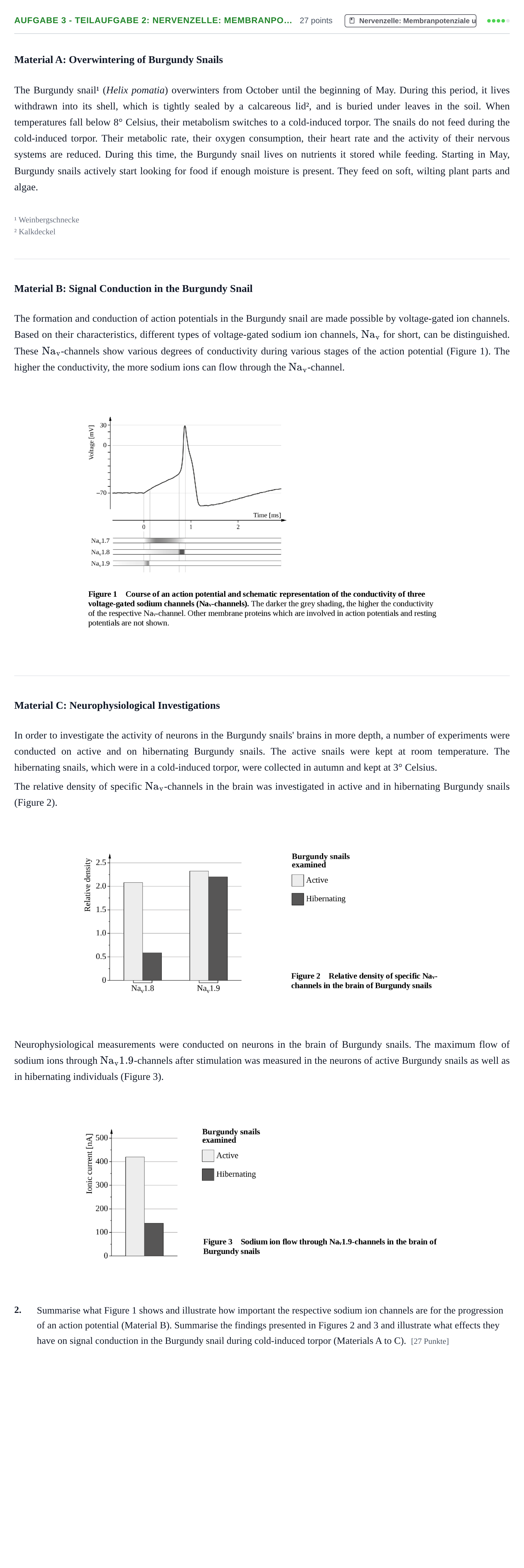
The formation and conduction of action potentials in the Burgundy snail are made possible by voltage-gated ion channels. Based on their characteristics, different types of voltage-gated sodium ion channels, for short, can be distinguished. These -channels show various degrees of conductivity during various stages of the action potential (Figure 1). The higher the conductivity, the more sodium ions can flow through the -channel.
Material C: Neurophysiological Investigations
In order to investigate the activity of neurons in the Burgundy snails' brains in more depth, a number of experiments were conducted on active and on hibernating Burgundy snails. The active snails were kept at room temperature. The hibernating snails, which were in a cold-induced torpor, were collected in autumn and kept at 3° Celsius.
The relative density of specific -channels in the brain was investigated in active and in hibernating Burgundy snails (Figure 2).
Neurophysiological measurements were conducted on neurons in the brain of Burgundy snails. The maximum flow of sodium ions through -channels after stimulation was measured in the neurons of active Burgundy snails as well as in hibernating individuals (Figure 3).
2.
Summarise what Figure 1 shows and illustrate how important the respective sodium ion channels are for the progression of an action potential (Material B). Summarise the findings presented in Figures 2 and 3 and illustrate what effects they have on signal conduction in the Burgundy snail during cold-induced torpor (Materials A to C).
[27 Punkte]
Lösung
Nach den offiziellen Korrekturhinweisen
2. Summarise what Figure 1 shows and illustrate how important the respective sodium ion channels are for the progression of an action potential (Material B). Summarise the findings presented in Figures 2 and 3 and illustrate what effects they have on signal conduction in the Burgundy snail during cold-induced torpor (Materials A to C).
Lösung: 1. Summary of Figure 1 and Importance of Channels: • Nav1.9 exhibits conductivity mainly during early initial depolarisation. • Nav1.7 conducts from early depolarisation up to reaching the threshold potential. • Nav1.8 exhibits high conductivity during the steep depolarisation phase and up to the peak of the action potential (responsible for potential reversal / overshoot). • Together, all three channels coordinate the Na+ influx required for the initiation and rapid upstroke of action potentials. During repolarisation and hyperpolarisation, they are inactivated/refractory. 2. Summary of Figures 2 and 3: • Figure 2: The relative density of Nav1.8 channels in the brain of hibernating snails is about 75% lower (approx. 0.6 vs 2.1) than in active snails, whereas Nav1.9 density remains essentially unchanged (approx. 2.2 to 2.3). • Figure 3: Sodium current through Nav1.9 channels in hibernating snails is reduced by about two-thirds (approx. 140 nA vs 420 nA) compared to active snails. 3. Consequences on Signal Conduction during Torpor: • With strongly reduced Nav1.8 density, reaching the threshold rarely triggers a full action potential. • Even though Nav1.9 density is unchanged, low temperature reduces its sodium conductance markedly. • Consequently, action potential generation and propagation are heavily suppressed even upon incoming stimuli. • This leads to reduced neuronal activity in the brain, keeping the snail quiescent in torpor.
Die ausführliche Erklärung Schritt für Schritt (mit KI) gibt es mit Premium. Premium
Löse sie direkt hier: automatische Korrektur, Hinweise und Lösung Schritt für Schritt.
‹ Aufgabe 3 - Nervenzelle: Membranpotenziale und Er… · GK · Haupttermin 2023 · Aufgabe 3 - Membranpotenziale und Erregungsleitung · GK · Haupttermin · Weiterbildungskolleg 2023 ›
Mehr Aufgaben zu Nervenzelle: Membranpotenziale und Erregungsleitung
- Aufgabe Chili neurobiologisch betrachtet · GK · Chili 2025
- Aufgabe 1 - Nervenzelle: Membranpotenziale und Erregungsl… · GK · Hornisse-GN 2025
- Aufgabe 1 – Nervenzelle: Membranpotenziale und Er… · LK · Hornisse-EN 2025
- Aufgabe 2 bis 5 - Nervenzelle und Sinneszellen · LK · Katzenminze 2025
- Aufgabe 3 - Nervenzelle: Membranpotenziale und Er… · GK · Haupttermin 2023
- Aufgabe 3 - Membranpotenziale und Erregungsleitung · GK · Haupttermin · Weiterbildungskolleg 2023
- Aufgabe 2 - Aktionspotenzial · GK · Nachtermin · Weiterbildungskolleg 2023
- Aufgabe 3 - Nervenzelle: Membranpotenziale und Er… · LK · Haupttermin 2023
- Aufgabe 3 - Nervenzelle: Membranpotenziale und Er… · LK · Haupttermin · Weiterbildungskolleg 2023
- Aufgabe 2 - Nervenzelle: Membranpotenziale und Er… · LK · Nachtermin 2023