Aufgabe Vorschlag B - Weimarer Republik: Entstehung, Verf… · Abitur Hessen Geschichte GK · bilingual Englisch 2022
Thema: Weimarer Republik: Entstehung, Verfassung und innere Belastungen · Aus der Prüfung GK · bilingual Englisch (2022)
Aufgabenstellung
Material
Rogers, Foerster, Schwarz: Aspects of German political institutions (1932)
An essay by three political scientists of Columbia University (Lindsay Rogers, Freda Foerster, Sanford Schwarz), published in the American journal "Political Science Quarterly" in September 1932.
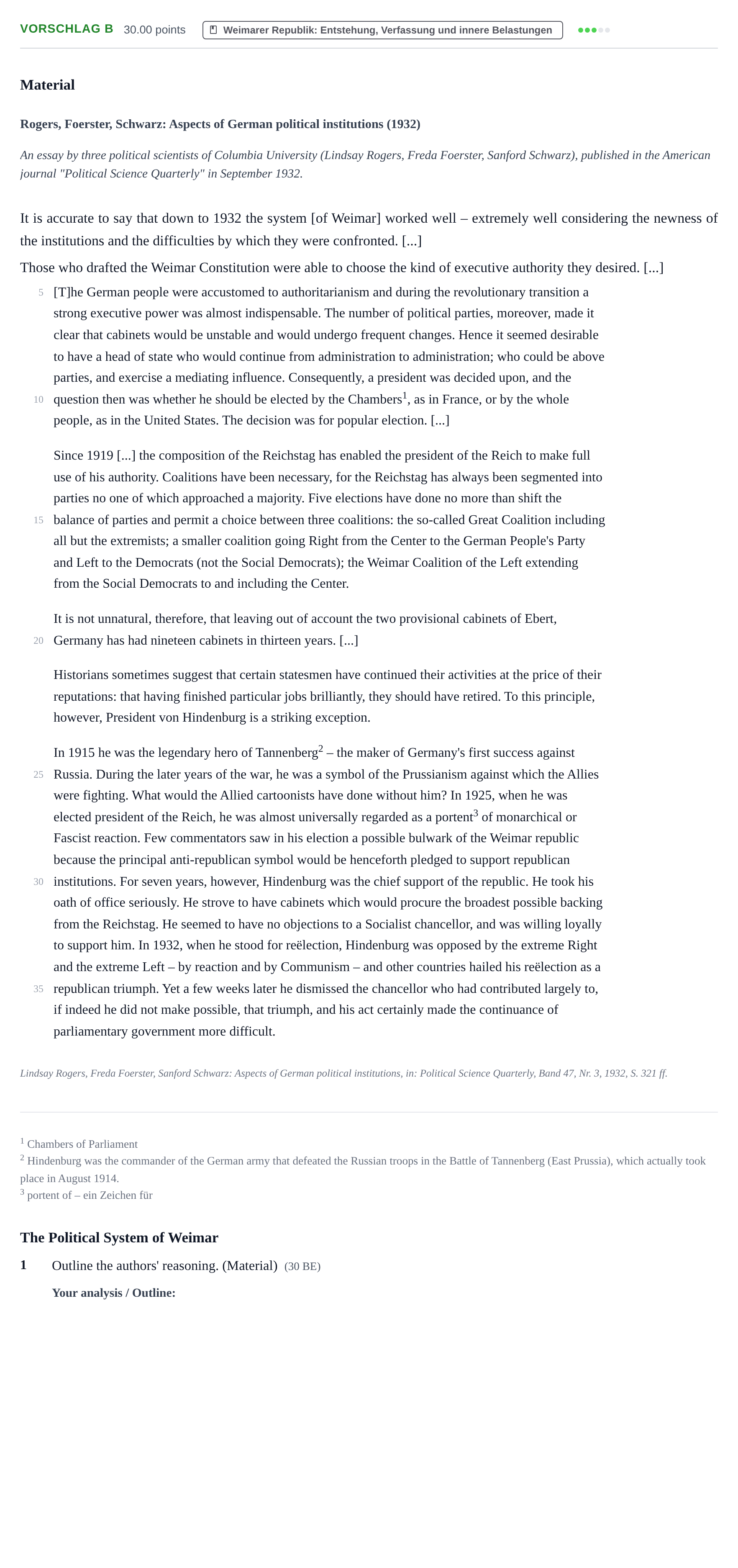
It is accurate to say that down to 1932 the system [of Weimar] worked well – extremely well considering the newness of the institutions and the difficulties by which they were confronted. [...]
Those who drafted the Weimar Constitution were able to choose the kind of executive authority they desired. [...]
5 [T]he German people were accustomed to authoritarianism and during the revolutionary transition a
strong executive power was almost indispensable. The number of political parties, moreover, made it
clear that cabinets would be unstable and would undergo frequent changes. Hence it seemed desirable
to have a head of state who would continue from administration to administration; who could be above
parties, and exercise a mediating influence. Consequently, a president was decided upon, and the
10 question then was whether he should be elected by the Chambers 1, as in France, or by the whole
people, as in the United States. The decision was for popular election. [...]
Since 1919 [...] the composition of the Reichstag has enabled the president of the Reich to make full
use of his authority. Coalitions have been necessary, for the Reichstag has always been segmented into
parties no one of which approached a majority. Five elections have done no more than shift the
15 balance of parties and permit a choice between three coalitions: the so-called Great Coalition including
all but the extremists; a smaller coalition going Right from the Center to the German People's Party
and Left to the Democrats (not the Social Democrats); the Weimar Coalition of the Left extending
from the Social Democrats to and including the Center.
It is not unnatural, therefore, that leaving out of account the two provisional cabinets of Ebert,
20 Germany has had nineteen cabinets in thirteen years. [...]
Historians sometimes suggest that certain statesmen have continued their activities at the price of their
reputations: that having finished particular jobs brilliantly, they should have retired. To this principle,
however, President von Hindenburg is a striking exception.
In 1915 he was the legendary hero of Tannenberg 2 – the maker of Germany's first success against
25 Russia. During the later years of the war, he was a symbol of the Prussianism against which the Allies
were fighting. What would the Allied cartoonists have done without him? In 1925, when he was
elected president of the Reich, he was almost universally regarded as a portent 3 of monarchical or
Fascist reaction. Few commentators saw in his election a possible bulwark of the Weimar republic
because the principal anti-republican symbol would be henceforth pledged to support republican
30 institutions. For seven years, however, Hindenburg was the chief support of the republic. He took his
oath of office seriously. He strove to have cabinets which would procure the broadest possible backing
from the Reichstag. He seemed to have no objections to a Socialist chancellor, and was willing loyally
to support him. In 1932, when he stood for reëlection, Hindenburg was opposed by the extreme Right
and the extreme Left – by reaction and by Communism – and other countries hailed his reëlection as a
35 republican triumph. Yet a few weeks later he dismissed the chancellor who had contributed largely to,
if indeed he did not make possible, that triumph, and his act certainly made the continuance of
parliamentary government more difficult.
Lindsay Rogers, Freda Foerster, Sanford Schwarz: Aspects of German political institutions, in: Political Science Quarterly, Band 47, Nr. 3, 1932, S. 321 ff.
1 Chambers of Parliament
2 Hindenburg was the commander of the German army that defeated the Russian troops in the Battle of Tannenberg (East Prussia), which actually took place in August 1914.
3 portent of – ein Zeichen für
The Political System of Weimar
1
Outline the authors' reasoning. (Material) (30 BE)
Lösung
Nach den offiziellen Korrekturhinweisen
1 Outline the authors' reasoning. (Material)
Lösung: In einer Einleitung werden Autor, Titel, Textsorte, Erscheinungsjahr, Thema und Adressat genannt. Anschließend wird die Argumentation der Autoren strukturiert wiedergegeben: - Positiver Gesamteindruck: Das politische System der Weimarer Republik habe bis 1932 angesichts der schwierigen Rahmenbedingungen sehr gut funktioniert. - Starke Exekutive: Die Entscheidung für eine machtvolle Exekutive sei aufgrund der autoritären Tradition der Deutschen und der revolutionären Umbrüche folgerichtig gewesen. - Rolle des Reichspräsidenten: Die Schaffung eines starken, vom Volk gewählten Präsidentenamtes, das über den Parteien stehe und bei instabilen Regierungen für Kontinuität sorge, sei sinnvoll gewesen. - Parteienvielfalt und Koalitionen: Wegen der Zersplitterung des Reichstags seien Koalitionsregierungen unvermeidlich gewesen (19 Kabinette in 13 Jahren); drei Koalitionstypen dominierten. - Hindenburgs Rolle: Er habe sich bis 1932 überraschend als verfassungstreues Staatsoberhaupt erwiesen, auch sozialdemokratische Kanzler gestützt, jedoch mit der Entlassung Brüning 1932 das parlamentarische System geschwächt.
Die ausführliche Erklärung Schritt für Schritt (mit KI) gibt es mit Premium. Premium
Löse sie direkt hier: automatische Korrektur, Hinweise und Lösung Schritt für Schritt.
‹ Aufgabe Vorschlag A - Aufgabe 3 · GK 2022 · Aufgabe Vorschlag B - Aufgaben 1-2: Weimarer Republik · LK 2022 ›