Ejercicio A · Inglés PAU Madrid Ordinaria Martes 2023
Tema: Comprensión Lectora · Del examen Ordinaria Martes (2023)
Enunciado
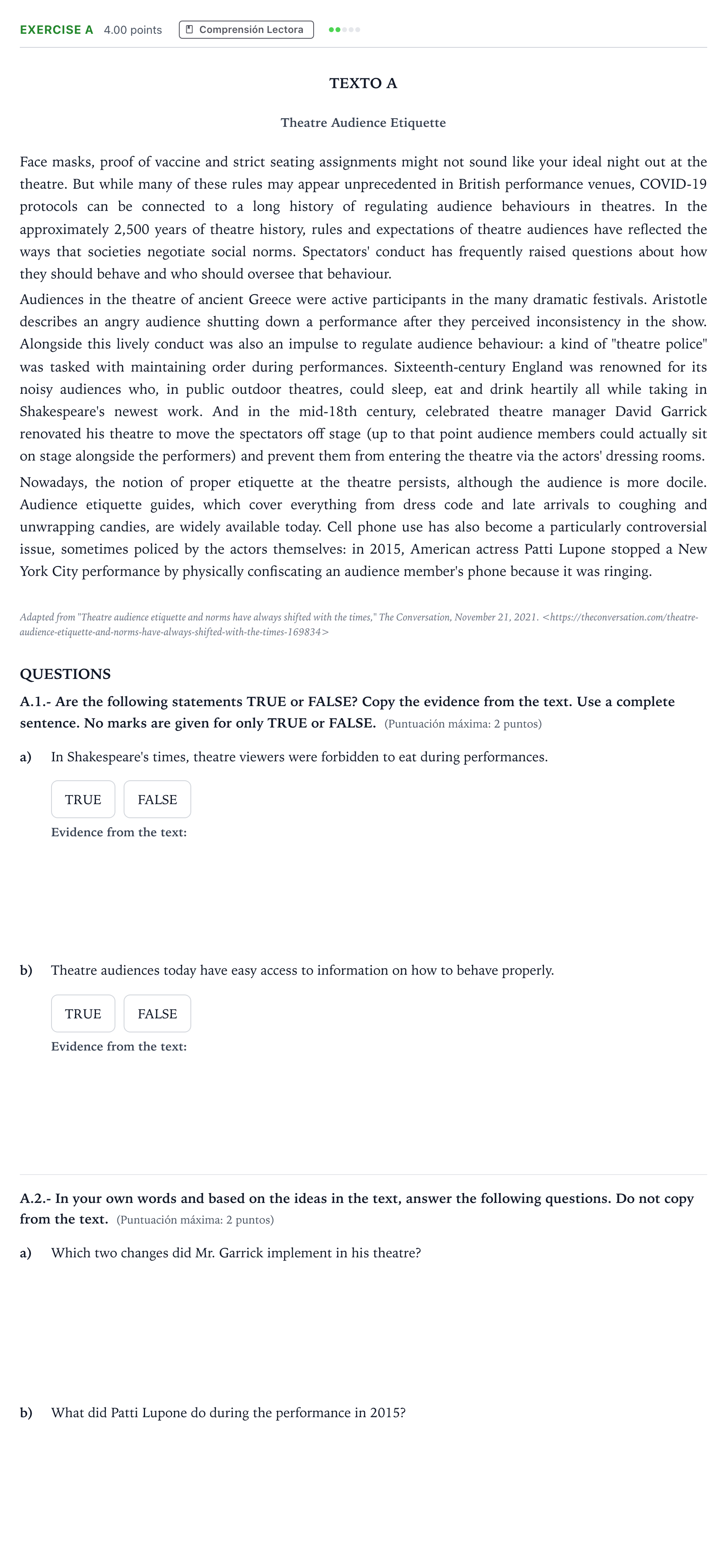
TEXTO A
Theatre Audience Etiquette
Face masks, proof of vaccine and strict seating assignments might not sound like your ideal night out at the theatre. But while many of these rules may appear unprecedented in British performance venues, COVID-19 protocols can be connected to a long history of regulating audience behaviours in theatres. In the approximately 2,500 years of theatre history, rules and expectations of theatre audiences have reflected the ways that societies negotiate social norms. Spectators' conduct has frequently raised questions about how they should behave and who should oversee that behaviour.
Audiences in the theatre of ancient Greece were active participants in the many dramatic festivals. Aristotle describes an angry audience shutting down a performance after they perceived inconsistency in the show. Alongside this lively conduct was also an impulse to regulate audience behaviour: a kind of "theatre police" was tasked with maintaining order during performances. Sixteenth-century England was renowned for its noisy audiences who, in public outdoor theatres, could sleep, eat and drink heartily all while taking in Shakespeare's newest work. And in the mid-18th century, celebrated theatre manager David Garrick renovated his theatre to move the spectators off stage (up to that point audience members could actually sit on stage alongside the performers) and prevent them from entering the theatre via the actors' dressing rooms.
Nowadays, the notion of proper etiquette at the theatre persists, although the audience is more docile. Audience etiquette guides, which cover everything from dress code and late arrivals to coughing and unwrapping candies, are widely available today. Cell phone use has also become a particularly controversial issue, sometimes policed by the actors themselves: in 2015, American actress Patti Lupone stopped a New York City performance by physically confiscating an audience member's phone because it was ringing.
Adapted from "Theatre audience etiquette and norms have always shifted with the times," The Conversation, November 21, 2021. <https://theconversation.com/theatre-audience-etiquette-and-norms-have-always-shifted-with-the-times-169834>
QUESTIONS
A.1.- Are the following statements TRUE or FALSE? Copy the evidence from the text. Use a complete sentence. No marks are given for only TRUE or FALSE. (Puntuación máxima: 2 puntos)
a)
In Shakespeare's times, theatre viewers were forbidden to eat during performances.
TRUE
FALSE
b)
Theatre audiences today have easy access to information on how to behave properly.
TRUE
FALSE
A.2.- In your own words and based on the ideas in the text, answer the following questions. Do not copy from the text. (Puntuación máxima: 2 puntos)
a)
Which two changes did Mr. Garrick implement in his theatre?
b)
What did Patti Lupone do during the performance in 2015?
Solución
Según los criterios oficiales de corrección
A.1. Are the following statements TRUE or FALSE?
Solución: a) FALSE b) TRUE
A.1. a) Copy the evidence from the text for: In Shakespeare's times, theatre viewers were forbidden to eat during performances.
Solución: "Sixteenth-century England was renowned for its noisy audiences who, in public outdoor theatres, could sleep, eat and drink heartily all while taking in Shakespeare’s newest work."
A.1. b) Copy the evidence from the text for: Theatre audiences today have easy access to information on how to behave properly.
Solución: "Audience etiquette guides, which cover everything from dress code and late arrivals to coughing and unwrapping candies, are widely available today."
A.2. a) Which two changes did Mr. Garrick implement in his theatre?
Solución: He renewed the theatre so as not to let people sit on the stage and come in through the back door. / He renovated his theatre to remove spectators from the stage and stop them from entering through the actors' dressing rooms.
A.2. b) What did Patti Lupone do during the performance in 2015?
Solución: She interrupted a show in New York City to actually take away the cellular device from a spectator as it was buzzing. / She stopped the performance and confiscated an audience member's phone because it was ringing.
La explicación paso a paso, hecha con IA, es Premium. Premium
Resuélvelo aquí mismo: corrección automática, pistas y solución paso a paso.
‹ Ejercicio B · Ordinaria Lunes 2023 · Ejercicio B · Ordinaria Martes 2023 ›
Más ejercicios de Comprensión Lectora
- Ejercicio B.1 - B.2 · Ordinaria (2ª lengua) 2023
- Ejercicio A.1 - A.2 · Ordinaria (2ª lengua) Coincidencias 2023
- Ejercicio B.1 - B.2 · Ordinaria (2ª lengua) Coincidencias 2023
- Ejercicio A · Ordinaria Lunes 2023
- Ejercicio B · Ordinaria Lunes 2023
- Ejercicio B · Ordinaria Martes 2023
- Ejercicio A · Extraordinaria 2022
- Ejercicio B · Extraordinaria 2022
- Ejercicio A · Extraordinaria (2ª lengua) 2022
- Ejercicio B · Extraordinaria (2ª lengua) 2022