Ejercicio B.1 - B.2 · Inglés PAU Madrid Ordinaria (2ª lengua) Coincidencias 2023
Tema: Comprensión Lectora · Del examen Ordinaria (2ª lengua) Coincidencias (2023)
Enunciado
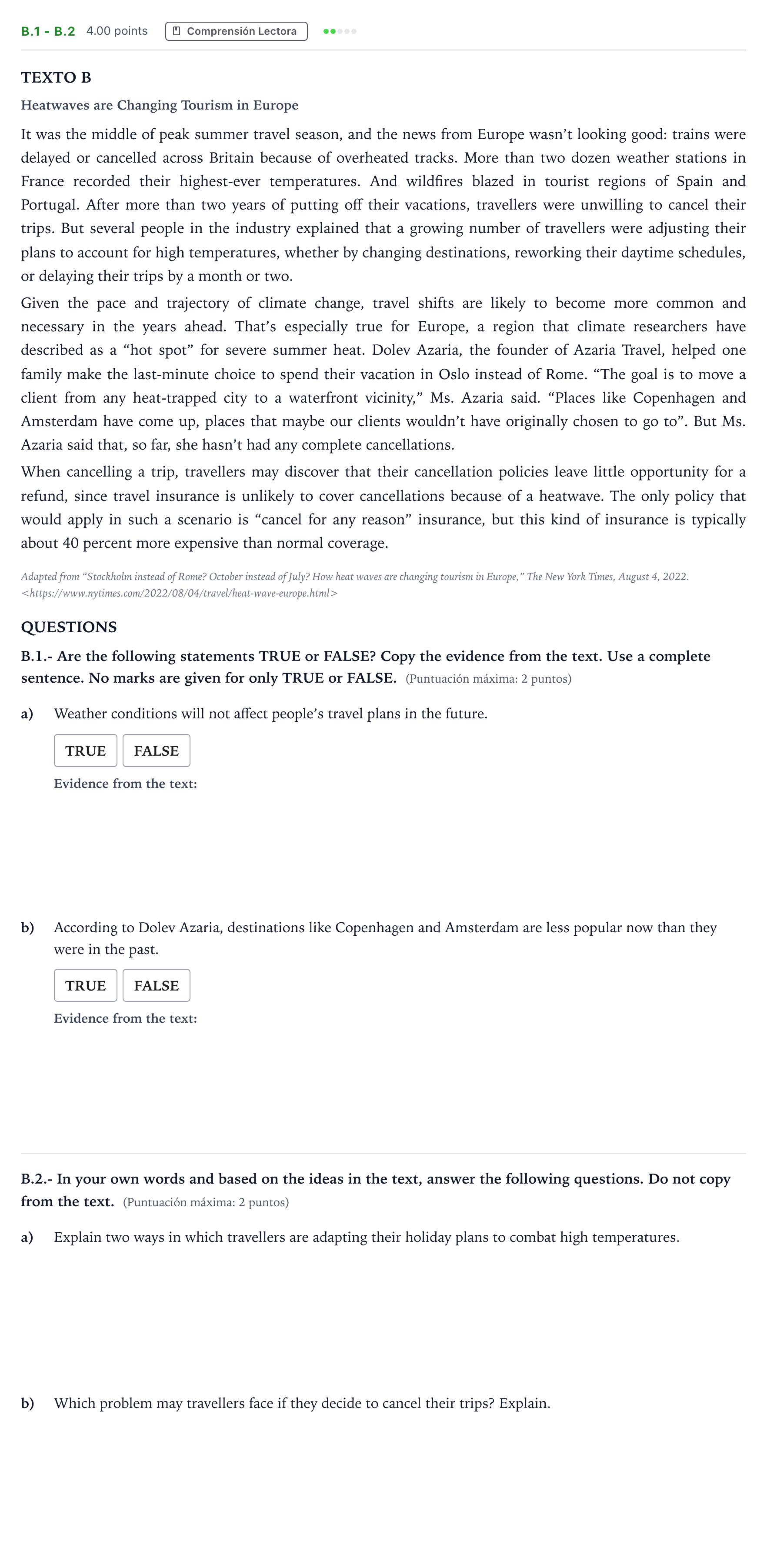
TEXTO B
Heatwaves are Changing Tourism in Europe
It was the middle of peak summer travel season, and the news from Europe wasn’t looking good: trains were delayed or cancelled across Britain because of overheated tracks. More than two dozen weather stations in France recorded their highest-ever temperatures. And wildfires blazed in tourist regions of Spain and Portugal. After more than two years of putting off their vacations, travellers were unwilling to cancel their trips. But several people in the industry explained that a growing number of travellers were adjusting their plans to account for high temperatures, whether by changing destinations, reworking their daytime schedules, or delaying their trips by a month or two.
Given the pace and trajectory of climate change, travel shifts are likely to become more common and necessary in the years ahead. That’s especially true for Europe, a region that climate researchers have described as a “hot spot” for severe summer heat. Dolev Azaria, the founder of Azaria Travel, helped one family make the last-minute choice to spend their vacation in Oslo instead of Rome. “The goal is to move a client from any heat-trapped city to a waterfront vicinity,” Ms. Azaria said. “Places like Copenhagen and Amsterdam have come up, places that maybe our clients wouldn’t have originally chosen to go to”. But Ms. Azaria said that, so far, she hasn’t had any complete cancellations.
When cancelling a trip, travellers may discover that their cancellation policies leave little opportunity for a refund, since travel insurance is unlikely to cover cancellations because of a heatwave. The only policy that would apply in such a scenario is “cancel for any reason” insurance, but this kind of insurance is typically about 40 percent more expensive than normal coverage.
Adapted from “Stockholm instead of Rome? October instead of July? How heat waves are changing tourism in Europe,” The New York Times, August 4, 2022. <https://www.nytimes.com/2022/08/04/travel/heat-wave-europe.html>
QUESTIONS
B.1.- Are the following statements TRUE or FALSE? Copy the evidence from the text. Use a complete sentence. No marks are given for only TRUE or FALSE.
(Puntuación máxima: 2 puntos)
a)
Weather conditions will not affect people’s travel plans in the future.
TRUE
FALSE
b)
According to Dolev Azaria, destinations like Copenhagen and Amsterdam are less popular now than they were in the past.
TRUE
FALSE
B.2.- In your own words and based on the ideas in the text, answer the following questions. Do not copy from the text.
(Puntuación máxima: 2 puntos)
a)
Explain two ways in which travellers are adapting their holiday plans to combat high temperatures.
b)
Which problem may travellers face if they decide to cancel their trips? Explain.
Solución
Según los criterios oficiales de corrección
B.1.- Are the following statements TRUE or FALSE? a) Weather conditions will not affect people’s travel plans in the future. b) According to Dolev Azaria, destinations like Copenhagen and Amsterdam are less popular now than they were in the past.
Solución: a) FALSE b) FALSE
B.1. a) Weather conditions will not affect people’s travel plans in the future. (Copy evidence from the text)
Solución: "Given the pace and trajectory of climate change, travel shifts are likely to become more common and necessary in the years ahead."
B.1. b) According to Dolev Azaria, destinations like Copenhagen and Amsterdam are less popular now than they were in the past. (Copy evidence from the text)
Solución: "Places like Copenhagen and Amsterdam have come up, places that maybe our clients wouldn’t have originally chosen to go to."
B.2. a) Explain two ways in which travellers are adapting their holiday plans to combat high temperatures.
Solución: They are changing their minds about destinations, modifying their day’s schedules, or putting off their vacation by several weeks.
B.2. b) Which problem may travellers face if they decide to cancel their trips? Explain.
Solución: They may find that the insurance company will not give them their money back, as cancellations due to weather conditions are not frequently accepted.
La explicación paso a paso, hecha con IA, es Premium. Premium
Resuélvelo aquí mismo: corrección automática, pistas y solución paso a paso.
‹ Ejercicio A.1 - A.2 · Ordinaria (2ª lengua) Coincidencias 2023 · Ejercicio A · Ordinaria Lunes 2023 ›
Más ejercicios de Comprensión Lectora
- Ejercicio A · Modelo 2023
- Ejercicio B · Modelo 2023
- Ejercicio A.1 - A.2 · Ordinaria (2ª lengua) 2023
- Ejercicio B.1 - B.2 · Ordinaria (2ª lengua) 2023
- Ejercicio A.1 - A.2 · Ordinaria (2ª lengua) Coincidencias 2023
- Ejercicio A · Ordinaria Lunes 2023
- Ejercicio B · Ordinaria Lunes 2023
- Ejercicio A · Ordinaria Martes 2023
- Ejercicio B · Ordinaria Martes 2023
- Ejercicio A · Extraordinaria 2022