Ejercicio A.1 - A.2 · Inglés PAU Madrid Ordinaria (2ª lengua) Coincidencias 2023
Tema: Comprensión Lectora · Del examen Ordinaria (2ª lengua) Coincidencias (2023)
Enunciado
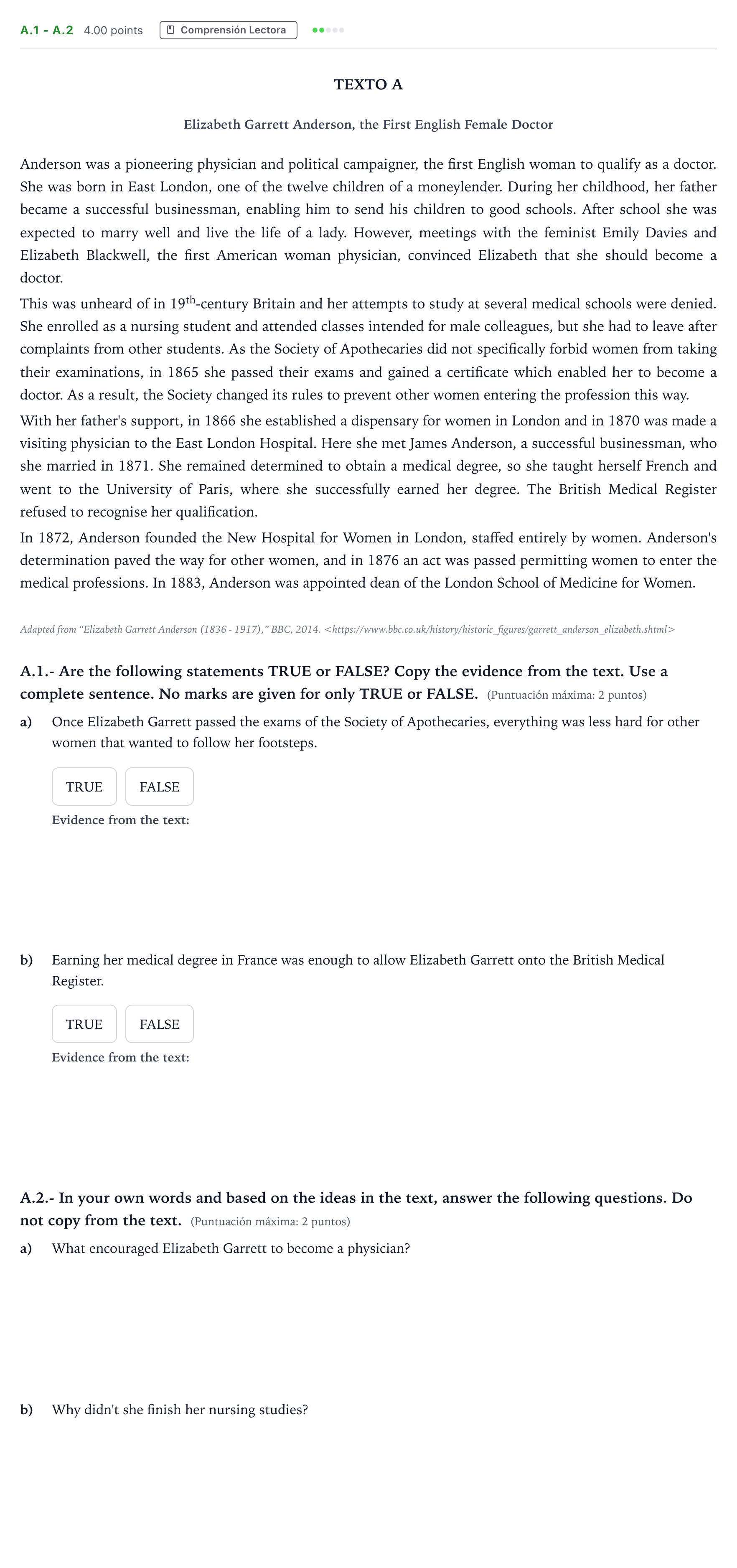
TEXTO A
Elizabeth Garrett Anderson, the First English Female Doctor
Anderson was a pioneering physician and political campaigner, the first English woman to qualify as a doctor. She was born in East London, one of the twelve children of a moneylender. During her childhood, her father became a successful businessman, enabling him to send his children to good schools. After school she was expected to marry well and live the life of a lady. However, meetings with the feminist Emily Davies and Elizabeth Blackwell, the first American woman physician, convinced Elizabeth that she should become a doctor.
This was unheard of in 19 th -century Britain and her attempts to study at several medical schools were denied. She enrolled as a nursing student and attended classes intended for male colleagues, but she had to leave after complaints from other students. As the Society of Apothecaries did not specifically forbid women from taking their examinations, in 1865 she passed their exams and gained a certificate which enabled her to become a doctor. As a result, the Society changed its rules to prevent other women entering the profession this way.
With her father's support, in 1866 she established a dispensary for women in London and in 1870 was made a visiting physician to the East London Hospital. Here she met James Anderson, a successful businessman, who she married in 1871. She remained determined to obtain a medical degree, so she taught herself French and went to the University of Paris, where she successfully earned her degree. The British Medical Register refused to recognise her qualification.
In 1872, Anderson founded the New Hospital for Women in London, staffed entirely by women. Anderson's determination paved the way for other women, and in 1876 an act was passed permitting women to enter the medical professions. In 1883, Anderson was appointed dean of the London School of Medicine for Women.
Adapted from “Elizabeth Garrett Anderson (1836 - 1917),” BBC, 2014. <https://www.bbc.co.uk/history/historic_figures/garrett_anderson_elizabeth.shtml>
A.1.- Are the following statements TRUE or FALSE? Copy the evidence from the text. Use a complete sentence. No marks are given for only TRUE or FALSE. (Puntuación máxima: 2 puntos)
a)
Once Elizabeth Garrett passed the exams of the Society of Apothecaries, everything was less hard for other women that wanted to follow her footsteps.
TRUE
FALSE
b)
Earning her medical degree in France was enough to allow Elizabeth Garrett onto the British Medical Register.
TRUE
FALSE
A.2.- In your own words and based on the ideas in the text, answer the following questions. Do not copy from the text. (Puntuación máxima: 2 puntos)
a)
What encouraged Elizabeth Garrett to become a physician?
b)
Why didn't she finish her nursing studies?
Solución
Según los criterios oficiales de corrección
A.1 a) Once Elizabeth Garrett passed the exams of the Society of Apothecaries, everything was less hard for other women that wanted to follow her footsteps. (Evidence)
Solución: "As a result, the Society changed its rules to prevent other women entering the profession this way."
A.1 b) Earning her medical degree in France was enough to allow Elizabeth Garrett onto the British Medical Register. (Evidence)
Solución: "The British Medical Register refused to recognise her qualification."
A.2 a) What encouraged Elizabeth Garrett to become a physician?
Solución: She decided to become a doctor after meeting the activist Emily Davies and the first female doctor in the US, Elizabeth Blackwell.
A.2 b) Why didn't she finish her nursing studies?
Solución: She was able to study nursing alongside male peers for some time, but because of their objections, she was banned from continuing her studies.
A.1 True or False selection
Solución: a) FALSE b) FALSE
La explicación paso a paso, hecha con IA, es Premium. Premium
Resuélvelo aquí mismo: corrección automática, pistas y solución paso a paso.
‹ Ejercicio B.1 - B.2 · Ordinaria (2ª lengua) 2023 · Ejercicio B.1 - B.2 · Ordinaria (2ª lengua) Coincidencias 2023 ›
Más ejercicios de Comprensión Lectora
- Ejercicio B.1 - B.2 · Extraordinaria (2ª lengua) 2023
- Ejercicio A · Modelo 2023
- Ejercicio B · Modelo 2023
- Ejercicio A.1 - A.2 · Ordinaria (2ª lengua) 2023
- Ejercicio B.1 - B.2 · Ordinaria (2ª lengua) 2023
- Ejercicio B.1 - B.2 · Ordinaria (2ª lengua) Coincidencias 2023
- Ejercicio A · Ordinaria Lunes 2023
- Ejercicio B · Ordinaria Lunes 2023
- Ejercicio A · Ordinaria Martes 2023
- Ejercicio B · Ordinaria Martes 2023