Ejercicio A · Inglés PAU Madrid Ordinaria Lunes 2023
Tema: Comprensión Lectora · Del examen Ordinaria Lunes (2023)
Enunciado
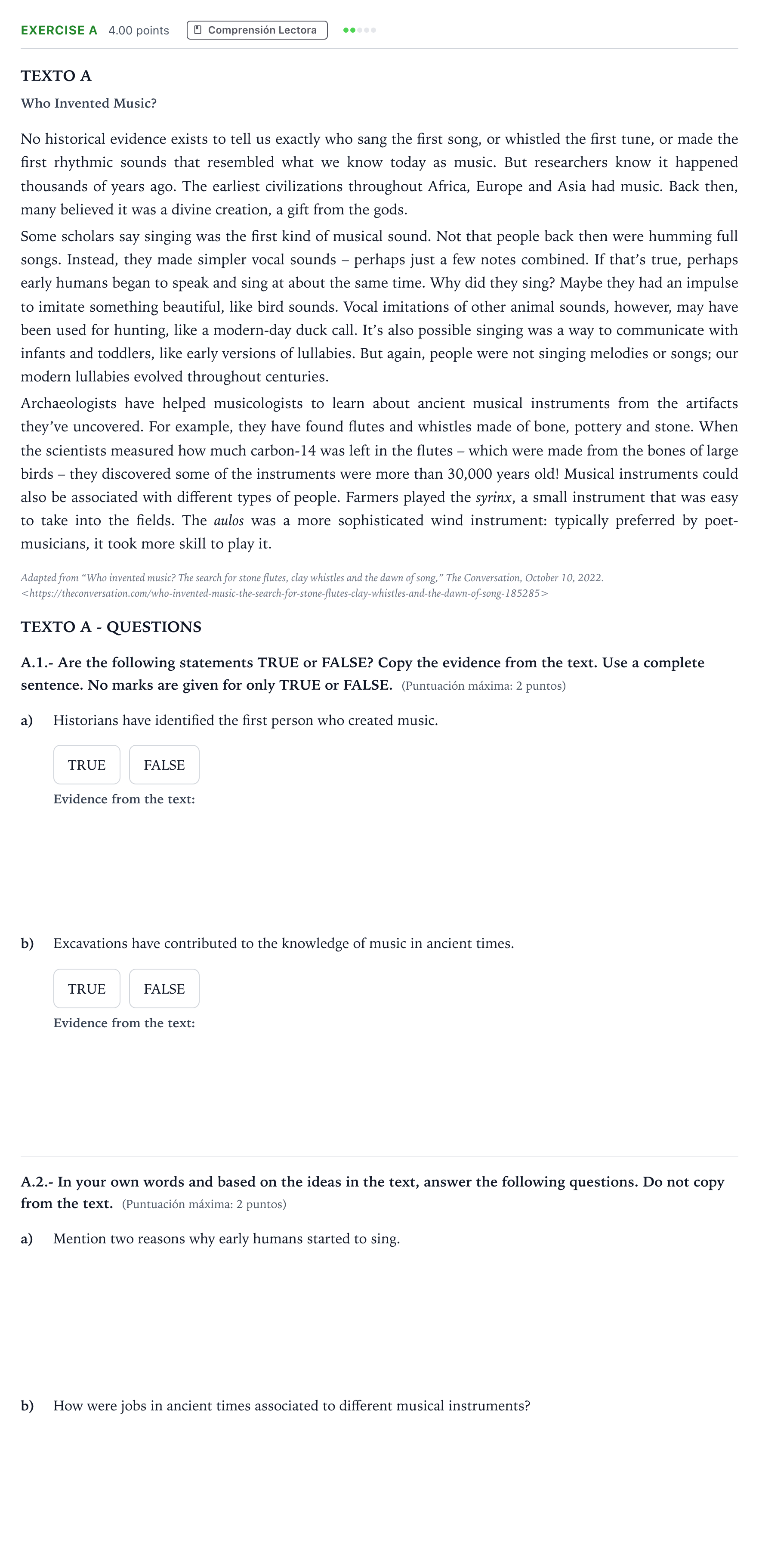
TEXTO A
Who Invented Music?
No historical evidence exists to tell us exactly who sang the first song, or whistled the first tune, or made the first rhythmic sounds that resembled what we know today as music. But researchers know it happened thousands of years ago. The earliest civilizations throughout Africa, Europe and Asia had music. Back then, many believed it was a divine creation, a gift from the gods.
Some scholars say singing was the first kind of musical sound. Not that people back then were humming full songs. Instead, they made simpler vocal sounds – perhaps just a few notes combined. If that’s true, perhaps early humans began to speak and sing at about the same time. Why did they sing? Maybe they had an impulse to imitate something beautiful, like bird sounds. Vocal imitations of other animal sounds, however, may have been used for hunting, like a modern-day duck call. It’s also possible singing was a way to communicate with infants and toddlers, like early versions of lullabies. But again, people were not singing melodies or songs; our modern lullabies evolved throughout centuries.
Archaeologists have helped musicologists to learn about ancient musical instruments from the artifacts they’ve uncovered. For example, they have found flutes and whistles made of bone, pottery and stone. When the scientists measured how much carbon-14 was left in the flutes – which were made from the bones of large birds – they discovered some of the instruments were more than 30,000 years old! Musical instruments could also be associated with different types of people. Farmers played the syrinx, a small instrument that was easy to take into the fields. The aulos was a more sophisticated wind instrument: typically preferred by poet-musicians, it took more skill to play it.
Adapted from “Who invented music? The search for stone flutes, clay whistles and the dawn of song,” The Conversation, October 10, 2022. <https://theconversation.com/who-invented-music-the-search-for-stone-flutes-clay-whistles-and-the-dawn-of-song-185285>
TEXTO A - QUESTIONS
A.1.- Are the following statements TRUE or FALSE? Copy the evidence from the text. Use a complete sentence. No marks are given for only TRUE or FALSE. (Puntuación máxima: 2 puntos)
a)
Historians have identified the first person who created music.
TRUE
FALSE
b)
Excavations have contributed to the knowledge of music in ancient times.
TRUE
FALSE
A.2.- In your own words and based on the ideas in the text, answer the following questions. Do not copy from the text. (Puntuación máxima: 2 puntos)
a)
Mention two reasons why early humans started to sing.
b)
How were jobs in ancient times associated to different musical instruments?
Solución
Según los criterios oficiales de corrección
A.1. a) Historians have identified the first person who created music.
Solución: FALSE
A.1. a) Copy the evidence from the text: Historians have identified the first person who created music.
Solución: "No historical evidence exists to tell us exactly who sang the first song, or whistled the first tune, or made the first rhythmic sounds that resembled what we know today as music."
A.1. b) Excavations have contributed to the knowledge of music in ancient times.
Solución: TRUE
A.1. b) Copy the evidence from the text: Excavations have contributed to the knowledge of music in ancient times.
Solución: "Archaeologists have helped musicologists to learn about ancient musical instruments from the artifacts they've uncovered."
A.2. a) Mention two reasons why early humans started to sing.
Solución: Several reasons might explain this, such as the wish to reproduce beautiful sounds like those made by birds, or as a mechanism to attract and hunt animals. Also, singing could have been used as a way to interact with children, in the way modern children's songs do.
A.2. b) How were jobs in ancient times associated to different musical instruments?
Solución: People working in the countryside used little instruments that were easy to carry and take with them, while poet-musicians played aulos, more complex and requiring special abilities.
La explicación paso a paso, hecha con IA, es Premium. Premium
Resuélvelo aquí mismo: corrección automática, pistas y solución paso a paso.
‹ Ejercicio B.1 - B.2 · Ordinaria (2ª lengua) Coincidencias 2023 · Ejercicio B · Ordinaria Lunes 2023 ›
Más ejercicios de Comprensión Lectora
- Ejercicio B · Modelo 2023
- Ejercicio A.1 - A.2 · Ordinaria (2ª lengua) 2023
- Ejercicio B.1 - B.2 · Ordinaria (2ª lengua) 2023
- Ejercicio A.1 - A.2 · Ordinaria (2ª lengua) Coincidencias 2023
- Ejercicio B.1 - B.2 · Ordinaria (2ª lengua) Coincidencias 2023
- Ejercicio B · Ordinaria Lunes 2023
- Ejercicio A · Ordinaria Martes 2023
- Ejercicio B · Ordinaria Martes 2023
- Ejercicio A · Extraordinaria 2022
- Ejercicio B · Extraordinaria 2022