Aufgabe HT 3 - Sozialstaat · Abitur NRW Sozialwissenschaften GK · Haupttermin · bilingual Englisch 2021
Thema: Sozialstaat und soziale Sicherung · Aus der Prüfung GK · Haupttermin · bilingual Englisch (2021)
Aufgabenstellung
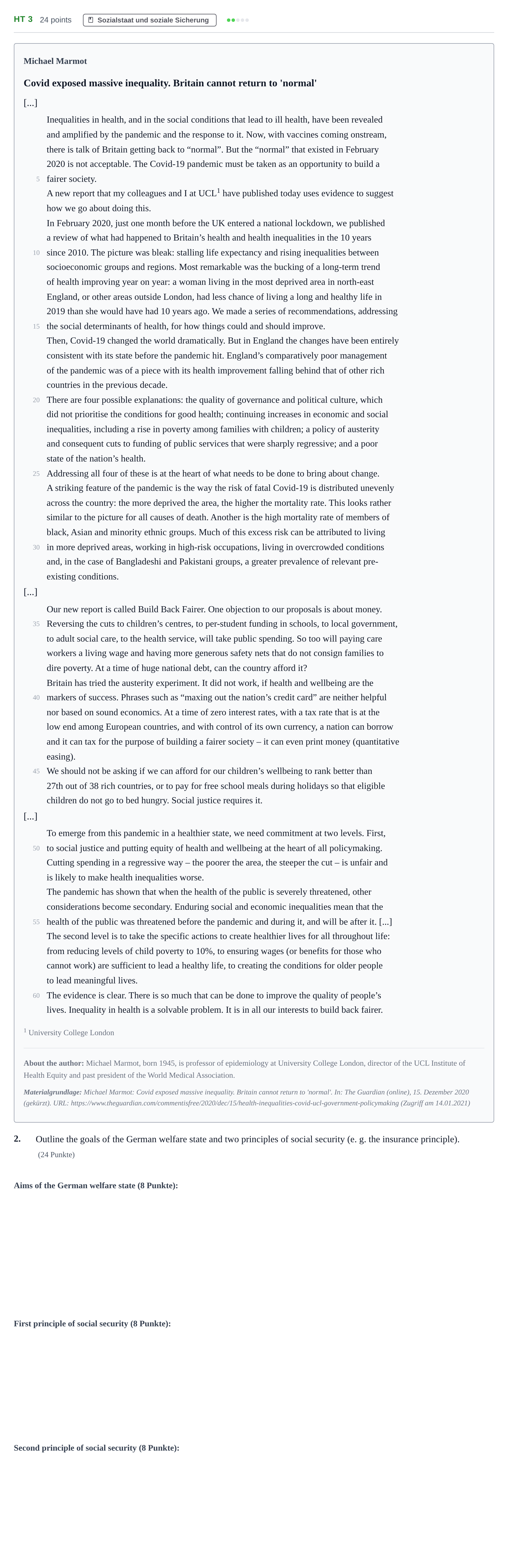
Michael Marmot
Covid exposed massive inequality. Britain cannot return to 'normal'
[...]
Inequalities in health, and in the social conditions that lead to ill health, have been revealed
and amplified by the pandemic and the response to it. Now, with vaccines coming onstream,
there is talk of Britain getting back to “normal”. But the “normal” that existed in February
2020 is not acceptable. The Covid-19 pandemic must be taken as an opportunity to build a
5 fairer society.
A new report that my colleagues and I at UCL 1 have published today uses evidence to suggest
how we go about doing this.
In February 2020, just one month before the UK entered a national lockdown, we published
a review of what had happened to Britain’s health and health inequalities in the 10 years
10 since 2010. The picture was bleak: stalling life expectancy and rising inequalities between
socioeconomic groups and regions. Most remarkable was the bucking of a long-term trend
of health improving year on year: a woman living in the most deprived area in north-east
England, or other areas outside London, had less chance of living a long and healthy life in
2019 than she would have had 10 years ago. We made a series of recommendations, addressing
15 the social determinants of health, for how things could and should improve.
Then, Covid-19 changed the world dramatically. But in England the changes have been entirely
consistent with its state before the pandemic hit. England’s comparatively poor management
of the pandemic was of a piece with its health improvement falling behind that of other rich
countries in the previous decade.
20 There are four possible explanations: the quality of governance and political culture, which
did not prioritise the conditions for good health; continuing increases in economic and social
inequalities, including a rise in poverty among families with children; a policy of austerity
and consequent cuts to funding of public services that were sharply regressive; and a poor
state of the nation’s health.
25 Addressing all four of these is at the heart of what needs to be done to bring about change.
A striking feature of the pandemic is the way the risk of fatal Covid-19 is distributed unevenly
across the country: the more deprived the area, the higher the mortality rate. This looks rather
similar to the picture for all causes of death. Another is the high mortality rate of members of
black, Asian and minority ethnic groups. Much of this excess risk can be attributed to living
30 in more deprived areas, working in high-risk occupations, living in overcrowded conditions
and, in the case of Bangladeshi and Pakistani groups, a greater prevalence of relevant pre-
existing conditions.
[...]
Our new report is called Build Back Fairer. One objection to our proposals is about money.
35 Reversing the cuts to children’s centres, to per-student funding in schools, to local government,
to adult social care, to the health service, will take public spending. So too will paying care
workers a living wage and having more generous safety nets that do not consign families to
dire poverty. At a time of huge national debt, can the country afford it?
Britain has tried the austerity experiment. It did not work, if health and wellbeing are the
40 markers of success. Phrases such as “maxing out the nation’s credit card” are neither helpful
nor based on sound economics. At a time of zero interest rates, with a tax rate that is at the
low end among European countries, and with control of its own currency, a nation can borrow
and it can tax for the purpose of building a fairer society – it can even print money (quantitative
easing).
45 We should not be asking if we can afford for our children’s wellbeing to rank better than
27th out of 38 rich countries, or to pay for free school meals during holidays so that eligible
children do not go to bed hungry. Social justice requires it.
[...]
To emerge from this pandemic in a healthier state, we need commitment at two levels. First,
50 to social justice and putting equity of health and wellbeing at the heart of all policymaking.
Cutting spending in a regressive way – the poorer the area, the steeper the cut – is unfair and
is likely to make health inequalities worse.
The pandemic has shown that when the health of the public is severely threatened, other
considerations become secondary. Enduring social and economic inequalities mean that the
55 health of the public was threatened before the pandemic and during it, and will be after it. [...]
The second level is to take the specific actions to create healthier lives for all throughout life:
from reducing levels of child poverty to 10%, to ensuring wages (or benefits for those who
cannot work) are sufficient to lead a healthy life, to creating the conditions for older people
to lead meaningful lives.
60 The evidence is clear. There is so much that can be done to improve the quality of people’s
lives. Inequality in health is a solvable problem. It is in all our interests to build back fairer.
1 University College London
About the author: Michael Marmot, born 1945, is professor of epidemiology at University College London, director of the UCL Institute of Health Equity and past president of the World Medical Association.
Materialgrundlage: Michael Marmot: Covid exposed massive inequality. Britain cannot return to 'normal'. In: The Guardian (online), 15. Dezember 2020 (gekürzt). URL: https://www.theguardian.com/commentisfree/2020/dec/15/health-inequalities-covid-ucl-government-policymaking (Zugriff am 14.01.2021)
2.
Outline the goals of the German welfare state and two principles of social security (e. g. the insurance principle). (24 Punkte)
Lösung
Nach den offiziellen Korrekturhinweisen
Aims of the German welfare state (8 Punkte)
Lösung: Darstellung der zentralen Zielsetzungen des deutschen Sozialstaates (gesellschaftliche Teilhabe, Sicherung eines menschenwürdigen Daseins, Inpflichtnahme Besserverdienender, Daseinsvorsorge).
First principle of social security (8 Punkte)
Lösung: Darstellung eines Grundprinzips sozialer Sicherung (Versicherungsprinzip, Versorgungsprinzip oder Fürsorgeprinzip).
Second principle of social security (8 Punkte)
Lösung: Darstellung eines zweiten Grundprinzips sozialer Sicherung (ausgewählt aus Versicherungs-, Versorgungs- oder Fürsorgeprinzip).
Die ausführliche Erklärung Schritt für Schritt (mit KI) gibt es mit Premium. Premium
Löse sie direkt hier: automatische Korrektur, Hinweise und Lösung Schritt für Schritt.
‹ Aufgabe HT 3 - Sozialstaat · LK · Haupttermin 2022 · Aufgabe NT 1 - Aufgabe 2 · GK · Nachtermin 2021 ›
Mehr Aufgaben zu Sozialstaat und soziale Sicherung
- Aufgabe HT 3 · GK · Haupttermin 2022
- Aufgabe HT 3 - Sozialstaat und soziale Sicherung · GK · Haupttermin · Wirtschaft 2022
- Aufgabe NT 3 - Sozialstaat und soziale Sicherung · GK · Nachtermin 2022
- Aufgabe 3 - Sozialstaat und soziale Sicherung · GK · Nachtermin · Wirtschaft 2022
- Aufgabe HT 3 - Sozialstaat · LK · Haupttermin 2022
- Aufgabe NT 1 - Aufgabe 2 · GK · Nachtermin 2021
- Aufgabe 3 - Teilaufgaben 2 und 3 · LK · Nachtermin 2021