Aufgabe HT 2 · Abitur NRW Sozialwissenschaften GK · Haupttermin · bilingual Englisch 2021
Thema: Europäische Integration: Geschichte, Institutionen und Modelle · Aus der Prüfung GK · Haupttermin · bilingual Englisch (2021)
Aufgabenstellung
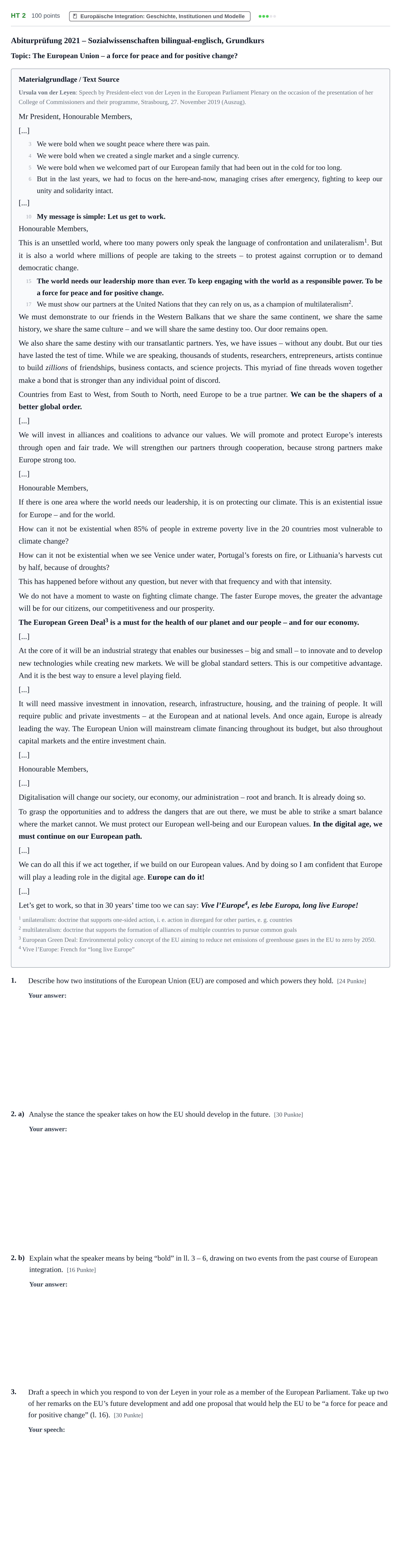
Abiturprüfung 2021 – Sozialwissenschaften bilingual-englisch, Grundkurs
Topic: The European Union – a force for peace and for positive change?
Materialgrundlage / Text Source
Ursula von der Leyen: Speech by President-elect von der Leyen in the European Parliament Plenary on the occasion of the presentation of her College of Commissioners and their programme, Strasbourg, 27. November 2019 (Auszug).
Mr President, Honourable Members,
[...]
3 We were bold when we sought peace where there was pain.
4 We were bold when we created a single market and a single currency.
5 We were bold when we welcomed part of our European family that had been out in the cold for too long.
6 But in the last years, we had to focus on the here-and-now, managing crises after emergency, fighting to keep our unity and solidarity intact.
[...]
10 My message is simple: Let us get to work.
Honourable Members,
This is an unsettled world, where too many powers only speak the language of confrontation and unilateralism 1. But it is also a world where millions of people are taking to the streets – to protest against corruption or to demand democratic change.
15 The world needs our leadership more than ever. To keep engaging with the world as a responsible power. To be a force for peace and for positive change.
17 We must show our partners at the United Nations that they can rely on us, as a champion of multilateralism 2.
We must demonstrate to our friends in the Western Balkans that we share the same continent, we share the same history, we share the same culture – and we will share the same destiny too. Our door remains open.
We also share the same destiny with our transatlantic partners. Yes, we have issues – without any doubt. But our ties have lasted the test of time. While we are speaking, thousands of students, researchers, entrepreneurs, artists continue to build zillions of friendships, business contacts, and science projects. This myriad of fine threads woven together make a bond that is stronger than any individual point of discord.
Countries from East to West, from South to North, need Europe to be a true partner. We can be the shapers of a better global order.
[...]
We will invest in alliances and coalitions to advance our values. We will promote and protect Europe’s interests through open and fair trade. We will strengthen our partners through cooperation, because strong partners make Europe strong too.
[...]
Honourable Members,
If there is one area where the world needs our leadership, it is on protecting our climate. This is an existential issue for Europe – and for the world.
How can it not be existential when 85% of people in extreme poverty live in the 20 countries most vulnerable to climate change?
How can it not be existential when we see Venice under water, Portugal’s forests on fire, or Lithuania’s harvests cut by half, because of droughts?
This has happened before without any question, but never with that frequency and with that intensity.
We do not have a moment to waste on fighting climate change. The faster Europe moves, the greater the advantage will be for our citizens, our competitiveness and our prosperity.
The European Green Deal 3 is a must for the health of our planet and our people – and for our economy.
[...]
At the core of it will be an industrial strategy that enables our businesses – big and small – to innovate and to develop new technologies while creating new markets. We will be global standard setters. This is our competitive advantage. And it is the best way to ensure a level playing field.
[...]
It will need massive investment in innovation, research, infrastructure, housing, and the training of people. It will require public and private investments – at the European and at national levels. And once again, Europe is already leading the way. The European Union will mainstream climate financing throughout its budget, but also throughout capital markets and the entire investment chain.
[...]
Honourable Members,
[...]
Digitalisation will change our society, our economy, our administration – root and branch. It is already doing so.
To grasp the opportunities and to address the dangers that are out there, we must be able to strike a smart balance where the market cannot. We must protect our European well-being and our European values. In the digital age, we must continue on our European path.
[...]
We can do all this if we act together, if we build on our European values. And by doing so I am confident that Europe will play a leading role in the digital age. Europe can do it!
[...]
Let’s get to work, so that in 30 years’ time too we can say: Vive l’Europe 4, es lebe Europa, long live Europe!
1 unilateralism: doctrine that supports one-sided action, i. e. action in disregard for other parties, e. g. countries
2 multilateralism: doctrine that supports the formation of alliances of multiple countries to pursue common goals
3 European Green Deal: Environmental policy concept of the EU aiming to reduce net emissions of greenhouse gases in the EU to zero by 2050.
4 Vive l’Europe: French for “long live Europe”
1.
Describe how two institutions of the European Union (EU) are composed and which powers they hold.
[24 Punkte]
2. a)
Analyse the stance the speaker takes on how the EU should develop in the future.
[30 Punkte]
2. b)
Explain what the speaker means by being “bold” in ll. 3 – 6, drawing on two events from the past course of European integration.
[16 Punkte]
3.
Draft a speech in which you respond to von der Leyen in your role as a member of the European Parliament. Take up two of her remarks on the EU’s future development and add one proposal that would help the EU to be “a force for peace and for positive change” (l. 16).
[30 Punkte]
Lösung
Nach den offiziellen Korrekturhinweisen
1. Describe how two institutions of the European Union (EU) are composed and which powers they hold.
Lösung: Description of two EU institutions (e.g. European Council and European Parliament): 1. European Council (Europäischer Rat): - Composition: Heads of State or Government of the 27 EU member states, the President of the European Council, the President of the European Commission, and (in an advisory capacity) the High Representative for Foreign Affairs and Security Policy. - Powers/Tasks: Setting the general political directions and priorities of the EU; impulse generator for the further development of European integration; handling major issues where no consensus could be found in the Council of the EU; nominating the Commission President. 2. European Parliament (Europäisches Parlament): - Composition: 705 directly elected Members from all EU member states via national electoral systems; degressively proportional representation based on population size. - Powers/Tasks: Legislative function (debating and passing EU legislation jointly with the Council of the EU); budgetary authority (passing the EU budget jointly with the Council); democratic oversight and control over other institutions (especially the Commission, including committees of inquiry and motions of censure); electing the Commission President and approving the College of Commissioners.
2. a) Analyse the stance the speaker takes on how the EU should develop in the future.
Lösung: Analysis of von der Leyen's speech: - Text classification: Excerpt from Ursula von der Leyen's speech before the EP plenary on 27 November 2019 presenting her College of Commissioners and agenda; theme is the future development and strategic orientation of the EU. - Position: The EU must build on its past integration successes and step forward as a global leader and champion of multilateralism based on European values. Integration must be deepened proactively in key areas. - Line of reasoning: * Historical review of courage and achievements versus recent reactive crisis management (ll. 3–7). * Diagnosis of a fractured world challenged by unilateralism, corruption, and instability (ll. 12–14). * Call to leadership: multilateralism, open doors for Western Balkans, close transatlantic partnership (ll. 15–29). * Key policy pillars: European Green Deal as an existential imperative and economic/industrial growth driver (ll. 36–60); Digitalisation managed through a European path balancing innovation and public welfare (ll. 62–71). * Concluding multilingual rallying call ('Vive l’Europe, es lebe Europa, long live Europe!'). - Rhetorical devices & Argumentation: Inclusive plural pronouns ('we must', 'we share', 'we will') to forge unity; evocative, emotional imagery ('myriad of fine threads', 'part of our European family... out in the cold'); recurring motivating leitmotif ('Let us get to work'). - Intention: Mobilise MEPs and member states to support her progressive, proactive programme across foreign affairs, climate policy, and digital transformation.
2. b) Explain what the speaker means by being “bold” in ll. 3 – 6, drawing on two events from the past course of European integration.
Lösung: Explanation of 'being bold' referencing two integration milestones: 1. 'We were bold when we sought peace where there was pain' (l. 3): Refers to the founding of the European Coal and Steel Community (ECSC / Montanunion) in 1951 (Schuman Declaration 1950). Pooling Franco-German coal and steel under a common High Authority made war materially impossible and laid the economic foundation for post-WWII reconciliation and lasting European peace. 2. 'We were bold when we created a single market and a single currency' (l. 4): Refers to the Single European Act (1986) establishing the four freedoms of the Internal Market and the Maastricht Treaty (1992) establishing the European Union and the Economic and Monetary Union (EMU), which culminated in the introduction of the Euro. 3. 'We were bold when we welcomed part of our European family that had been out in the cold for too long' (ll. 5–6): Refers to the Eastern Enlargement (EU-Osterweiterung), particularly the 2004 accession of ten Central and Eastern European states (plus Malta and Cyprus), followed by Romania and Bulgaria in 2007 and Croatia in 2013, overcoming the Cold War division of Europe.
3. Draft a speech in which you respond to von der Leyen in your role as a member of the European Parliament. Take up two of her remarks on the EU’s future development and add one proposal that would help the EU to be “a force for peace and for positive change” (l. 16).
Lösung: Speech draft as an MEP replying to von der Leyen: - Formal structure & Rhetorical opening: Appropriate salutation ('Madam President-elect, Colleagues, Honourable Members'), setting a clear parliamentary context and responding to von der Leyen's presentation. - Reference to two remarks by von der Leyen: 1. Western Balkans / Enlargement ('Our door remains open'): Commending the commitment to the Western Balkans, while pointing out the necessity of clear reform roadmaps, the protection of the rule of law, and overcoming internal EU stalemates regarding candidate status (e.g. North Macedonia). 2. European Green Deal: Welcoming the ambition to become climate-neutral by 2050 and set global green industrial standards, but critically examining the funding mechanism, social cushioning for coal-dependent regions, and distribution of the financial burden across member states. - Own concrete proposal for the EU to be 'a force for peace and for positive change': Deepening the Common Security and Defence Policy (CSDP) by establishing permanent joint European response forces or expanding civil-military crisis prevention capabilities in line with NATO, while strengthening European diplomacy, democratic development aid, and conflict prevention globally. - Persuasive conclusion: Recalling core European values (peace, solidarity, human rights), summarising the parliamentary commitment to critical scrutiny and constructive cooperation, and ending with an inspiring appeal for European solidarity.
Die ausführliche Erklärung Schritt für Schritt (mit KI) gibt es mit Premium. Premium
Löse sie direkt hier: automatische Korrektur, Hinweise und Lösung Schritt für Schritt.
‹ Aufgabe 2 · GK · Haupttermin 2021 · Aufgabe HT 2 · GK · Haupttermin · Wirtschaft 2021 ›
Mehr Aufgaben zu Europäische Integration: Geschichte, Institutionen und Modelle
- Aufgabe HT 2 · LK · Haupttermin 2022
- Aufgabe 2 · LK · Haupttermin · Wirtschaft 2022
- Aufgabe 2 (SW LK NT 2) · LK · Nachtermin 2022
- Aufgabe 2 · LK · Nachtermin · Wirtschaft 2022
- Aufgabe 2 · GK · Haupttermin 2021
- Aufgabe HT 2 · GK · Haupttermin · Wirtschaft 2021
- Aufgabe NT 2 - Aufgabe 1 · GK · Nachtermin 2021
- Aufgabe NT 2 - 2 a) Europäische Integration · GK · Nachtermin 2021
- Aufgabe HT 2 - Aufgabe 1 · LK · Haupttermin 2021
- Aufgabe HT 2 - Aufgabe 2 · LK · Haupttermin 2021