Aufgabe 2 - Teilaufgabe 1: Synapse, Hormone und n… · Abitur NRW Biologie GK · Haupttermin · bilingual Englisch 2023
Thema: Synapse, Hormone und neuronale Plastizität · Aus der Prüfung GK · Haupttermin · bilingual Englisch (2023)
Aufgabenstellung
Material A: The Effect of the Pesticide Azamethiphos
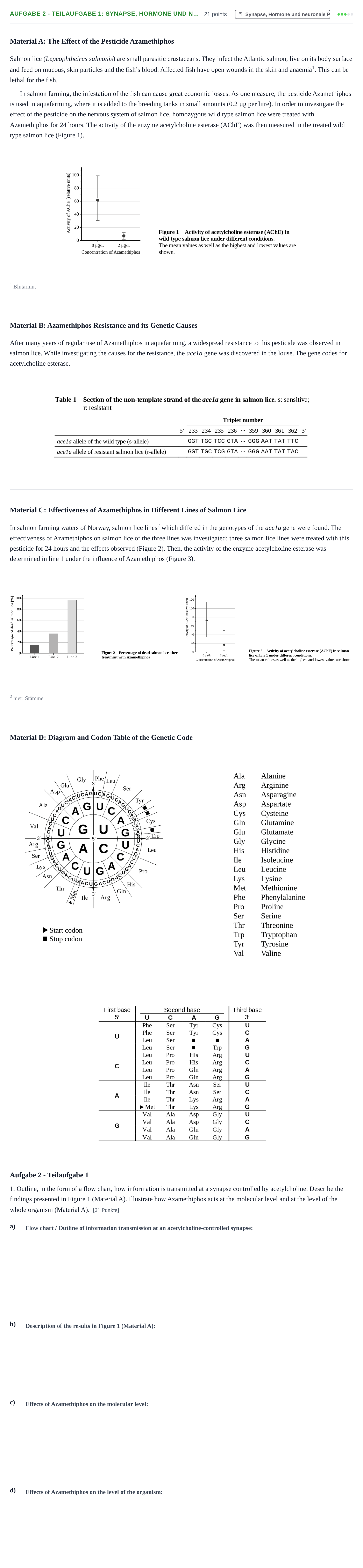
Salmon lice ( Lepeophtheirus salmonis) are small parasitic crustaceans. They infect the Atlantic salmon, live on its body surface and feed on mucous, skin particles and the fish’s blood. Affected fish have open wounds in the skin and anaemia 1. This can be lethal for the fish.
In salmon farming, the infestation of the fish can cause great economic losses. As one measure, the pesticide Azamethiphos is used in aquafarming, where it is added to the breeding tanks in small amounts (0.2 µg per litre). In order to investigate the effect of the pesticide on the nervous system of salmon lice, homozygous wild type salmon lice were treated with Azamethiphos for 24 hours. The activity of the enzyme acetylcholine esterase (AChE) was then measured in the treated wild type salmon lice (Figure 1).
1 Blutarmut
Material B: Azamethiphos Resistance and its Genetic Causes
After many years of regular use of Azamethiphos in aquafarming, a widespread resistance to this pesticide was observed in salmon lice. While investigating the causes for the resistance, the ace1a gene was discovered in the louse. The gene codes for acetylcholine esterase.
Material C: Effectiveness of Azamethiphos in Different Lines of Salmon Lice
In salmon farming waters of Norway, salmon lice lines 2 which differed in the genotypes of the ace1a gene were found. The effectiveness of Azamethiphos on salmon lice of the three lines was investigated: three salmon lice lines were treated with this pesticide for 24 hours and the effects observed (Figure 2). Then, the activity of the enzyme acetylcholine esterase was determined in line 1 under the influence of Azamethiphos (Figure 3).
2 hier: Stämme
Material D: Diagram and Codon Table of the Genetic Code
Aufgabe 2 - Teilaufgabe 1
1. Outline, in the form of a flow chart, how information is transmitted at a synapse controlled by acetylcholine. Describe the findings presented in Figure 1 (Material A). Illustrate how Azamethiphos acts at the molecular level and at the level of the whole organism (Material A).
[21 Punkte]
a)
b)
c)
d)
Lösung
Nach den offiziellen Korrekturhinweisen
1. Outline, in the form of a flow chart, how information is transmitted at a synapse controlled by acetylcholine.
Lösung: Action potential arrives at the presynaptic terminal → opening of voltage-gated calcium channels → influx of calcium ions → synaptic vesicles fuse with presynaptic membrane → acetylcholine is released into the synaptic cleft → neurotransmitter diffuses across the synaptic cleft → acetylcholine binds to receptors on the postsynaptic membrane → sodium ion channels open → sodium ions flow into postsynaptic cytoplasm → excitatory postsynaptic potential (EPSP) is generated.
Describe the findings presented in Figure 1 (Material A).
Lösung: Without Azamethiphos (0 µg/L), the activity of AChE in salmon lice has a mean of around 60 relative units (ranging between 30 and 100 relative units). With the addition of Azamethiphos (2 µg/L), the activity of AChE drops significantly to below 10 relative units (approx. 7 units), with minimal deviation from the mean.
Illustrate how Azamethiphos acts at the molecular level (Material A).
Lösung: Azamethiphos inhibits the enzyme acetylcholine esterase (AChE). As a consequence, acetylcholine in the synaptic cleft is no longer broken down into acetate and choline. Acetylcholine accumulates, leading to continuous binding to postsynaptic receptors, persistent opening of sodium channels, excessive influx of sodium ions, and permanent depolarization/excitation (continuous EPSP) of the postsynaptic neuron.
Illustrate how Azamethiphos acts at the level of the whole organism (Material A).
Lösung: Continuous excitation of neurons leads to constant signals sent to muscle cells, causing permanent contractions and muscle spasms/cramps, which ultimately leads to the death of the salmon lice.
Die ausführliche Erklärung Schritt für Schritt (mit KI) gibt es mit Premium. Premium
Löse sie direkt hier: automatische Korrektur, Hinweise und Lösung Schritt für Schritt.
‹ Aufgabe 2 - Synapse, Hormone und neuronale Plasti… · GK · Haupttermin 2023 · Aufgabe 2 - Synapse und Synapsengifte · GK · Haupttermin · Weiterbildungskolleg 2023 ›
Mehr Aufgaben zu Synapse, Hormone und neuronale Plastizität
- Aufgabe 1–3 - Synapse, Hormone und neuronale Plastizität · GK · Trichternetzspinne 2025
- Aufgabe 1 – Synapse, Hormone und neuronale Plasti… · LK · Hornisse-EN 2025
- Aufgabe 1 - Synapse und Hormone · LK · Katzenminze 2025
- Aufgabe Teilaufgaben 1, 2, 4 - Synapse, Hormone und neuro… · LK · Narkosemittel 2025
- Aufgabe 2 - Synapse, Hormone und neuronale Plasti… · GK · Haupttermin 2023
- Aufgabe 2 - Synapse und Synapsengifte · GK · Haupttermin · Weiterbildungskolleg 2023
- Aufgabe 2 - Teilaufgabe 3: Synapse, Hormone und n… · GK · Nachtermin 2023
- Aufgabe 2 - Synapse und Schmerztherapie · GK · Nachtermin · Weiterbildungskolleg 2023
- Aufgabe 2 - Synapse, Hormone und neuronale Plasti… · LK · Nachtermin 2023
- Aufgabe 2 - Teilaufgabe 4: Neurobiologie und Schm… · LK · Nachtermin · Weiterbildungskolleg 2023