Aufgabe 1 - Teilaufgabe 3: Evolutionsfaktoren und… · Abitur NRW Biologie GK · Haupttermin · bilingual Englisch 2023
Thema: Evolutionsfaktoren und Artbildung · Aus der Prüfung GK · Haupttermin · bilingual Englisch (2023)
Aufgabenstellung
Material A: The Genus Ariamnes on the Hawaii Archipelago
The genus Ariamnes belongs to the family of tangle-web spiders 1 and occurs with numerous species on the Hawaii Archipelago. The biggest species, A. kahili, reaches a maximum size of 11.3 mm. Ariamnes spiders hide in various resting habitats during daytime (Table 1). They are nocturnal predators that do not build site-specific webs. Instead, they run around looking for prey and catch them with a web woven between their hind legs. A kleptoparasitic behaviour was observed in some species: these spiders climb onto the webs of other spider species and feed on their prey or on the spiders themselves. Other spider species and especially birds feed on Ariamnes spiders.
Table 1 Occurrence and selected traits of the known Ariamnes species on the Hawaii Archipelago
Species · Habitat · Resting habitat during daytime · Shape of the abdomen · Colouring · Kleptoparasitic behaviour
A. huinakolu · humid forest · moss · short · dark · shown
A. kahili · humid forest · under leaves · long · gold · shown
A. uwepa · moderate humidity · under leaves · long · gold · not shown
A. makue · moderate humidity · dead ferns · long · dark · shown
A. poele · humid forest · dead ferns · long · dark · not shown
A. melekalikimaka · humid forest · under leaves · medium · gold · shown
A. alepeleke · humid forest · under leaves · medium · gold · not shown
A. laau · humid forest · dead ferns · long · dark · shown
A. corniger · dry forest · white lichens · long · matt white · not shown
A. waikula · humid forest · under leaves · long · gold · not shown
A. hiwa · humid forest · cracks in rocks · long · dark · not shown
1 Haubennetzspinne
Material B: Relationships between Ariamnes Spiders
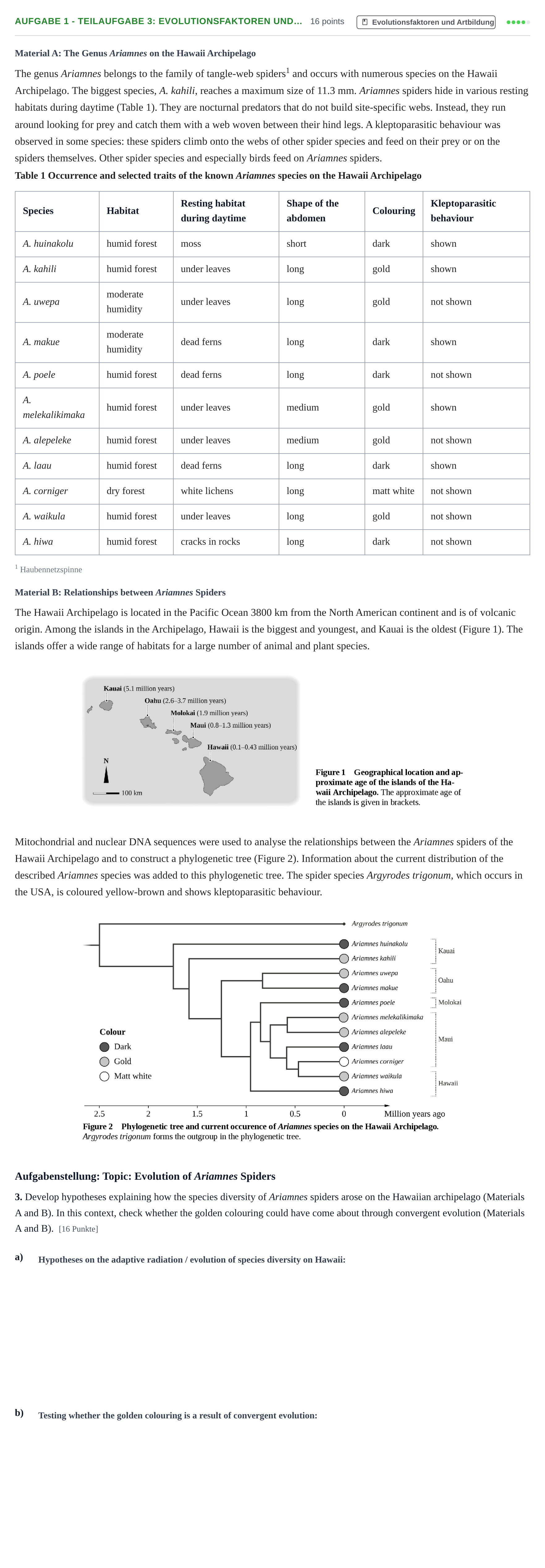
The Hawaii Archipelago is located in the Pacific Ocean 3800 km from the North American continent and is of volcanic origin. Among the islands in the Archipelago, Hawaii is the biggest and youngest, and Kauai is the oldest (Figure 1). The islands offer a wide range of habitats for a large number of animal and plant species.
Mitochondrial and nuclear DNA sequences were used to analyse the relationships between the Ariamnes spiders of the Hawaii Archipelago and to construct a phylogenetic tree (Figure 2). Information about the current distribution of the described Ariamnes species was added to this phylogenetic tree. The spider species Argyrodes trigonum, which occurs in the USA, is coloured yellow-brown and shows kleptoparasitic behaviour.
Aufgabenstellung: Topic: Evolution of Ariamnes Spiders
3. Develop hypotheses explaining how the species diversity of Ariamnes spiders arose on the Hawaiian archipelago (Materials A and B). In this context, check whether the golden colouring could have come about through convergent evolution (Materials A and B). [16 Punkte]
a)
b)
Lösung
Nach den offiziellen Korrekturhinweisen
Develop hypotheses explaining how the species diversity of Ariamnes spiders arose on the Hawaiian archipelago (Materials A and B)
Lösung: Die Entstehung der Artenvielfalt beruht auf adaptiver Radiation durch das Zusammenspiel von allopatrischer Artbildung und ökologischer Einnischung: 1. Kolonisation: Eine Gründerpopulation gelangte vom Festland auf die älteste Insel Kauai. 2. Geografische Isolation: Einzelne Tiere besiedelten schrittweise neu entstehende Nachbarinseln; der fehlende Genfluss führte zur allopatrischen Artbildung (z. B. Trennung von *A. corniger* auf Maui und *A. waikula* auf Hawaii). 3. Ökologische Differenzierung: Innerhalb derselben Insel kam es zur Einnischung (adaptive Radiation) durch unterschiedliche Ruhehabitate (Blätter, Moos, Flechten, Felsspalten) und Jagdstrategien (z. B. Kleptoparasitismus), um interspezifische Konkurrenz zu vermeiden (z. B. *A. uwepa* und *A. makue* auf Oahu).
Check whether the golden colouring could have come about through convergent evolution (Materials A and B)
Lösung: Das Merkmal der goldenen Färbung ist teilweise das Ergebnis konvergenter Evolution, teilweise auf gemeinsame Abstammung zurückzuführen: - Konvergenz: Arten wie *A. kahili* (Kauai), *A. uwepa* (Oahu) und *A. waikula* (Hawaii) sind im Stammbaum nicht direkt miteinander verwandt, sondern stehen dunklen Arten näher. Ihre goldene Färbung hat sich demnach unabhängig voneinander unter vergleichbarem Selektionsdruck (Tarnung unter Blättern vor Fressfeinden) entwickelt. - Homologie / gemeinsame Abstammung: Die Schwesterarten *A. melekalikimaka* und *A. alepeleke* auf Maui sind sehr nah verwandt; bei ihnen geht die goldene Färbung auf einen gemeinsamen Vorfahren zurück und ist somit kein Fall von Konvergenz.
Die ausführliche Erklärung Schritt für Schritt (mit KI) gibt es mit Premium. Premium
Löse sie direkt hier: automatische Korrektur, Hinweise und Lösung Schritt für Schritt.
‹ Aufgabe 3 - Evolutionsfaktoren und Artbildung · GK · Haupttermin 2023 · Aufgabe 3 - Teilaufgaben 1 und 3: Evolutionsfakto… · GK · Haupttermin · bilingual Englisch 2023 ›
Mehr Aufgaben zu Evolutionsfaktoren und Artbildung
- Aufgabe 4 - Evolutionsfaktoren und Artbildung · GK · Weißklee 2025
- Aufgabe 2–4 - Evolutionsfaktoren und Artbildung · LK · Elefanten-EN 2025
- Aufgabe 3 - Artbildung bei der Nord-Giraffe · LK · Giraffe 2025
- Aufgabe 1 - Evolutionsfaktoren und Artbildung · GK · Haupttermin 2023
- Aufgabe 3 - Evolutionsfaktoren und Artbildung · GK · Haupttermin 2023
- Aufgabe 3 - Teilaufgaben 1 und 3: Evolutionsfakto… · GK · Haupttermin · bilingual Englisch 2023
- Aufgabe 1 - Evolutionsfaktoren und Artbildung · GK · Haupttermin · Weiterbildungskolleg 2023
- Aufgabe 3 - Evolutionsfaktoren und Angepasstheiten · GK · Haupttermin · Weiterbildungskolleg 2023
- Aufgabe 1 - Teilaufgabe 1: Evolutionsfaktoren und… · GK · Nachtermin 2023
- Aufgabe 1 - Selektion · GK · Nachtermin · Weiterbildungskolleg 2023