Aufgabe 3 - Teilaufgaben 1 und 3: Evolutionsfakto… · Abitur NRW Biologie GK · Haupttermin · bilingual Englisch 2023
Thema: Evolutionsfaktoren und Artbildung · Aus der Prüfung GK · Haupttermin · bilingual Englisch (2023)
Aufgabenstellung
Material A: Overwintering of Burgundy Snails
The Burgundy snail¹ ( Helix pomatia) overwinters from October until the beginning of May. During this period, it lives withdrawn into its shell, which is tightly sealed by a calcareous lid², and is buried under leaves in the soil. When temperatures fall below 8° Celsius, their metabolism switches to a cold-induced torpor. The snails do not feed during the cold-induced torpor. Their metabolic rate, their oxygen consumption, their heart rate and the activity of their nervous systems are reduced. During this time, the Burgundy snail lives on nutrients it stored while feeding. Starting in May, Burgundy snails actively start looking for food if enough moisture is present. They feed on soft, wilting plant parts and algae.
¹ Weinbergschnecke
² Kalkdeckel
Material B: Signal Conduction in the Burgundy Snail
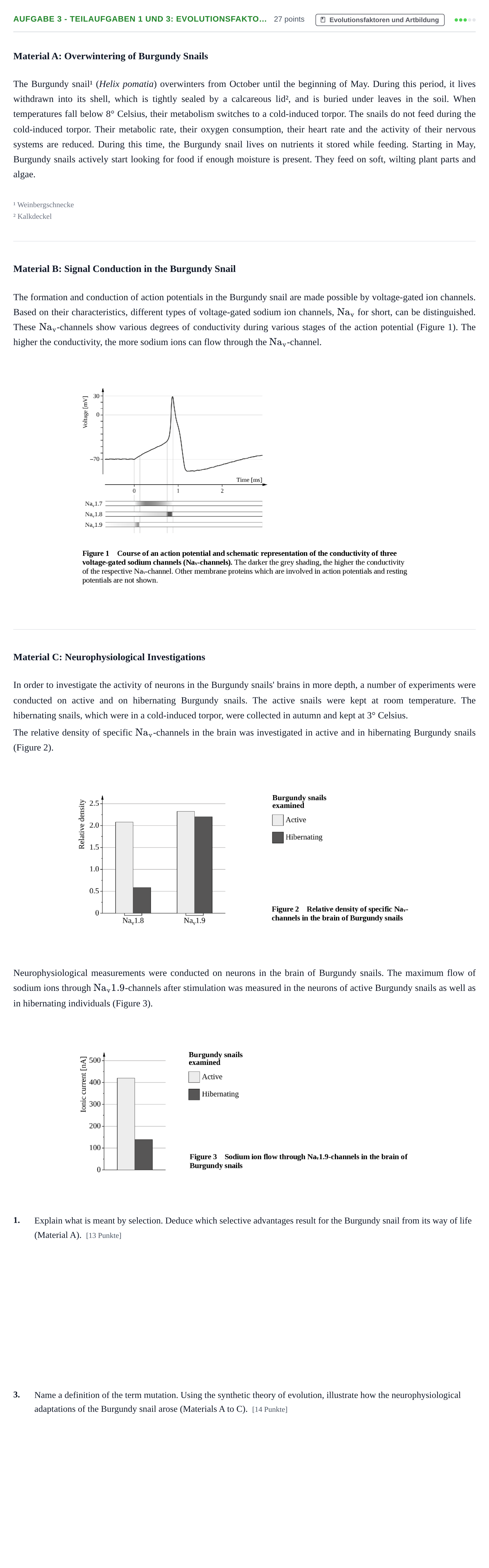
The formation and conduction of action potentials in the Burgundy snail are made possible by voltage-gated ion channels. Based on their characteristics, different types of voltage-gated sodium ion channels, for short, can be distinguished. These -channels show various degrees of conductivity during various stages of the action potential (Figure 1). The higher the conductivity, the more sodium ions can flow through the -channel.
Material C: Neurophysiological Investigations
In order to investigate the activity of neurons in the Burgundy snails' brains in more depth, a number of experiments were conducted on active and on hibernating Burgundy snails. The active snails were kept at room temperature. The hibernating snails, which were in a cold-induced torpor, were collected in autumn and kept at 3° Celsius.
The relative density of specific -channels in the brain was investigated in active and in hibernating Burgundy snails (Figure 2).
Neurophysiological measurements were conducted on neurons in the brain of Burgundy snails. The maximum flow of sodium ions through -channels after stimulation was measured in the neurons of active Burgundy snails as well as in hibernating individuals (Figure 3).
1.
Explain what is meant by selection. Deduce which selective advantages result for the Burgundy snail from its way of life (Material A). [13 Punkte]
3.
Name a definition of the term mutation. Using the synthetic theory of evolution, illustrate how the neurophysiological adaptations of the Burgundy snail arose (Materials A to C). [14 Punkte]
Lösung
Nach den offiziellen Korrekturhinweisen
1. Explain what is meant by selection. Deduce which selective advantages result for the Burgundy snail from its way of life (Material A).
Lösung: Selection: • Selection means that individuals of a population with traits that are better adapted to existing environmental conditions have higher reproductive success than less adapted individuals. • Better-adapted individuals contribute more of their genetic material into the gene pool of following generations, leading to directed change in the population's gene pool. Selective advantages from lifestyle: • Burrowing into the soil and mechanical protection by the shell provide protection from predators during cold temperatures. • Storing nutrient reserves during favorable conditions enables overwintering without active feeding. • Lowering metabolic rate during overwintering reduces consumption of stored nutrients. • Tight sealing of the shell by a calcareous lid reduces water loss during cold-induced torpor, preventing desiccation.
3. Name a definition of the term mutation. Using the synthetic theory of evolution, illustrate how the neurophysiological adaptations of the Burgundy snail arose (Materials A to C).
Lösung: Definition of mutation: • Spontaneous, random changes in the nucleotide / base sequence of the DNA of an individual. Evolution of neurophysiological adaptations: • Mutations created genetic variation in genes encoding sodium channels (Nav-genes) within the snail population. • Individuals carrying mutated alleles (e.g. altered regulation/expression of Nav1.8 channels or temperature-sensitive alterations in the amino acid sequence of Nav1.9 channels) showed reduced neuronal brain activity during cold temperatures. • Lower neuronal activity in torpor prevents premature waking or disturbance, saving critical energy resources (ATP required by Na+/K+-ATPases). • Individuals with these advantageous alleles had greater reproductive fitness and higher winter survival, so these alleles increased in frequency in the gene pool across generations.
Die ausführliche Erklärung Schritt für Schritt (mit KI) gibt es mit Premium. Premium
Löse sie direkt hier: automatische Korrektur, Hinweise und Lösung Schritt für Schritt.
‹ Aufgabe 1 - Teilaufgabe 3: Evolutionsfaktoren und… · GK · Haupttermin · bilingual Englisch 2023 · Aufgabe 1 - Evolutionsfaktoren und Artbildung · GK · Haupttermin · Weiterbildungskolleg 2023 ›
Mehr Aufgaben zu Evolutionsfaktoren und Artbildung
- Aufgabe 2–4 - Evolutionsfaktoren und Artbildung · LK · Elefanten-EN 2025
- Aufgabe 3 - Artbildung bei der Nord-Giraffe · LK · Giraffe 2025
- Aufgabe 1 - Evolutionsfaktoren und Artbildung · GK · Haupttermin 2023
- Aufgabe 3 - Evolutionsfaktoren und Artbildung · GK · Haupttermin 2023
- Aufgabe 1 - Teilaufgabe 3: Evolutionsfaktoren und… · GK · Haupttermin · bilingual Englisch 2023
- Aufgabe 1 - Evolutionsfaktoren und Artbildung · GK · Haupttermin · Weiterbildungskolleg 2023
- Aufgabe 3 - Evolutionsfaktoren und Angepasstheiten · GK · Haupttermin · Weiterbildungskolleg 2023
- Aufgabe 1 - Teilaufgabe 1: Evolutionsfaktoren und… · GK · Nachtermin 2023
- Aufgabe 1 - Selektion · GK · Nachtermin · Weiterbildungskolleg 2023
- Aufgabe 1 - Evolutionsfaktoren und Artbildung · LK · Haupttermin 2023