Ejercicio B · Inglés PAU Madrid Ordinaria Coincidencias 2024
Tema: Comprensión Lectora · Del examen Ordinaria Coincidencias (2024)
Enunciado
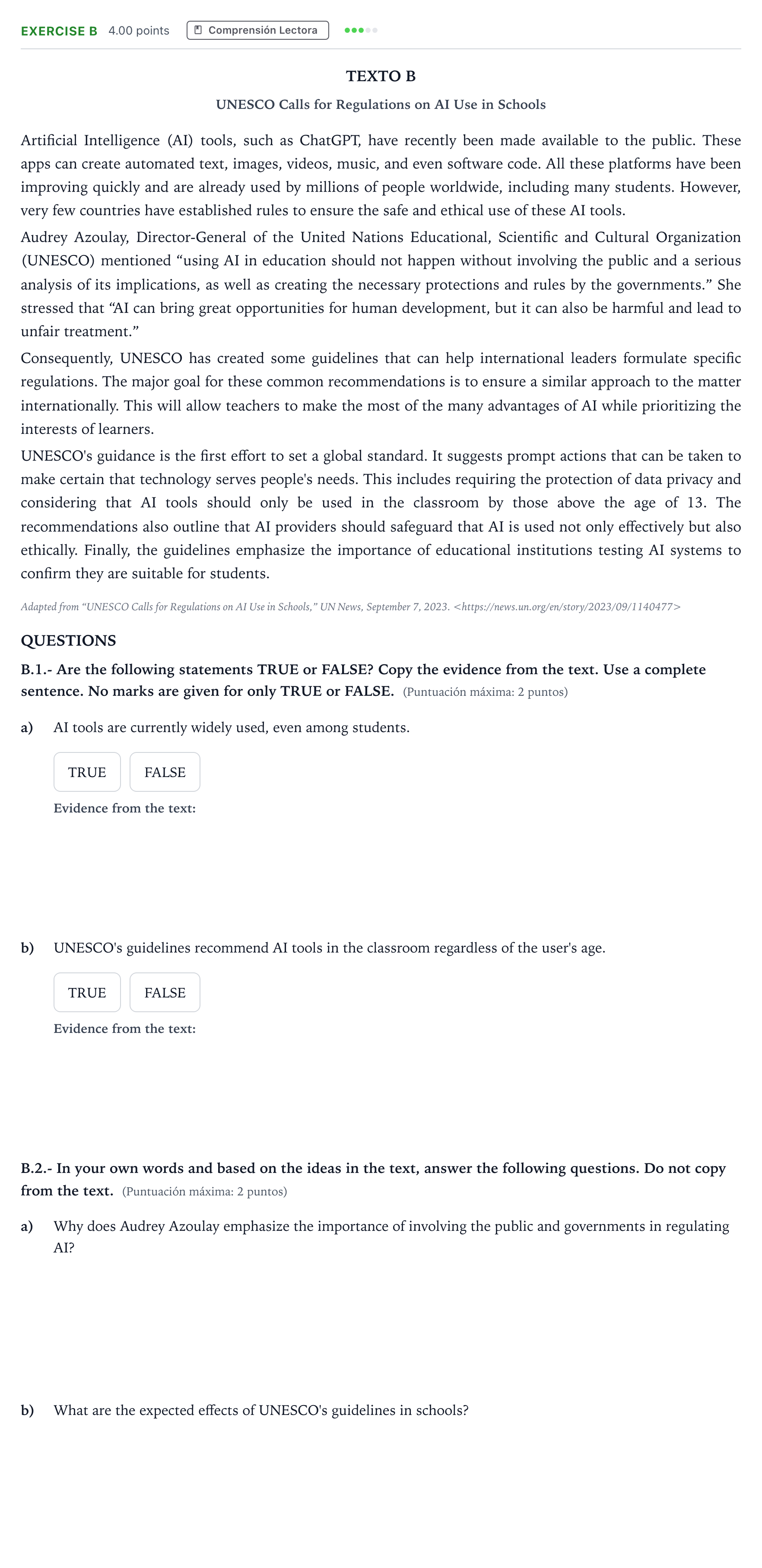
TEXTO B
UNESCO Calls for Regulations on AI Use in Schools
Artificial Intelligence (AI) tools, such as ChatGPT, have recently been made available to the public. These apps can create automated text, images, videos, music, and even software code. All these platforms have been improving quickly and are already used by millions of people worldwide, including many students. However, very few countries have established rules to ensure the safe and ethical use of these AI tools.
Audrey Azoulay, Director-General of the United Nations Educational, Scientific and Cultural Organization (UNESCO) mentioned “using AI in education should not happen without involving the public and a serious analysis of its implications, as well as creating the necessary protections and rules by the governments.” She stressed that “AI can bring great opportunities for human development, but it can also be harmful and lead to unfair treatment.”
Consequently, UNESCO has created some guidelines that can help international leaders formulate specific regulations. The major goal for these common recommendations is to ensure a similar approach to the matter internationally. This will allow teachers to make the most of the many advantages of AI while prioritizing the interests of learners.
UNESCO's guidance is the first effort to set a global standard. It suggests prompt actions that can be taken to make certain that technology serves people's needs. This includes requiring the protection of data privacy and considering that AI tools should only be used in the classroom by those above the age of 13. The recommendations also outline that AI providers should safeguard that AI is used not only effectively but also ethically. Finally, the guidelines emphasize the importance of educational institutions testing AI systems to confirm they are suitable for students.
Adapted from “UNESCO Calls for Regulations on AI Use in Schools,” UN News, September 7, 2023. <https://news.un.org/en/story/2023/09/1140477>
QUESTIONS
B.1.- Are the following statements TRUE or FALSE? Copy the evidence from the text. Use a complete sentence. No marks are given for only TRUE or FALSE.
(Puntuación máxima: 2 puntos)
a)
AI tools are currently widely used, even among students.
TRUE
FALSE
b)
UNESCO's guidelines recommend AI tools in the classroom regardless of the user's age.
TRUE
FALSE
B.2.- In your own words and based on the ideas in the text, answer the following questions. Do not copy from the text.
(Puntuación máxima: 2 puntos)
a)
Why does Audrey Azoulay emphasize the importance of involving the public and governments in regulating AI?
b)
What are the expected effects of UNESCO's guidelines in schools?
Solución
Según los criterios oficiales de corrección
B.1. a) AI tools are currently widely used, even among students. (Evidence)
Solución: All these platforms have been improving quickly and are already used by millions of people worldwide, including many students.
B.1. b) UNESCO's guidelines recommend AI tools in the classroom regardless of the user's age. (Evidence)
Solución: This includes requiring the protection of data privacy and considering that AI tools should only be used in the classroom by those above the age of 13.
B.2. a) Why does Audrey Azoulay emphasize the importance of involving the public and governments in regulating AI?
Solución: Because AI could offer extraordinary prospects for future progress, yet it also could cause damage and contribute to unjust situations.
B.2. b) What are the expected effects of UNESCO's guidelines in schools?
Solución: Educators will be able to benefit from the positive aspects of these tools while students' needs are still the number one concern.
B.1 True/False options
Solución: a) TRUE; b) FALSE
La explicación paso a paso, hecha con IA, es Premium. Premium
Resuélvelo aquí mismo: corrección automática, pistas y solución paso a paso.
‹ Ejercicio A · Ordinaria Coincidencias 2024 · Ejercicio A.1 · Ordinaria Lunes 2024 ›
Más ejercicios de Comprensión Lectora
- Ejercicio A · Modelo 2024
- Ejercicio B · Modelo 2024
- Ejercicio A.1 - A.2 · Ordinaria 2024
- Ejercicio B.1 - B.2 · Ordinaria 2024
- Ejercicio A · Ordinaria Coincidencias 2024
- Ejercicio A.1 · Ordinaria Lunes 2024
- Ejercicio A.2 · Ordinaria Lunes 2024
- Ejercicio B.1 · Ordinaria Lunes 2024
- Ejercicio B.2 · Ordinaria Lunes 2024
- Ejercicio A · Ordinaria Martes 2024