Ejercicio B.1 - B.2 · Inglés PAU Madrid Ordinaria 2024
Tema: Comprensión Lectora · Del examen Ordinaria (2024)
Enunciado
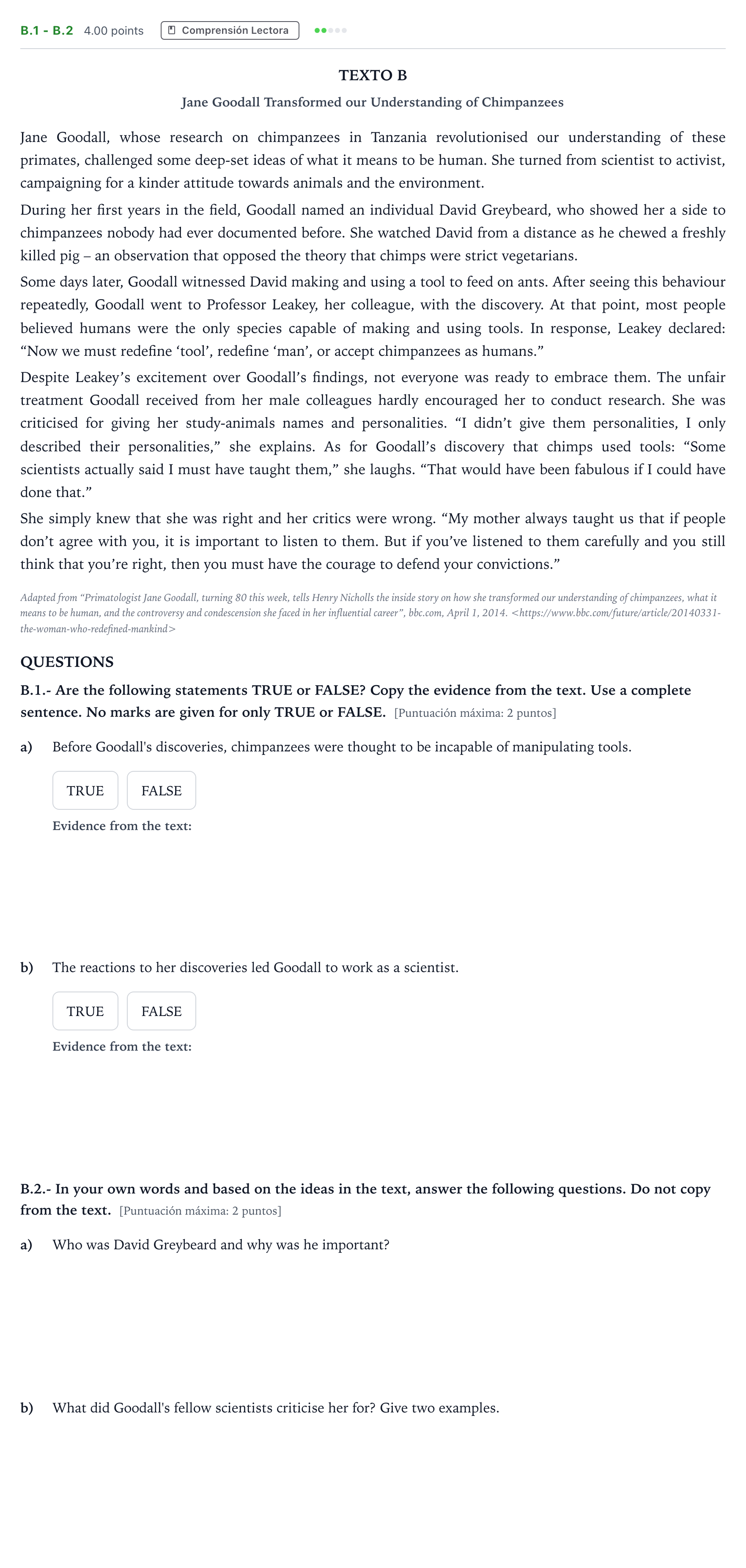
TEXTO B
Jane Goodall Transformed our Understanding of Chimpanzees
Jane Goodall, whose research on chimpanzees in Tanzania revolutionised our understanding of these primates, challenged some deep-set ideas of what it means to be human. She turned from scientist to activist, campaigning for a kinder attitude towards animals and the environment.
During her first years in the field, Goodall named an individual David Greybeard, who showed her a side to chimpanzees nobody had ever documented before. She watched David from a distance as he chewed a freshly killed pig – an observation that opposed the theory that chimps were strict vegetarians.
Some days later, Goodall witnessed David making and using a tool to feed on ants. After seeing this behaviour repeatedly, Goodall went to Professor Leakey, her colleague, with the discovery. At that point, most people believed humans were the only species capable of making and using tools. In response, Leakey declared: “Now we must redefine ‘tool’, redefine ‘man’, or accept chimpanzees as humans.”
Despite Leakey’s excitement over Goodall’s findings, not everyone was ready to embrace them. The unfair treatment Goodall received from her male colleagues hardly encouraged her to conduct research. She was criticised for giving her study-animals names and personalities. “I didn’t give them personalities, I only described their personalities,” she explains. As for Goodall’s discovery that chimps used tools: “Some scientists actually said I must have taught them,” she laughs. “That would have been fabulous if I could have done that.”
She simply knew that she was right and her critics were wrong. “My mother always taught us that if people don’t agree with you, it is important to listen to them. But if you’ve listened to them carefully and you still think that you’re right, then you must have the courage to defend your convictions.”
Adapted from “Primatologist Jane Goodall, turning 80 this week, tells Henry Nicholls the inside story on how she transformed our understanding of chimpanzees, what it means to be human, and the controversy and condescension she faced in her influential career”, bbc.com, April 1, 2014. <https://www.bbc.com/future/article/20140331-the-woman-who-redefined-mankind>
QUESTIONS
B.1.- Are the following statements TRUE or FALSE? Copy the evidence from the text. Use a complete sentence. No marks are given for only TRUE or FALSE. [Puntuación máxima: 2 puntos]
a)
Before Goodall's discoveries, chimpanzees were thought to be incapable of manipulating tools.
TRUE
FALSE
b)
The reactions to her discoveries led Goodall to work as a scientist.
TRUE
FALSE
B.2.- In your own words and based on the ideas in the text, answer the following questions. Do not copy from the text. [Puntuación máxima: 2 puntos]
a)
Who was David Greybeard and why was he important?
b)
What did Goodall's fellow scientists criticise her for? Give two examples.
Solución
Según los criterios oficiales de corrección
B.1. Are the following statements TRUE or FALSE? a) Before Goodall's discoveries, chimpanzees were thought to be incapable of manipulating tools.
Solución: TRUE
Evidence for B.1.a: Before Goodall's discoveries, chimpanzees were thought to be incapable of manipulating tools.
Solución: "At that point, most people believed humans were the only species capable of making and using tools."
B.1. Are the following statements TRUE or FALSE? b) The reactions to her discoveries led Goodall to work as a scientist.
Solución: FALSE
Evidence for B.1.b: The reactions to her discoveries led Goodall to work as a scientist.
Solución: "The unfair treatment Goodall received from her male colleagues hardly encouraged her to conduct research."
B.2.a) Who was David Greybeard and why was he important?
Solución: David Greybeard was a chimpanzee and he was important because he was the first chimpanzee to be seen behaving in a certain way (eating meat / making and using tools).
B.2.b) What did Goodall's fellow scientists criticise her for? Give two examples.
Solución: Her colleagues were against her ideas because they said she had given the animals human qualities and she had helped chimpanzees to learn how to use tools.
La explicación paso a paso, hecha con IA, es Premium. Premium
Resuélvelo aquí mismo: corrección automática, pistas y solución paso a paso.
‹ Ejercicio A.1 - A.2 · Ordinaria 2024 · Ejercicio A · Ordinaria Coincidencias 2024 ›
Más ejercicios de Comprensión Lectora
- Ejercicio A · Extraordinaria (2) 2024
- Ejercicio B · Extraordinaria (2) 2024
- Ejercicio A · Modelo 2024
- Ejercicio B · Modelo 2024
- Ejercicio A.1 - A.2 · Ordinaria 2024
- Ejercicio A · Ordinaria Coincidencias 2024
- Ejercicio B · Ordinaria Coincidencias 2024
- Ejercicio A.1 · Ordinaria Lunes 2024
- Ejercicio A.2 · Ordinaria Lunes 2024
- Ejercicio B.1 · Ordinaria Lunes 2024