Ejercicio A · Inglés PAU Madrid Modelo 2024
Tema: Comprensión Lectora · Del examen Modelo (2024)
Enunciado
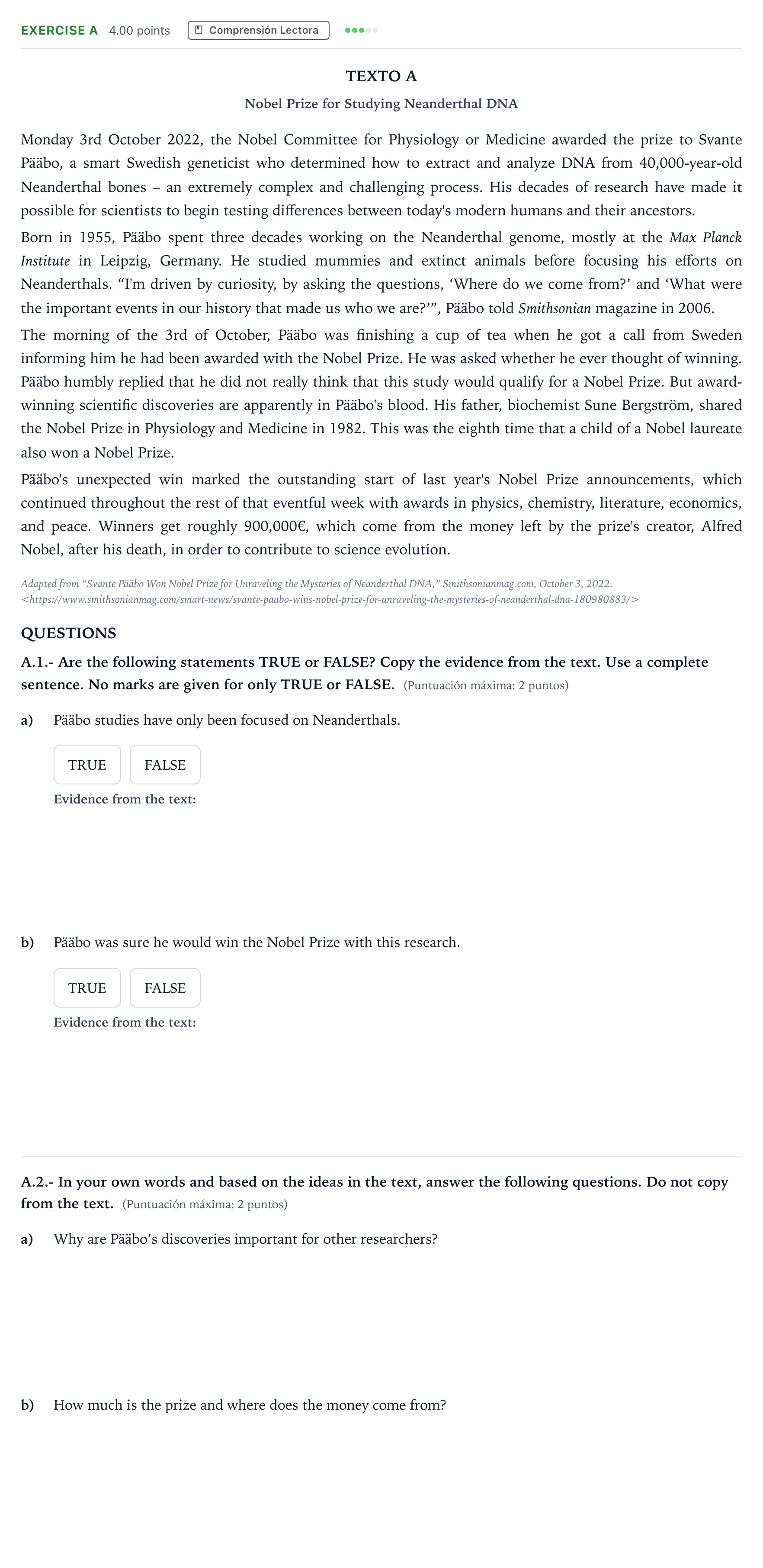
TEXTO A
Nobel Prize for Studying Neanderthal DNA
Monday 3rd October 2022, the Nobel Committee for Physiology or Medicine awarded the prize to Svante Pääbo, a smart Swedish geneticist who determined how to extract and analyze DNA from 40,000-year-old Neanderthal bones – an extremely complex and challenging process. His decades of research have made it possible for scientists to begin testing differences between today's modern humans and their ancestors.
Born in 1955, Pääbo spent three decades working on the Neanderthal genome, mostly at the Max Planck Institute in Leipzig, Germany. He studied mummies and extinct animals before focusing his efforts on Neanderthals. “I'm driven by curiosity, by asking the questions, ‘Where do we come from?’ and ‘What were the important events in our history that made us who we are?’”, Pääbo told Smithsonian magazine in 2006.
The morning of the 3rd of October, Pääbo was finishing a cup of tea when he got a call from Sweden informing him he had been awarded with the Nobel Prize. He was asked whether he ever thought of winning. Pääbo humbly replied that he did not really think that this study would qualify for a Nobel Prize. But award-winning scientific discoveries are apparently in Pääbo's blood. His father, biochemist Sune Bergström, shared the Nobel Prize in Physiology and Medicine in 1982. This was the eighth time that a child of a Nobel laureate also won a Nobel Prize.
Pääbo's unexpected win marked the outstanding start of last year's Nobel Prize announcements, which continued throughout the rest of that eventful week with awards in physics, chemistry, literature, economics, and peace. Winners get roughly 900,000€, which come from the money left by the prize's creator, Alfred Nobel, after his death, in order to contribute to science evolution.
Adapted from “Svante Pääbo Won Nobel Prize for Unraveling the Mysteries of Neanderthal DNA,” Smithsonianmag.com, October 3, 2022. <https://www.smithsonianmag.com/smart-news/svante-paabo-wins-nobel-prize-for-unraveling-the-mysteries-of-neanderthal-dna-180980883/>
QUESTIONS
A.1.- Are the following statements TRUE or FALSE? Copy the evidence from the text. Use a complete sentence. No marks are given for only TRUE or FALSE.
(Puntuación máxima: 2 puntos)
a)
Pääbo studies have only been focused on Neanderthals.
TRUE
FALSE
b)
Pääbo was sure he would win the Nobel Prize with this research.
TRUE
FALSE
A.2.- In your own words and based on the ideas in the text, answer the following questions. Do not copy from the text.
(Puntuación máxima: 2 puntos)
a)
Why are Pääbo’s discoveries important for other researchers?
b)
How much is the prize and where does the money come from?
Solución
Según los criterios oficiales de corrección
A.1. a) Pääbo studies have only been focused on Neanderthals.
Solución: FALSE
A.1. a) Copy the evidence from the text: Pääbo studies have only been focused on Neanderthals.
Solución: "He studied mummies and extinct animals before focusing his efforts on Neanderthals."
A.1. b) Pääbo was sure he would win the Nobel Prize with this research.
Solución: FALSE
A.1. b) Copy the evidence from the text: Pääbo was sure he would win the Nobel Prize with this research.
Solución: "Pääbo humbly replied that he did not really think that this study would qualify for a Nobel Prize."
A.2. a) Why are Pääbo’s discoveries important for other researchers?
Solución: His many years of study have allowed other researchers to compare the present human beings with their predecessors.
A.2. b) How much is the prize and where does the money come from?
Solución: The people who win a Nobel Prize get around 900,000 euros that are part of the money that Alfred Nobel, the inventor of the prize, left because he wanted to help science improve.
La explicación paso a paso, hecha con IA, es Premium. Premium
Resuélvelo aquí mismo: corrección automática, pistas y solución paso a paso.
‹ Ejercicio B · Extraordinaria (2) 2024 · Ejercicio B · Modelo 2024 ›
Más ejercicios de Comprensión Lectora
- Problema 2 · Ordinaria 9:30 2025
- Ejercicio A · Extraordinaria 2024
- Ejercicio B · Extraordinaria 2024
- Ejercicio A · Extraordinaria (2) 2024
- Ejercicio B · Extraordinaria (2) 2024
- Ejercicio B · Modelo 2024
- Ejercicio A.1 - A.2 · Ordinaria 2024
- Ejercicio B.1 - B.2 · Ordinaria 2024
- Ejercicio A · Ordinaria Coincidencias 2024
- Ejercicio B · Ordinaria Coincidencias 2024