Ejercicio A.1 - A.2 · Inglés PAU Madrid Ordinaria 2024
Tema: Comprensión Lectora · Del examen Ordinaria (2024)
Enunciado
TEXTO A
The Benefits of Listening to Your Favorite Music
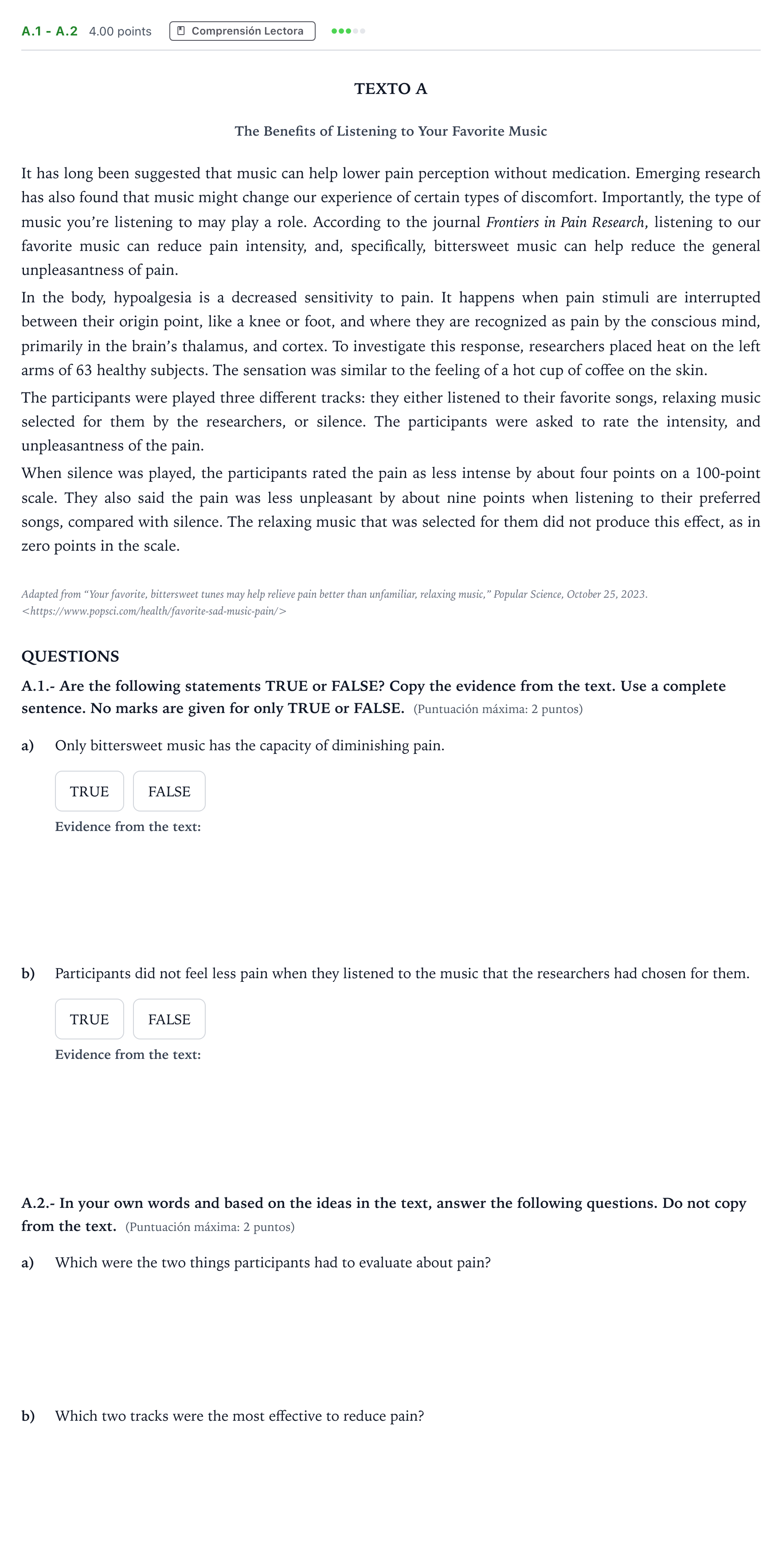
It has long been suggested that music can help lower pain perception without medication. Emerging research has also found that music might change our experience of certain types of discomfort. Importantly, the type of music you’re listening to may play a role. According to the journal Frontiers in Pain Research, listening to our favorite music can reduce pain intensity, and, specifically, bittersweet music can help reduce the general unpleasantness of pain.
In the body, hypoalgesia is a decreased sensitivity to pain. It happens when pain stimuli are interrupted between their origin point, like a knee or foot, and where they are recognized as pain by the conscious mind, primarily in the brain’s thalamus, and cortex. To investigate this response, researchers placed heat on the left arms of 63 healthy subjects. The sensation was similar to the feeling of a hot cup of coffee on the skin.
The participants were played three different tracks: they either listened to their favorite songs, relaxing music selected for them by the researchers, or silence. The participants were asked to rate the intensity, and unpleasantness of the pain.
When silence was played, the participants rated the pain as less intense by about four points on a 100-point scale. They also said the pain was less unpleasant by about nine points when listening to their preferred songs, compared with silence. The relaxing music that was selected for them did not produce this effect, as in zero points in the scale.
Adapted from “Your favorite, bittersweet tunes may help relieve pain better than unfamiliar, relaxing music,” Popular Science, October 25, 2023. <https://www.popsci.com/health/favorite-sad-music-pain/>
QUESTIONS
A.1.- Are the following statements TRUE or FALSE? Copy the evidence from the text. Use a complete sentence. No marks are given for only TRUE or FALSE.
(Puntuación máxima: 2 puntos)
a)
Only bittersweet music has the capacity of diminishing pain.
TRUE
FALSE
b)
Participants did not feel less pain when they listened to the music that the researchers had chosen for them.
TRUE
FALSE
A.2.- In your own words and based on the ideas in the text, answer the following questions. Do not copy from the text.
(Puntuación máxima: 2 puntos)
a)
Which were the two things participants had to evaluate about pain?
b)
Which two tracks were the most effective to reduce pain?
Solución
Según los criterios oficiales de corrección
A.1.a) Are the following statements TRUE or FALSE? Only bittersweet music has the capacity of diminishing pain.
Solución: FALSE
A.1.a) Copy the evidence from the text: Only bittersweet music has the capacity of diminishing pain.
Solución: "According to the journal Frontiers in Pain Research, listening to our favorite music can reduce pain intensity, and, specifically, bittersweet music can help reduce the general unpleasantness of pain."
A.1.b) Are the following statements TRUE or FALSE? Participants did not feel less pain when they listened to the music that the researchers had chosen for them.
Solución: TRUE
A.1.b) Copy the evidence from the text: Participants did not feel less pain when they listened to the music that the researchers had chosen for them.
Solución: "The relaxing music that was selected for them did not produce this effect, as in zero points in the scale."
A.2.a) Which were the two things participants had to evaluate about pain?
Solución: Subjects had to assess how strong the pain was, and how much discomfort it produced.
A.2.b) Which two tracks were the most effective to reduce pain?
Solución: The sound of the participants' preferred melodies, and the sound of silence were shown to be the most efficient.
La explicación paso a paso, hecha con IA, es Premium. Premium
Resuélvelo aquí mismo: corrección automática, pistas y solución paso a paso.
‹ Ejercicio B · Modelo 2024 · Ejercicio B.1 - B.2 · Ordinaria 2024 ›
Más ejercicios de Comprensión Lectora
- Ejercicio B · Extraordinaria 2024
- Ejercicio A · Extraordinaria (2) 2024
- Ejercicio B · Extraordinaria (2) 2024
- Ejercicio A · Modelo 2024
- Ejercicio B · Modelo 2024
- Ejercicio B.1 - B.2 · Ordinaria 2024
- Ejercicio A · Ordinaria Coincidencias 2024
- Ejercicio B · Ordinaria Coincidencias 2024
- Ejercicio A.1 · Ordinaria Lunes 2024
- Ejercicio A.2 · Ordinaria Lunes 2024