Ejercicio Exercise 1 · Física I URV 2024
Tema: Treball, energia i energia potencial · Del examen Physics I - 1st & 2nd Partial Exam (January 2024) (2024)
Enunciado
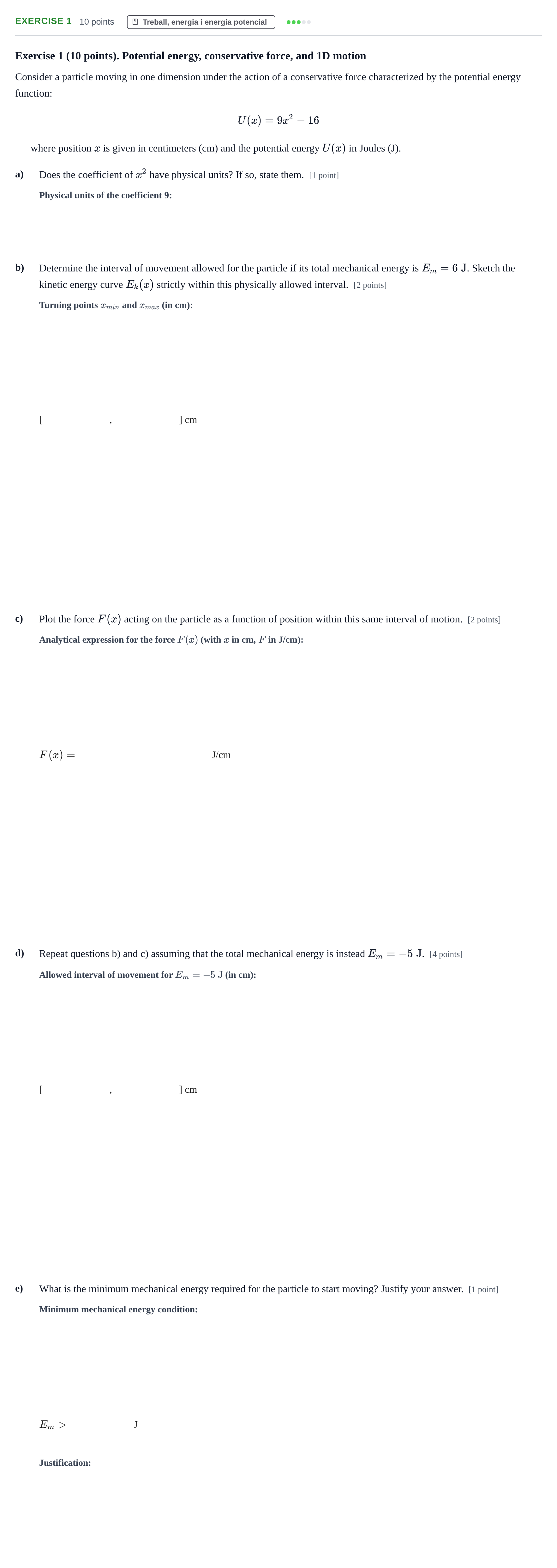
Exercise 1 (10 points). Potential energy, conservative force, and 1D motion
Consider a particle moving in one dimension under the action of a conservative force characterized by the potential energy function:
where position is given in centimeters (cm) and the potential energy in Joules (J).
a)
Does the coefficient of have physical units? If so, state them. [1 point]
b)
Determine the interval of movement allowed for the particle if its total mechanical energy is . Sketch the kinetic energy curve strictly within this physically allowed interval. [2 points]
[
,
] cm
c)
Plot the force acting on the particle as a function of position within this same interval of motion. [2 points]
J/cm
d)
Repeat questions b) and c) assuming that the total mechanical energy is instead . [4 points]
[
,
] cm
e)
What is the minimum mechanical energy required for the particle to start moving? Justify your answer. [1 point]
J
Solución
Según los criterios oficiales de corrección
a. Does the coefficient of x² have physical units? If so, state them.
Solución: / / /
b. Determine the lower turning point x_min (cm) for Em = 6 J
Solución: cm / cm
b. Determine the upper turning point x_max (cm) for Em = 6 J
Solución: cm / cm
c. Expression of the force F(x) acting on the particle
Solución:
d. Lower turning point x_min (cm) for Em = -5 J
Solución: cm / cm
d. Upper turning point x_max (cm) for Em = -5 J
Solución: cm / cm
e. Minimum mechanical energy required for the particle to start moving
Solución:
e. Justification of the minimum mechanical energy required
Solución: At , reaches its minimum . At , and the particle is in static equilibrium; for motion to occur, , so .
Sketches and Plots: b) Ek(x) curve for Em = 6 J; c) F(x) plot for Em = 6 J; d) Ek(x) and F(x) plots for Em = -5 J
Solución: b. Sketch of for : Inverted parabola symmetric around with a maximum of , dropping to at the turning points . Strictly plotted inside this interval. c. Plot of : Straight line passing through the origin with negative slope (or ). At , ; at , ; at , . d. Plots for : is an inverted parabola reaching peak and vanishing at . The force is identical in functional form but plotted over the narrower domain , spanning from to .
La explicación paso a paso, hecha con IA, es Premium. Premium
Resuélvelo aquí mismo: corrección automática, pistas y solución paso a paso.
‹ Ejercicio Exercise 1 · 2024 · Question 1 - Treball, energia i energia potencial · 2023 ›
Más ejercicios de Treball, energia i energia potencial
- Ejercicio Exercise 1 · 2024
- Question 1 - Treball, energia i energia potencial · 2023
- Ejercicio 2 - Problema (Parcial Nov 2021) · 2021
- Ejercicio 11 - Qüestió D (Recuperació 2019-2020) · 2021
- Ejercicio 2 Qüestió 1 · 2017
- Ejercicio Setembre 2001 - Qüestió 1 · 2001
- Ejercicio Setembre 2001 - Qüestió 4 · 2001
- Ejercicio Control 1 (2021) - P1 · 2001
- Problema. Càlcul del treball en un camí tancat · 2001
- Ejercicio Qüestió 1 - Treball, energia i energia potencial · Examen de Física I