Problema 4 · Biología URV Practice Test: Biology and Genetics of Prokaryotes
Tema: Procariotes i virus · Del examen Practice Test: Biology and Genetics of Prokaryotes
Enunciado
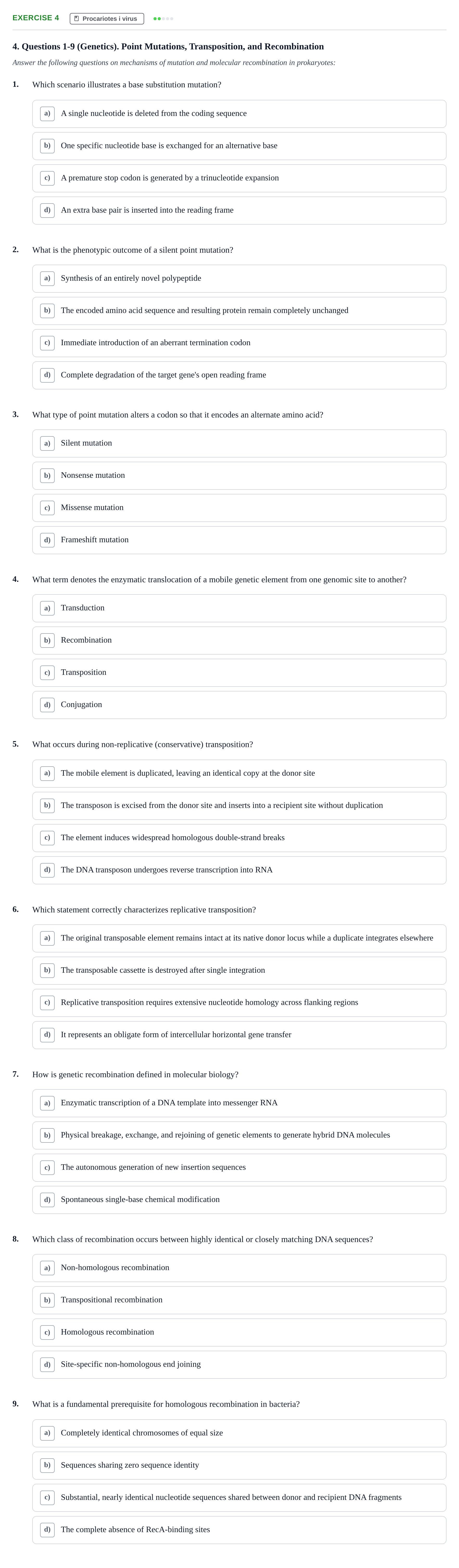
4. Questions 1-9 (Genetics). Point Mutations, Transposition, and Recombination
Answer the following questions on mechanisms of mutation and molecular recombination in prokaryotes:
1.
Which scenario illustrates a base substitution mutation?
)
2.
What is the phenotypic outcome of a silent point mutation?
)
3.
What type of point mutation alters a codon so that it encodes an alternate amino acid?
)
4.
What term denotes the enzymatic translocation of a mobile genetic element from one genomic site to another?
)
5.
What occurs during non-replicative (conservative) transposition?
)
6.
Which statement correctly characterizes replicative transposition?
)
7.
How is genetic recombination defined in molecular biology?
)
8.
Which class of recombination occurs between highly identical or closely matching DNA sequences?
)
9.
What is a fundamental prerequisite for homologous recombination in bacteria?
)
Solución
Según los criterios oficiales de corrección
1. Which scenario illustrates a base substitution mutation?
Solución: b) One specific nucleotide base is exchanged for an alternative base
2. What is the phenotypic outcome of a silent point mutation?
Solución: b) The encoded amino acid sequence and resulting protein remain completely unchanged
3. What type of point mutation alters a codon so that it encodes an alternate amino acid?
Solución: c) Missense mutation
4. What term denotes the enzymatic translocation of a mobile genetic element from one genomic site to another?
Solución: c) Transposition
5. What occurs during non-replicative (conservative) transposition?
Solución: b) The transposon is excised from the donor site and inserts into a recipient site without duplication
6. Which statement correctly characterizes replicative transposition?
Solución: a) The original transposable element remains intact at its native donor locus while a duplicate integrates elsewhere
7. How is genetic recombination defined in molecular biology?
Solución: b) Physical breakage, exchange, and rejoining of genetic elements to generate hybrid DNA molecules
8. Which class of recombination occurs between highly identical or closely matching DNA sequences?
Solución: c) Homologous recombination
9. What is a fundamental prerequisite for homologous recombination in bacteria?
Solución: c) Substantial, nearly identical nucleotide sequences shared between donor and recipient DNA fragments
La explicación paso a paso, hecha con IA, es Premium. Premium
Resuélvelo aquí mismo: corrección automática, pistas y solución paso a paso.
‹ Problema 3 · Practice Test: Biology and Genetics of Prokaryotes · Problema 5 · Practice Test: Biology and Genetics of Prokaryotes ›
Más ejercicios de Procariotes i virus
- Ejercicio 5 - Procariotes i virus · Examen: Part 2 - Procariotes, Fongs i Origen de la Vida
- Ejercicio 6 - Procariotes i virus · Examen: Part 2 - Procariotes, Fongs i Origen de la Vida
- Problema 1 · Practice Test: Biology and Genetics of Prokaryotes
- Problema 2 · Practice Test: Biology and Genetics of Prokaryotes
- Problema 3 · Practice Test: Biology and Genetics of Prokaryotes
- Problema 5 · Practice Test: Biology and Genetics of Prokaryotes
- Problema 6 · Practice Test: Biology and Genetics of Prokaryotes
- Problema 7 · Practice Test: Biology and Genetics of Prokaryotes
- Problema 8 · Practice Test: Biology and Genetics of Prokaryotes