Problema 3 · Biología URV Practice Test: Biology and Genetics of Prokaryotes
Tema: Procariotes i virus · Del examen Practice Test: Biology and Genetics of Prokaryotes
Enunciado
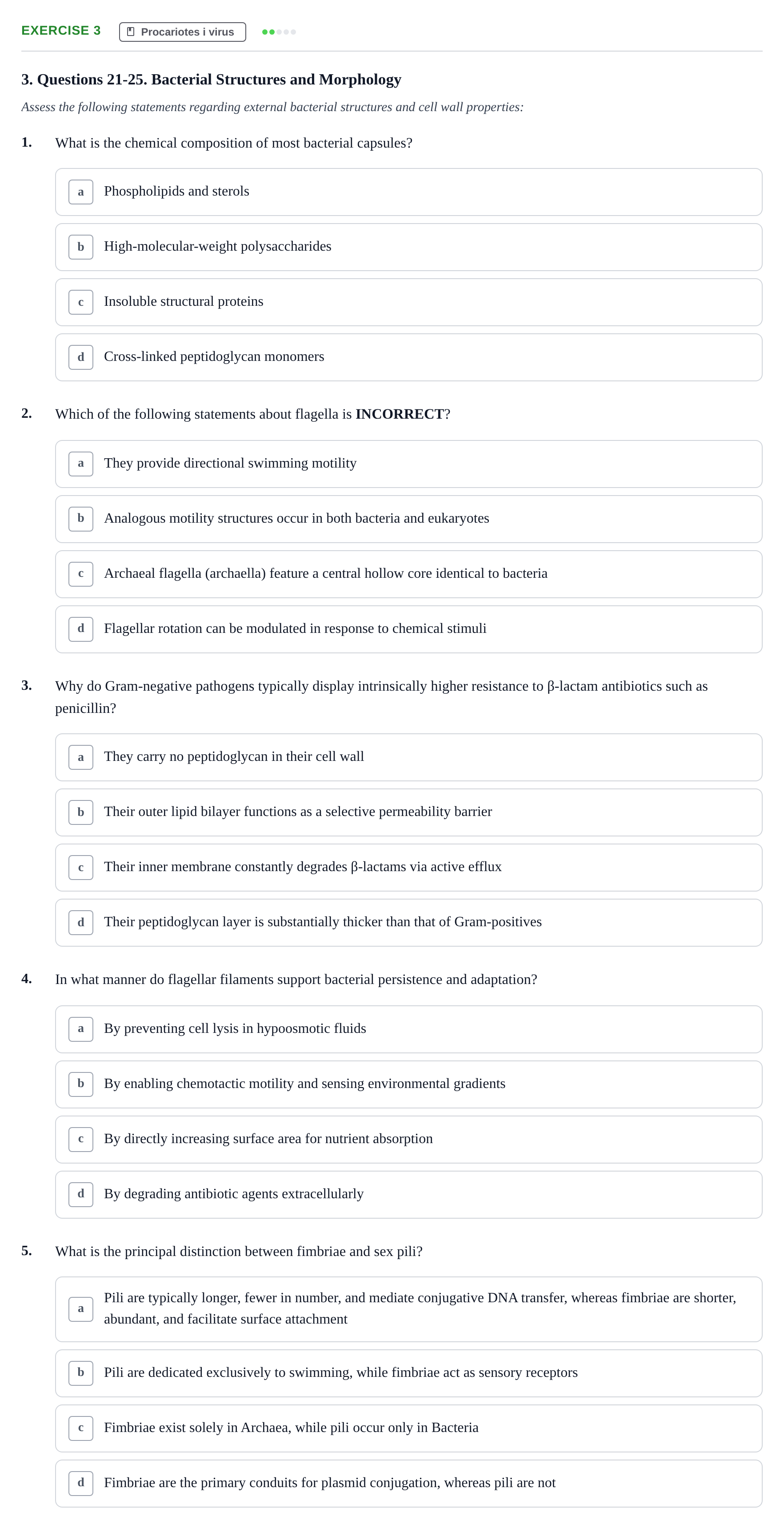
3. Questions 21-25. Bacterial Structures and Morphology
Assess the following statements regarding external bacterial structures and cell wall properties:
1.
What is the chemical composition of most bacterial capsules?
2.
Which of the following statements about flagella is INCORRECT ?
3.
Why do Gram-negative pathogens typically display intrinsically higher resistance to β-lactam antibiotics such as penicillin?
4.
In what manner do flagellar filaments support bacterial persistence and adaptation?
5.
What is the principal distinction between fimbriae and sex pili?
Solución
Según los criterios oficiales de corrección
1. What is the chemical composition of most bacterial capsules?
Solución: b) High-molecular-weight polysaccharides
2. Which of the following statements about flagella is INCORRECT?
Solución: c) Archaeal flagella (archaella) feature a central hollow core identical to bacteria
3. Why do Gram-negative pathogens typically display intrinsically higher resistance to β-lactam antibiotics such as penicillin?
Solución: b) Their outer lipid bilayer functions as a selective permeability barrier
4. In what manner do flagellar filaments support bacterial persistence and adaptation?
Solución: b) By enabling chemotactic motility and sensing environmental gradients
5. What is the principal distinction between fimbriae and sex pili?
Solución: a) Pili are typically longer, fewer in number, and mediate conjugative DNA transfer, whereas fimbriae are shorter, abundant, and facilitate surface attachment
La explicación paso a paso, hecha con IA, es Premium. Premium
Resuélvelo aquí mismo: corrección automática, pistas y solución paso a paso.
‹ Problema 2 · Practice Test: Biology and Genetics of Prokaryotes · Problema 4 · Practice Test: Biology and Genetics of Prokaryotes ›
Más ejercicios de Procariotes i virus
- Ejercicio 4 - Procariotes i virus · Examen: Part 2 - Procariotes, Fongs i Origen de la Vida
- Ejercicio 5 - Procariotes i virus · Examen: Part 2 - Procariotes, Fongs i Origen de la Vida
- Ejercicio 6 - Procariotes i virus · Examen: Part 2 - Procariotes, Fongs i Origen de la Vida
- Problema 1 · Practice Test: Biology and Genetics of Prokaryotes
- Problema 2 · Practice Test: Biology and Genetics of Prokaryotes
- Problema 4 · Practice Test: Biology and Genetics of Prokaryotes
- Problema 5 · Practice Test: Biology and Genetics of Prokaryotes
- Problema 6 · Practice Test: Biology and Genetics of Prokaryotes
- Problema 7 · Practice Test: Biology and Genetics of Prokaryotes
- Problema 8 · Practice Test: Biology and Genetics of Prokaryotes