Sujet 2 - Partie 2 · Bac Anglais, monde contemporain Métropole 2025
Thème : Traduction ou transposition en français (partie 2 de l'écrit) · Tiré du sujet Métropole France (2025)
Énoncé
Document A
Detroit, Then and Now
A hundred and ten years ago, a symphony of machinery whirred as workers assembled the first Model T vehicles, regarded as the first broadly affordable car, at the bustling Ford Piquette Avenue Plant. Today, tourists stroll the aged wooden planks of the former factory floor, snapping photos of antique cars; the place that was once a symbol of American modernization now functions as a museum, and a love letter to Detroit’s past. The Motor City, the eponymous home of Motown Records, has been inextricably linked to the auto-manufacturing industry ever since Henry Ford débuted those cars at his factory.
In the nineteen-forties, Detroit was the fourth-largest city in America, drawing in workers with opportunities for stable employment on the assembly lines at the Ford, General Motors, and Chrysler plants. Starting in the fifties, however, the auto industry spread beyond Detroit: factories closed, and jobs vanished from the city that had been the center of the industry. The effects of that shift are still visible. […] Many facilities, now unused, serve as vandalized monuments to deindustrialization. The city rapidly became the textbook example of urban decay. Although more than 1.8 million people lived in the Motor City at its peak, fewer than seven hundred thousand now call Detroit home. In 2013, the city filed for the largest municipal bankruptcy in U.S. history.
Select areas of Detroit are now in the midst of another radical transformation. In the city’s core, developers have converted crumbling buildings into upscale apartments and have launched a new streetcar system. Coffee shops and trendy restaurants with Instagram-friendly offerings populate formerly abandoned streets. In Brooklyn and Manhattan, billboards 1 have popped up with messages attempting to lure gentrifiers 2 to Detroit. Many note that the revitalization of “America’s Comeback City” has been primarily confined to the downtown and midtown areas; blight and depression still loom in predominantly black neighborhoods outside the city center. Some argue that this focus on developing the city’s core has drawn attention and resources from communities that are still dealing with a housing crisis, a lack of city services, and widespread displacement. Amid the ongoing change, there is cautious optimism, among some, that Detroit’s motto— Speramus meliora; resurget cineribus (We hope for better things; it shall arise from the ashes)—will prove to be prescient.
The New Yorker, June 19, 2018
1 advertising panels
2 attract people who have money
Document B
Rising costs and gentrification force locals out of Detroit’s downtown and Midtown
Detroit is one of the poorest cities in the country, but it has one of the fastest growing rental rates 1 in the country, according to several market research reports. Since 2017, the average rent in Detroit has increased a staggering 46.2%, from 1,215, according to rent.com, which tracks apartment rates. During that period, the average annual income in Detroit has risen a modest 11%, from 34,762, according to census estimates.
Some of the steepest increases in rent occurred during the COVID-19 pandemic, at a time when Black Detroiters were disproportionately hit hard by unemployment.
Rising rental costs are especially worrisome in Detroit because about half of the city’s residents are renters, not owners.
HUD 2 recommends that renters spend no more than 30% of their income on rent. For the average Detroit household, that means spending no more than $869 a month, a rate that is exceedingly difficult to find. […]
Over the past decade, dozens of apartment buildings have been renovated or built downtown and in surrounding neighborhoods, attracting predominantly young, white, suburban professionals who can afford to pay high rents that often exceed $1,800 a month. As a result, these areas are losing their diversity and becoming inaccessible to lower-income and even middle-income Detroiters. […]
“Real estate speculation is driving gentrification,” says Linda Campbell, director of the Detroit People’s Platform, an activist group that promotes a more equitable city. “The disappointment for us is that the city government has failed majority Black Detroit. It feels like our community planning process is being driven by real estate speculation, as opposed to thoughtful, long-term planning for stabilization.” […]
The escalating housing costs are a key factor driving people out of Detroit, housing advocates say.
“We look at the latest trends at what’s happening in Detroit, and we see that Black Detroiters are leaving,” Campbell says. “They are finding that Detroit is no longer a place they want to call home. A model of economic development that is more equitable would lend itself 3 in the long-term to attracting residents back to the city.”
Detroit Metro Times, July 19, 2023
1 prices
2 US Department of Housing and Urban Development
3 contribute
Document C
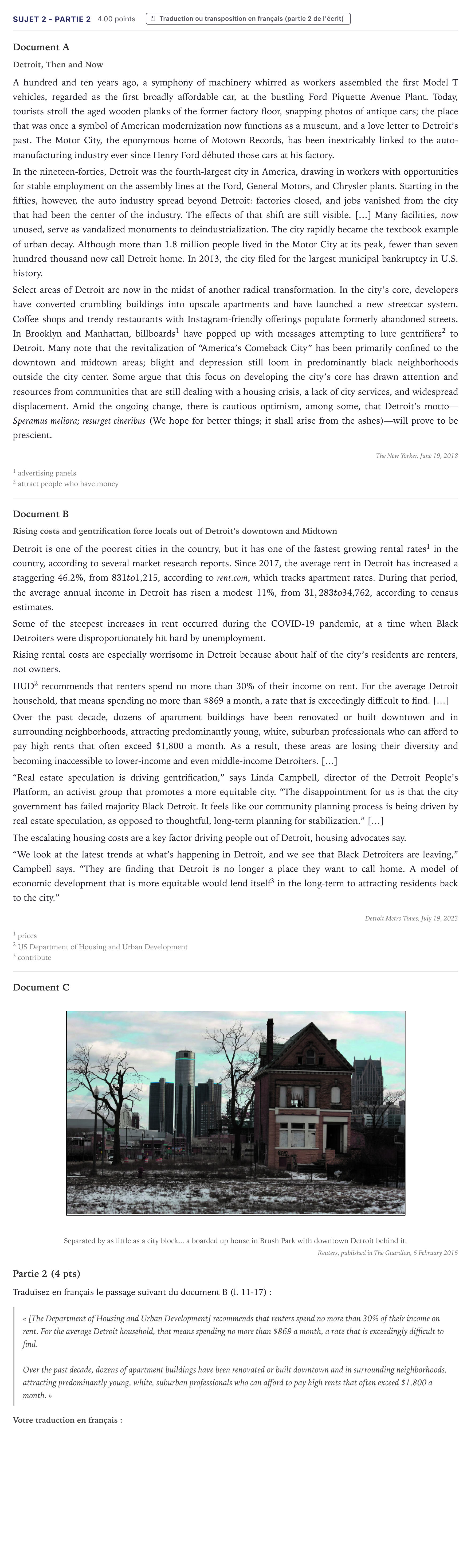
Separated by as little as a city block... a boarded up house in Brush Park with downtown Detroit behind it.
Reuters, published in The Guardian, 5 February 2015
Partie 2 (4 pts)
Traduisez en français le passage suivant du document B (l. 11-17):
« [The Department of Housing and Urban Development] recommends that renters spend no more than 30% of their income on rent. For the average Detroit household, that means spending no more than $869 a month, a rate that is exceedingly difficult to find.
Over the past decade, dozens of apartment buildings have been renovated or built downtown and in surrounding neighborhoods, attracting predominantly young, white, suburban professionals who can afford to pay high rents that often exceed $1,800 a month. »
Corrigé
Corrigé proposé par AprenAI (non officiel)
Traduisez en français le passage suivant du document B (l. 11-17) :
Réponse : [Le département du Logement et du Développement urbain] recommande aux locataires de ne pas consacrer plus de 30 % de leurs revenus au loyer. Pour un ménage moyen de Détroit, cela signifie ne pas dépenser plus de 869 $ par mois, un loyer extrêmement difficile à trouver. Au cours de la dernière décennie, des dizaines d'immeubles résidentiels ont été rénovés ou construits dans le centre-ville et les quartiers environnants, attirant principalement de jeunes cadres blancs des banlieues qui ont les moyens de payer des loyers élevés dépassant souvent 1 800 $ par mois.
L’explication pas à pas, faite avec l’IA, est réservée aux membres Premium. Premium
Résous-le ici : correction automatique, indices et corrigé détaillé.
‹ Sujet 1 - Partie 2 · Métropole 2025 · Sujet 1 - Partie 2 · Métropole remplacement 2025 ›
Plus d’exercices de Traduction ou transposition en français (partie 2 de l'écrit)
- Sujet 1 - Partie 2 · Métropole 2026
- Sujet 2 - Partie 2 · Métropole 2026
- Sujet 1 - Partie 2 · Métropole 2025
- Sujet 1 - Partie 2 · Métropole remplacement 2025
- Sujet 2 - Partie 2 · Métropole remplacement 2025
- Sujet 1 - Partie 2 · Métropole 2024
- Sujet 2 - Partie 2 · Métropole 2024
- Sujet 1 - Partie 2 · Métropole remplacement 2024
- Sujet 2 - Partie 2 · Métropole remplacement 2024
- Sujet 1 - Partie 2 · Métropole 2023