Sujet 1 - Partie 2 · Bac Anglais, monde contemporain Métropole 2024
Thème : Traduction ou transposition en français (partie 2 de l'écrit) · Tiré du sujet Métropole France (2024)
Énoncé
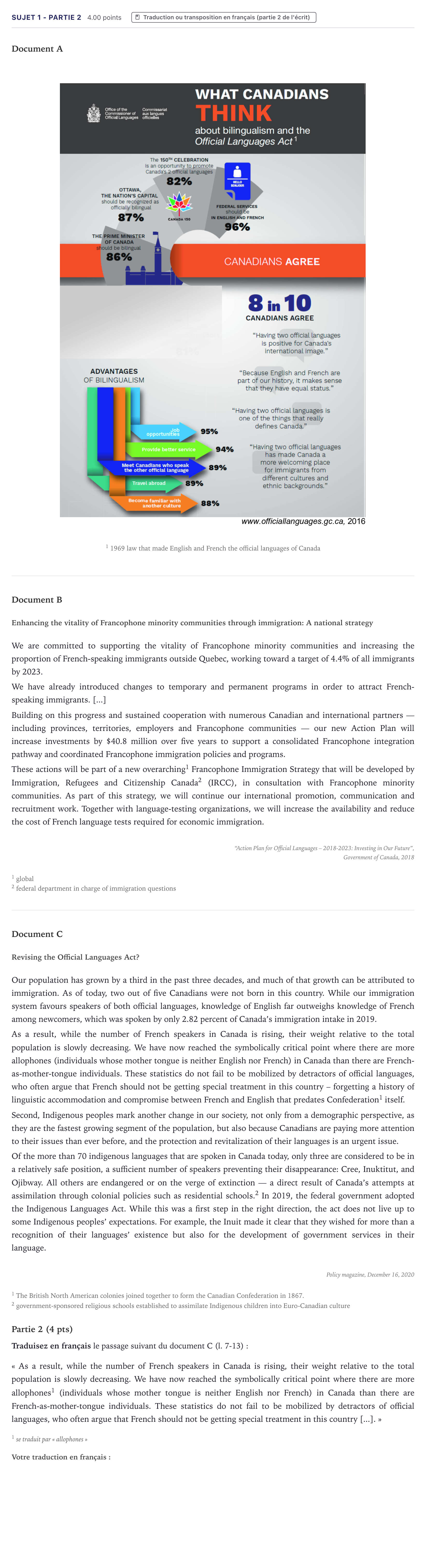
Document A
1 1969 law that made English and French the official languages of Canada
Document B
Enhancing the vitality of Francophone minority communities through immigration: A national strategy
We are committed to supporting the vitality of Francophone minority communities and increasing the proportion of French-speaking immigrants outside Quebec, working toward a target of 4.4% of all immigrants by 2023.
We have already introduced changes to temporary and permanent programs in order to attract French-speaking immigrants. [...]
Building on this progress and sustained cooperation with numerous Canadian and international partners — including provinces, territories, employers and Francophone communities — our new Action Plan will increase investments by $40.8 million over five years to support a consolidated Francophone integration pathway and coordinated Francophone immigration policies and programs.
These actions will be part of a new overarching 1 Francophone Immigration Strategy that will be developed by Immigration, Refugees and Citizenship Canada 2 (IRCC), in consultation with Francophone minority communities. As part of this strategy, we will continue our international promotion, communication and recruitment work. Together with language-testing organizations, we will increase the availability and reduce the cost of French language tests required for economic immigration.
“Action Plan for Official Languages – 2018-2023: Investing in Our Future”,
Government of Canada, 2018
1 global
2 federal department in charge of immigration questions
Document C
Revising the Official Languages Act?
Our population has grown by a third in the past three decades, and much of that growth can be attributed to immigration. As of today, two out of five Canadians were not born in this country. While our immigration system favours speakers of both official languages, knowledge of English far outweighs knowledge of French among newcomers, which was spoken by only 2.82 percent of Canada’s immigration intake in 2019.
As a result, while the number of French speakers in Canada is rising, their weight relative to the total population is slowly decreasing. We have now reached the symbolically critical point where there are more allophones (individuals whose mother tongue is neither English nor French) in Canada than there are French-as-mother-tongue individuals. These statistics do not fail to be mobilized by detractors of official languages, who often argue that French should not be getting special treatment in this country – forgetting a history of linguistic accommodation and compromise between French and English that predates Confederation 1 itself.
Second, Indigenous peoples mark another change in our society, not only from a demographic perspective, as they are the fastest growing segment of the population, but also because Canadians are paying more attention to their issues than ever before, and the protection and revitalization of their languages is an urgent issue.
Of the more than 70 indigenous languages that are spoken in Canada today, only three are considered to be in a relatively safe position, a sufficient number of speakers preventing their disappearance: Cree, Inuktitut, and Ojibway. All others are endangered or on the verge of extinction — a direct result of Canada’s attempts at assimilation through colonial policies such as residential schools. 2 In 2019, the federal government adopted the Indigenous Languages Act. While this was a first step in the right direction, the act does not live up to some Indigenous peoples’ expectations. For example, the Inuit made it clear that they wished for more than a recognition of their languages’ existence but also for the development of government services in their language.
Policy magazine, December 16, 2020
1 The British North American colonies joined together to form the Canadian Confederation in 1867.
2 government-sponsored religious schools established to assimilate Indigenous children into Euro-Canadian culture
Partie 2 (4 pts)
Traduisez en français le passage suivant du document C (l. 7-13):
« As a result, while the number of French speakers in Canada is rising, their weight relative to the total population is slowly decreasing. We have now reached the symbolically critical point where there are more allophones 1 (individuals whose mother tongue is neither English nor French) in Canada than there are French-as-mother-tongue individuals. These statistics do not fail to be mobilized by detractors of official languages, who often argue that French should not be getting special treatment in this country [...]. »
1 se traduit par « allophones »
Corrigé
Corrigé proposé par AprenAI (non officiel)
Traduisez en français le passage suivant du document C (l. 7-13) :
Réponse : En conséquence, alors que le nombre de francophones au Canada augmente, leur poids par rapport à la population totale diminue lentement. Nous avons désormais atteint le seuil symboliquement critique où il y a plus d'allophones (personnes dont la langue maternelle n'est ni l'anglais ni le français) au Canada que d'individus de langue maternelle française. Ces statistiques ne manquent pas d'être mobilisées par les détracteurs des langues officielles, qui soutiennent souvent que le français ne devrait pas bénéficier d'un traitement de faveur dans ce pays [...].
L’explication pas à pas, faite avec l’IA, est réservée aux membres Premium. Premium
Résous-le ici : correction automatique, indices et corrigé détaillé.
‹ Sujet 2 - Partie 2 · Métropole remplacement 2025 · Sujet 2 - Partie 2 · Métropole 2024 ›
Plus d’exercices de Traduction ou transposition en français (partie 2 de l'écrit)
- Sujet 2 - Partie 2 · Métropole 2026
- Sujet 1 - Partie 2 · Métropole 2025
- Sujet 2 - Partie 2 · Métropole 2025
- Sujet 1 - Partie 2 · Métropole remplacement 2025
- Sujet 2 - Partie 2 · Métropole remplacement 2025
- Sujet 2 - Partie 2 · Métropole 2024
- Sujet 1 - Partie 2 · Métropole remplacement 2024
- Sujet 2 - Partie 2 · Métropole remplacement 2024
- Sujet 1 - Partie 2 · Métropole 2023
- Sujet 2 - Partie 2 · Métropole 2023