Sujet 2 - Partie 2 · Bac Anglais, monde contemporain Métropole remplacement 2021
Thème : Traduction ou transposition en français (partie 2 de l'écrit) · Tiré du sujet Métropole France remplacement (2021)
Énoncé
Document A
Inside Queen Sono, Netflix's First African Original Series
When we think of the spy genre, the icons that come to mind first are often the white,
male masters of espionage, the James Bonds and Jason Bournes. But the new Netflix
series Queen Sono, out Feb. 28, offers its own take on the genre in the platform's first
fully produced African original series.
5 Assuming various aliases, lead character Queen (Pearl Thusi, best known for her roles
in U.S. television series Quantico and the Netflix film Catching Feelings) is a spy
searching for the truth behind her mother's assassination while undertaking a
dangerous assignment requiring her to traverse the African continent. In developing
the narrative, creator Kagiso Lediga sought to blend the history of South Africa with its
10 present-day politics, all set against the backdrop of a femicide crisis and increasing
violence against women. “I thought, how cool would it be to have a woman that
embodies something different, the idea that women can fight back,” he tells TIME.
The series was shot in 37 different locations with an all-African cast and crew, following
Queen on missions in Kenya's hub of Nairobi to an elite bar in Zimbabwe's capital,
15 Harare, as well as her base in Johannesburg. A variety of languages are interspersed
with English throughout the six episodes, including Afrikaans, isiXhosa and Swahili.
Lediga wanted to counter the way in which perceptions of Africa tend to get flattened
by those unfamiliar with its multifaceted reality, and to offer an alternative to
perceptions that focus on the hardships faced by people on the continent. “It's not just
20 about flies on babies suffering from malnutrition,” he says. “There's a vastness of
cultures. It's the second biggest continent, with some 1.3 billion people, and I'm hoping
people will get to appreciate that.” [...]
The legacy of apartheid is also depicted through the disparities in South Africa's living
standards; the country has one of the highest inequality rates in the world owing to the
25 legacy of apartheid. [...] “It's important to show the contemporariness of the African
narrative,” Lediga says. “Telling a story like this makes it urgent, makes it present.”
www.time.com, 3 March 2020
Document B
I'm a storyteller. And I would like to tell you a few personal stories about what I like to
call “the danger of the single story.” I grew up on a university campus in eastern
Nigeria. My mother says that I started reading at the age of two, although I think four
is probably close to the truth. So I was an early reader, and what I read were British
5 and American children's books.
I was also an early writer, and when I began to write, at about the age of seven, stories
in pencil with crayon illustrations that my poor mother was obligated to read, I wrote
exactly the kinds of stories I was reading: All my characters were white and blue-eyed,
they played in the snow, they ate apples, and they talked a lot about the weather, how
10 lovely it was that the sun had come out. (Laughter) Now, this despite the fact that I
lived in Nigeria. I had never been outside Nigeria. We didn't have snow, we ate
mangoes, and we never talked about the weather, because there was no need to.
My characters also drank a lot of ginger beer, because the characters in the British
books I read drank ginger beer. Never mind that I had no idea what ginger beer was.
15 (Laughter) And for many years afterwards, I would have a desperate desire to taste
ginger beer. But that is another story.
What this demonstrates, I think, is how impressionable and vulnerable we are in the
face of a story, particularly as children. Because all I had read were books in which
characters were foreign, I had become convinced that books by their very nature had
20 to have foreigners in them and had to be about things with which I could not personally
identify. Now, things changed when I discovered African books. There weren't many
of them available, and they weren't quite as easy to find as the foreign books.
But because of writers like Chinua Achebe 1 and Camara Laye 2, I went through a mental
shift in my perception of literature. I realized that people like me, girls with skin the color
25 of chocolate, whose kinky hair could not form ponytails, could also exist in literature. I
started to write about things I recognized.
Now, I loved those American and British books I read. They stirred my imagination.
They opened up new worlds for me. But the unintended consequence was that I did
not know that people like me could exist in literature. So what the discovery of African
30 writers did for me was this: It saved me from having a single story of what books are.
Chimamanda NGOZI ADICHIE, extract from a speech at TEDGlobal, 2009
1 a Nigerian author
2 a Guinean author
Document C
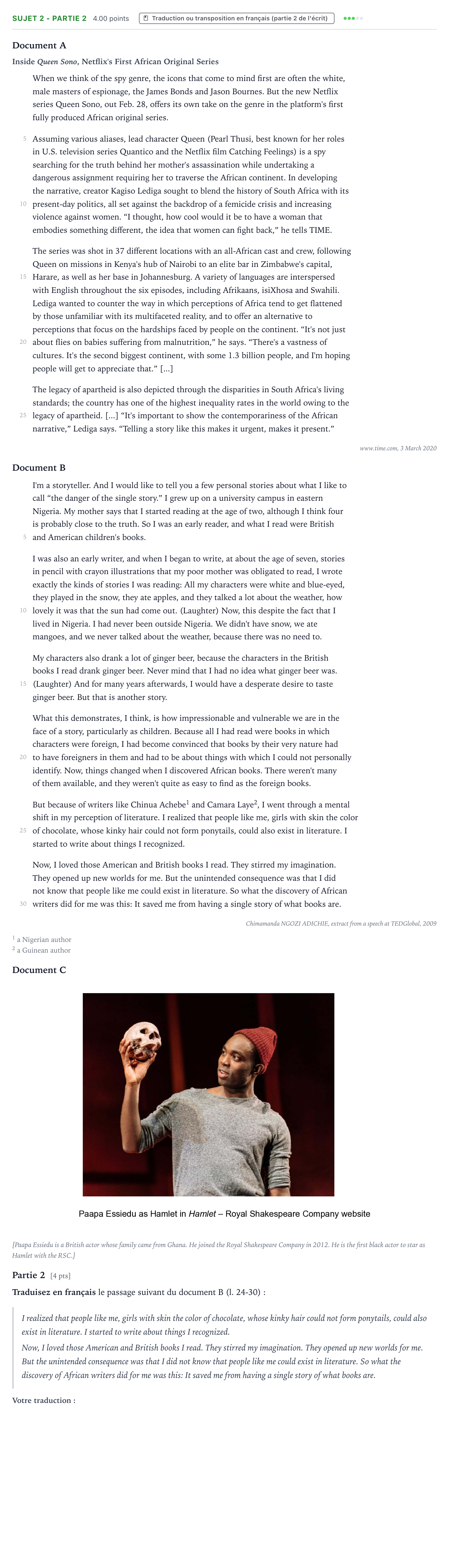
[Paapa Essiedu is a British actor whose family came from Ghana. He joined the Royal Shakespeare Company in 2012. He is the first black actor to star as Hamlet with the RSC.]
Partie 2 [4 pts]
Traduisez en français le passage suivant du document B (l. 24-30):
I realized that people like me, girls with skin the color of chocolate, whose kinky hair could not form ponytails, could also exist in literature. I started to write about things I recognized.
Now, I loved those American and British books I read. They stirred my imagination. They opened up new worlds for me. But the unintended consequence was that I did not know that people like me could exist in literature. So what the discovery of African writers did for me was this: It saved me from having a single story of what books are.
Corrigé
Corrigé proposé par AprenAI (non officiel)
Traduisez en français le passage suivant du document B (l. 24-30) :
Réponse : Je me suis rendu compte que des gens comme moi, des filles à la peau couleur de chocolat, dont les cheveux crépus ne pouvaient pas former de queue-de-cheval, pouvaient aussi exister dans la littérature. J'ai commencé à écrire sur des choses que je reconnaissais. Certes / Or, j'aimais ces livres américains et britanniques que je lisais. Ils stimulaient mon imagination. Ils m'ouvraient de nouveaux mondes. Mais la conséquence involontaire était que j'ignorais que des gens comme moi pouvaient exister dans la littérature. Ainsi, ce que la découverte des écrivains africains m'a apporté / a fait pour moi, c'est ceci : cela m'a évitée de n'avoir qu'une vision unique / une histoire unique de ce que sont les livres.
L’explication pas à pas, faite avec l’IA, est réservée aux membres Premium. Premium
Résous-le ici : correction automatique, indices et corrigé détaillé.
‹ Sujet 1 - Partie 2 · Métropole remplacement 2021