Sujet 1 - 1re partie · Bac Anglais Métropole 2026
Thème : Synthèse du dossier — Voyages, territoires, frontières · Tiré du sujet Métropole France (2026)
Énoncé
Document A
Lieutenant Dunbar travels to the American Frontier to reorganize a deserted military camp.
May 17, 1863
I've written nothing in this record for many days. So much has happened that I hardly know where to begin.
The Indians have come to visit on three occasions thus far and I have no doubt there will be more. Always the same two with their escort of six or seven other warriors. (I am amazed that all these people are warriors. Have not seen a man yet who is not a fighter.)
Our meetings have been highly amicable, though greatly hampered by the language barrier. Whatever I have learned to date is so little compared to what I could know. I still don't know what type of Indians they are but suspect them to be Comanche. I believe I have heard a word that sounds like Comanche more than once. [...]
We converse in made-up signs, a sort of pantomime which both Indians are starting to get the hang of. But it is very slow going, and most of our common ground has been established on the basis of failure rather than success in communication.
The fierce one dumps extraordinary amounts of sugar into his coffee. It won't be long before that ration is exhausted. Luckily, I do not take sugar. Ha! The fierce one (as I call him) is likable despite his taciturn manner, rather like a king of street toughs who, by virtue of his physical prowess, commands respect. Having spent some time on the streets myself, I respect him in this way.
Beyond that, there is a crude honesty and intent which I like.
He is a direct fellow.
I call the other man the quiet one and like him immensely. Unlike the fierce one, he is patient and inquisitive.
I think he is as frustrated as I with the language difficulties. He has taught me a few words of their speech, and I have done the same for him. I know the Comanche words for head, hand, horse, fire, coffee, house, and several others, as well as hello and good-bye. I don't know enough yet to make a sentence. It takes a long time to get the sounds right. I have no doubt it is hard for him as well.
The quiet one calls me Loo Ten Nant 1 and for some reason does not use Dunbar. I am sure he doesn't forget to use it (I have reminded him several times), so there must be another reason. It certainly has a distinctive ring... Loo Ten Nant.
He strikes me as being possessed of a first-rate intelligence. He listens with care and seems to notice everything. [...] Without language I am reduced to reading his reactions with my senses, but by all appearances he is favorably inclined toward me.
Michael BLAKE, Dances with Wolves, 1986
1 Loo Ten Nant: phonetics for "lieutenant"
Document B
Jim Burden, the young narrator, arrives in Nebraska, USA, for the first time and meets Ántonia Shimerda, her parents, her younger sister Yulka, and Krajiek, their neighbor.
As we approached the Shimerdas' dwelling, I could still see nothing but rough red hillocks, and draws 1 with shelving banks and long roots hanging out where the earth had crumbled away. Presently, against one of those banks, I saw a sort of shed [...]. The door stood open, and a woman and a girl of fourteen ran out and looked up at us hopefully. A little girl trailed along behind her. The woman had on her head the same embroidered shawl with silk fringes that she wore when she had alighted from the train at Black Hawk. She was not old, but she was certainly not young. Her face was alert and lively, with a sharp chin and shrewd little eyes. She shook grandmother's hand energetically. "Very glad, very glad!" she ejaculated. Immediately she pointed to the bank out of which she had emerged and said, "House no good, house no good!"
Grandmother nodded consolingly. "You'll get fixed up comfortable after while, Mrs. Shimerda; make good house."
My grandmother always spoke in a very loud tone to foreigners, as if they were deaf. She made Mrs. Shimerda understand the friendly intention of our visit, and the Bohemian 2 woman handled the loaves of bread and even smelled them, and examined the pies with lively curiosity, exclaiming, "Much good, much thank!"—and again she wrung grandmother's hand. [...]
While Krajiek was translating for Mr. Shimerda, Ántonia came up to me and held out her hand coaxingly. In a moment we were running up the steep draw-side together, Yulka trotting after us.
When we reached the level and could see the gold tree-tops, I pointed toward them, and Ántonia laughed and squeezed my hand as if to tell me how glad she was I had come. We raced off toward Squaw Creek and did not stop until the ground itself stopped—fell away before us so abruptly that the next step would have been out into the tree-tops. We stood panting on the edge of the ravine, looking down at the trees and bushes that grew below us. The wind was so strong that I had to hold my hat on, and the girls' skirts were blown out before them. Ántonia seemed to like it; she held her little sister by the hand and chattered away in that language which seemed to me spoken so much more rapidly than mine. She looked at me, her eyes fairly blazing with things she could not say.
"Name? What name?" she asked, touching me on the shoulder. I told her my name, and she repeated it after me [...].
Willa CATHER, My Ántonia, 1918
1 draws: small narrow valleys
2 Bohemian: from Bohemia, one of the largest historical regions of the Czech Republic
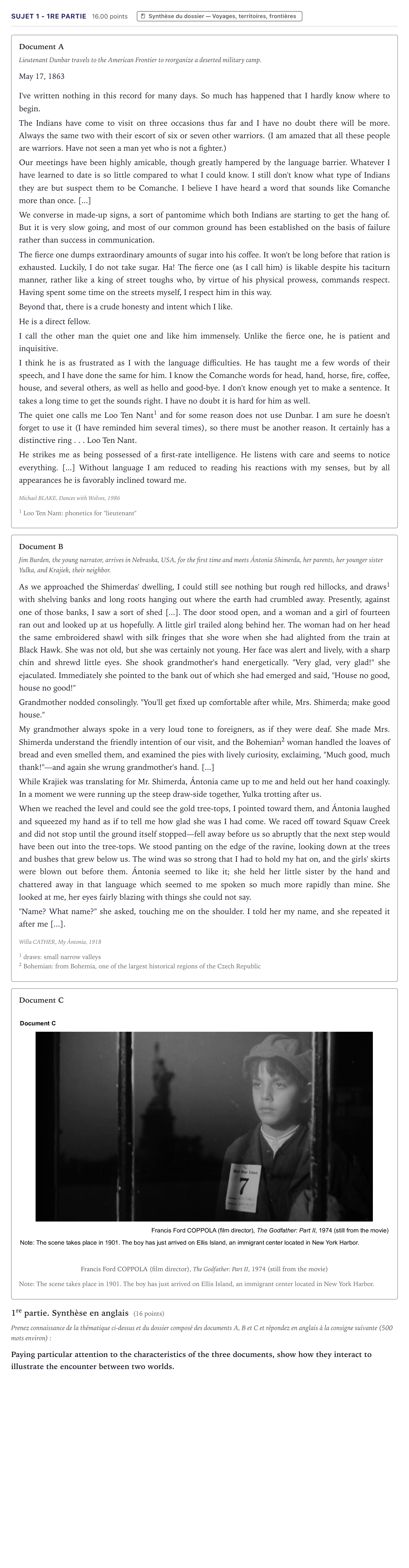
Document C
Francis Ford COPPOLA (film director), The Godfather: Part II, 1974 (still from the movie)
Note: The scene takes place in 1901. The boy has just arrived on Ellis Island, an immigrant center located in New York Harbor.
1 re partie. Synthèse en anglais (16 points)
Prenez connaissance de la thématique ci-dessus et du dossier composé des documents A, B et C et répondez en anglais à la consigne suivante (500 mots environ):
Paying particular attention to the characteristics of the three documents, show how they interact to illustrate the encounter between two worlds.
Corrigé
Corrigé proposé par AprenAI (non officiel)
Paying particular attention to the characteristics of the three documents, show how they interact to illustrate the encounter between two worlds.
Réponse : Sample Synthesis (~500 words): The encounter between disparate cultures lies at the heart of the American mythos. Within the theme "Voyages, territories, borders", this dossier brings together three perspectives on cultural encounters in American history: an excerpt from Michael Blake's novel *Dances with Wolves* (1986), set on the Western Frontier in 1863; a passage from Willa Cather's *My Ántonia* (1918), set on the Nebraska prairie; and a still from Francis Ford Coppola's film *The Godfather: Part II* (1974), showing a boy on Ellis Island in 1901. Although they differ in genre, medium and setting, the three documents explore how crossing physical, linguistic and social borders shapes the discovery of the "other". First, all three documents stress the barriers separating two realities. In Document C, the border is institutional and spatial: a young immigrant, standing behind a window frame, gazes at the blurred Statue of Liberty. The numbered tag pinned to his coat ("Red Star Lines 7") reduces him to an anonymous figure and marks the threshold between the Old World and the American promise. In the literary texts, isolation is equally present. In Document A, Lieutenant Dunbar, alone in a deserted military camp, meets warriors whose tribe he can only guess ("suspect them to be Comanche"). In Document B, the Bohemian Shimerda family lives in a rough shelter dug into a bank, a poor dwelling that the mother herself calls "no good". Language is the main divide: Dunbar relies on "made-up signs" and "pantomime", where failure prevails over success, while Mrs. Shimerda uses broken English ("Much good, much thank!") and Jim's grandmother speaks loudly "as if they were deaf". Nevertheless, the documents show how individuals bridge these gaps through curiosity, respect and non-verbal communication. In *Dances with Wolves*, the meetings are "highly amicable": Dunbar appreciates the "crude honesty" of the fierce one and admires the intelligence of the quiet one, with whom he exchanges words of their languages; the nickname "Loo Ten Nant" shows that each side reshapes the other's world. Similarly, in *My Ántonia*, the grandmother's gift of bread creates a bond, and the children, Jim and Ántonia, overcome the language barrier through laughter, gestures and touch; Ántonia's question "Name? What name?" marks the first step of a mutual discovery. Both texts, written in the first person, invite the reader to share the narrator's subjective and benevolent gaze on the newcomer or the native. However, while Blake and Cather depict reciprocal, hopeful encounters, Coppola's image strikes a more melancholic tone. The black-and-white composition, the dark frame and the distant, blurred statue emphasize the boy's solitude and silence: the encounter with America is not yet an exchange but an anxious contemplation of an idealized future, still out of reach. In conclusion, these documents complement each other by portraying the frontier not merely as a line on a map, but as a human experience combining estrangement, misunderstanding and hope. Whether it is a soldier meeting Native Americans, a pioneer child befriending an immigrant girl, or a lonely boy facing the symbol of the New World, the encounter between two worlds always oscillates between distance and the possibility of mutual enrichment, and it remains central to the construction of American identity.
L’explication pas à pas, faite avec l’IA, est réservée aux membres Premium. Premium
Résous-le ici : correction automatique, indices et corrigé détaillé.
Sujet 2 - Partie 1 · Métropole 2025 ›