Sujet 2 - 1re partie : Synthèse · Bac Anglais Métropole 2022
Thème : Synthèse du dossier — Voyages, territoires, frontières · Tiré du sujet Métropole France (2022)
Énoncé
1re partie. Synthèse en anglais (16 points)
Document A
US road trips: into the heart of America with Andrew McCARTHY.
There's nothing wrong that a hundred bucks and a full tank of gas can't fix. It's an idea at the core of the American psyche. From the first "road trips" of the pioneers lighting out for the west, to the California gold rush, to the dust bowl refugees of the Great Depression 1 chasing the sun across the continent, sustaining themselves on movement, banking on hope, America has counted on the rewards of the road.
Move forward and don't look back, your past won't follow you out here, the highway promises. The American road trip is a rite of passage; it's a lark 2, a last gasp. It is the essence of optimism in action. While we Americans claim no monopoly on the open road, the idea that renewal waits just around the bend, over the rise, or beyond that distant horizon, is deeply embedded in who we are as a people. Someone once said that to understand America, you need to understand baseball. I would argue that to truly understand America a road trip is in order. And the more miles you put between yourself and what you've left behind, the better.
The extended journey by car is a different kind of travel. You call all the shots. You decide when and where, left or right, turn back or forge ahead. The highway beckons 3, but it also challenges. [...]
That gesture of defiance hints at the secret that rests at the heart of the road trip – arrival is never the true goal. Maybe that's why, after the initial relief, disappointment is often the accompanying feeling upon reaching one's goal. [...] What exactly are we looking for with the wheel in our hand?
While still on the road, when still in motion, hope is allowed space and time to play out on its own field of dreams – and hope is something no reality can ever match. Since America is still an idea more than anything else, that hope is indispensable to our national psyche. It's no wonder that the facts of who we are and what we ultimately do, comes often as a shock and disappointment, even to ourselves.
But no matter. The road is there, calling...
Andrew McCARTHY, www.theguardian.com, April 2013
1 the Great Depression: a severe worldwide economic crisis that started in 1929 in the USA.
2 a lark: an adventure
3 beckons: attracts
Document B
I was in another big high cab, all set to go hundreds of miles across the night, and was I happy! And the new truckdriver was as crazy as the other and yelled just as much, and all I had to do was lean back and roll on. Now I could see Denver looming ahead of me like the Promised Land, way out there beneath the stars, across the prairie of Iowa and the plains of Nebraska, and I could see the greater vision of San Francisco beyond, like jewels in the night. [...] He told stories for a couple of hours, then, at a town in Iowa [...], he slept a few hours in the seat. I slept too, and took one little walk along the lonely brick walls illuminated by one lamp, with the prairie brooding at the end of each little street and the smell of the corn like dew in the night.
He woke up with a start at dawn. Off we roared, and an hour later the smoke of Des Moines 1 appeared ahead over the green cornfields. [...] Now I wanted to sleep a whole day. [...] By instinct I wandered down to the railroad tracks - and there're a lot of them in Des Moines - and wound up in a gloomy old Plains inn of a hotel by the locomotive roundhouse, and spent a long day sleeping on a big clean hard white bed with dirty remarks carved in the wall beside my pillow and the beat yellow windowshades pulled over the smoky scene of the rail-yards. I woke up as the sun was reddening; and that was the one distinct time in my life, the strangest moment of all, when I didn't know who I was - I was far away from home, haunted and tired with travel, in a cheap hotel room I'd never seen, hearing the hiss of steam outside, and the creak of the old wood of the hotel, and footsteps upstairs, and all the sad sounds, and I looked at the cracked high ceiling and really didn't know who I was for about fifteen strange seconds. I wasn't scared; I was just somebody else, some stranger, and my whole life was a haunted life, the life of a ghost. I was halfway across America, at the dividing line between the East of my youth and the West of my future, and maybe that's why it happened right there and then, that strange red afternoon.
Jack KEROUAC, On The Road, 1957
1 Des Moines is the capital city of the state of Iowa (USA).
Document C
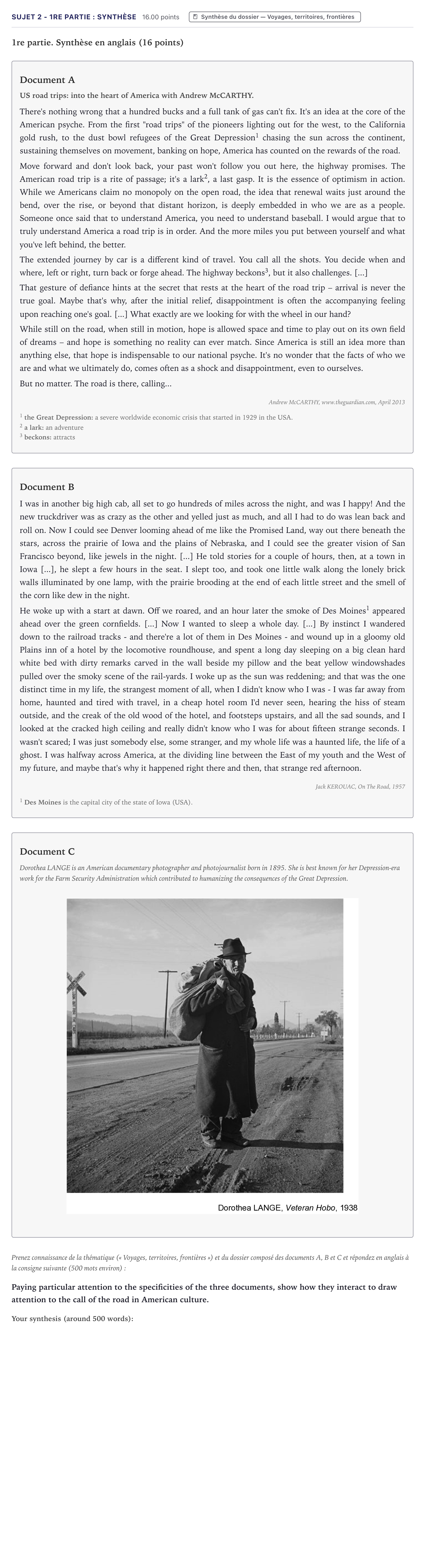
Dorothea LANGE is an American documentary photographer and photojournalist born in 1895. She is best known for her Depression-era work for the Farm Security Administration which contributed to humanizing the consequences of the Great Depression.
Prenez connaissance de la thématique (« Voyages, territoires, frontières ») et du dossier composé des documents A, B et C et répondez en anglais à la consigne suivante (500 mots environ):
Paying particular attention to the specificities of the three documents, show how they interact to draw attention to the call of the road in American culture.
Corrigé
Corrigé proposé par AprenAI (non officiel)
Paying particular attention to the specificities of the three documents, show how they interact to draw attention to the call of the road in American culture.
Réponse : The open road holds a mythical status in the American collective unconscious. Stemming from the historical push toward the western frontier, the call of the road embodies individual freedom, reinvention, and spiritual yearning. The three documents in this dossier offer complementary perspectives on this cultural pillar: Andrew McCarthy’s 2013 Guardian travel essay (Doc A) meditates philosophically on the psychology behind road trips; Jack Kerouac’s classic 1957 Beat novel *On the Road* (Doc B) dramatizes the ecstatic yet disorienting wanderlust of post-war youth; and Dorothea Lange’s 1938 documentary photograph *Veteran Hobo* (Doc C) grounds this migratory impulse in historical and economic hardship. First, all three documents depict the road as an irresistible impulse driven by hope and the promise of renewal. In Document A, McCarthy frames the highway as a foundational "rite of passage" deeply rooted in the American psyche since the westward pioneer trails and the California Gold Rush. It represents optimism in motion, promising that "renewal waits just around the bend." This sense of boundless forward momentum is reflected in Kerouac’s narrative (Doc B), where the narrator feels ecstatic hitchhiking across the vast plains, gazing toward Denver and San Francisco as a modern-day "Promised Land." Even Document C, taken during the Great Depression, captures this forward stride: a lone traveler walking along a highway past a railroad crossing sign, embodying the relentless momentum of those compelled to chase a better future. However, the documents also deconstruct the romanticized myth by revealing the estrangement and solitude inherent in wanderlust. Kerouac's protagonist experiences a sudden existential crisis in an unfamiliar Des Moines hotel: waking up on the "dividing line" between his past and future, he fails to recognize himself, feeling like a displaced "ghost." This echoes McCarthy’s reflection that arrival often brings disappointment, because the reality of achieving a destination can never match the transcendent "field of dreams" sustained during movement itself. Similarly, Lange's photograph strips away glamorous escapism. The "veteran hobo," bearing his worldly possessions in a sack over his shoulder, faces the camera with weathered eyes and a weary expression, reminding the viewer that for many Americans, taking to the road was an act of survival rather than leisure. Ultimately, these works show that the "call of the road" operates on multiple levels in American culture: as a philosophical quest for self-determination (Doc A), a countercultural search for identity (Doc B), and an enduring consequence of economic displacement (Doc C). Together, they illustrate that while the highway perpetually beckons Americans toward self-reinvention, the journey inevitably confronts travelers with their own vulnerability and the elusive nature of the American Dream.
L’explication pas à pas, faite avec l’IA, est réservée aux membres Premium. Premium
Résous-le ici : correction automatique, indices et corrigé détaillé.
‹ Sujet 2 - Partie 1 · Métropole remplacement 2024 · Sujet 1 - Partie 1 · Métropole Candidat libre 2021 (sujet 2) ›