Sujet 1 - Partie 1 · Bac Anglais Métropole Candidat libre 2021 (sujet 2)
Thème : Synthèse du dossier — Voyages, territoires, frontières · Tiré du sujet Métropole Candidat libre 2 (2021)
Énoncé
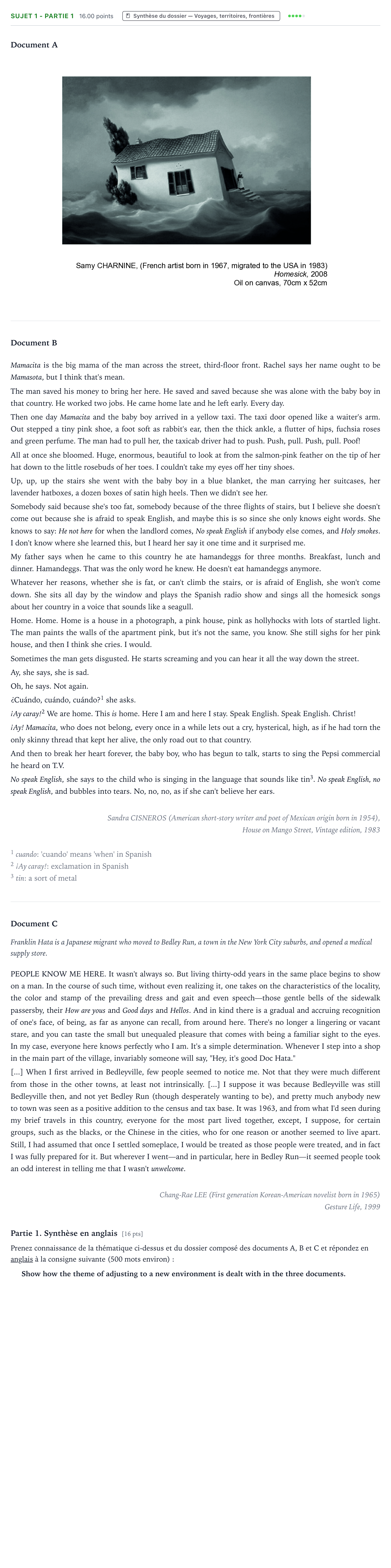
Document A
Document B
Mamacita is the big mama of the man across the street, third-floor front. Rachel says her name ought to be Mamasota, but I think that's mean.
The man saved his money to bring her here. He saved and saved because she was alone with the baby boy in that country. He worked two jobs. He came home late and he left early. Every day.
Then one day Mamacita and the baby boy arrived in a yellow taxi. The taxi door opened like a waiter's arm. Out stepped a tiny pink shoe, a foot soft as rabbit's ear, then the thick ankle, a flutter of hips, fuchsia roses and green perfume. The man had to pull her, the taxicab driver had to push. Push, pull. Push, pull. Poof!
All at once she bloomed. Huge, enormous, beautiful to look at from the salmon-pink feather on the tip of her hat down to the little rosebuds of her toes. I couldn't take my eyes off her tiny shoes.
Up, up, up the stairs she went with the baby boy in a blue blanket, the man carrying her suitcases, her lavender hatboxes, a dozen boxes of satin high heels. Then we didn't see her.
Somebody said because she's too fat, somebody because of the three flights of stairs, but I believe she doesn't come out because she is afraid to speak English, and maybe this is so since she only knows eight words. She knows to say: He not here for when the landlord comes, No speak English if anybody else comes, and Holy smokes. I don't know where she learned this, but I heard her say it one time and it surprised me.
My father says when he came to this country he ate hamandeggs for three months. Breakfast, lunch and dinner. Hamandeggs. That was the only word he knew. He doesn't eat hamandeggs anymore.
Whatever her reasons, whether she is fat, or can't climb the stairs, or is afraid of English, she won't come down. She sits all day by the window and plays the Spanish radio show and sings all the homesick songs about her country in a voice that sounds like a seagull.
Home. Home. Home is a house in a photograph, a pink house, pink as hollyhocks with lots of startled light. The man paints the walls of the apartment pink, but it's not the same, you know. She still sighs for her pink house, and then I think she cries. I would.
Sometimes the man gets disgusted. He starts screaming and you can hear it all the way down the street.
Ay, she says, she is sad.
Oh, he says. Not again.
¿Cuándo, cuándo, cuándo? 1 she asks.
¡Ay caray! 2 We are home. This is home. Here I am and here I stay. Speak English. Speak English. Christ!
¡Ay! Mamacita, who does not belong, every once in a while lets out a cry, hysterical, high, as if he had torn the only skinny thread that kept her alive, the only road out to that country.
And then to break her heart forever, the baby boy, who has begun to talk, starts to sing the Pepsi commercial he heard on T.V.
No speak English, she says to the child who is singing in the language that sounds like tin 3. No speak English, no speak English, and bubbles into tears. No, no, no, as if she can't believe her ears.
Sandra CISNEROS (American short-story writer and poet of Mexican origin born in 1954),
House on Mango Street, Vintage edition, 1983
1 cuando: 'cuando' means 'when' in Spanish
2 ¡Ay caray!: exclamation in Spanish
3 tin: a sort of metal
Document C
Franklin Hata is a Japanese migrant who moved to Bedley Run, a town in the New York City suburbs, and opened a medical supply store.
PEOPLE KNOW ME HERE. It wasn't always so. But living thirty-odd years in the same place begins to show on a man. In the course of such time, without even realizing it, one takes on the characteristics of the locality, the color and stamp of the prevailing dress and gait and even speech—those gentle bells of the sidewalk passersby, their How are yous and Good days and Hellos. And in kind there is a gradual and accruing recognition of one's face, of being, as far as anyone can recall, from around here. There's no longer a lingering or vacant stare, and you can taste the small but unequaled pleasure that comes with being a familiar sight to the eyes. In my case, everyone here knows perfectly who I am. It's a simple determination. Whenever I step into a shop in the main part of the village, invariably someone will say, "Hey, it's good Doc Hata."
[...] When I first arrived in Bedleyville, few people seemed to notice me. Not that they were much different from those in the other towns, at least not intrinsically. [...] I suppose it was because Bedleyville was still Bedleyville then, and not yet Bedley Run (though desperately wanting to be), and pretty much anybody new to town was seen as a positive addition to the census and tax base. It was 1963, and from what I'd seen during my brief travels in this country, everyone for the most part lived together, except, I suppose, for certain groups, such as the blacks, or the Chinese in the cities, who for one reason or another seemed to live apart. Still, I had assumed that once I settled someplace, I would be treated as those people were treated, and in fact I was fully prepared for it. But wherever I went—and in particular, here in Bedley Run—it seemed people took an odd interest in telling me that I wasn't unwelcome.
Chang-Rae LEE (First generation Korean-American novelist born in 1965)
Gesture Life, 1999
Partie 1. Synthèse en anglais [16 pts]
Prenez connaissance de la thématique ci-dessus et du dossier composé des documents A, B et C et répondez en anglais à la consigne suivante (500 mots environ):
Show how the theme of adjusting to a new environment is dealt with in the three documents.
Corrigé
Corrigé proposé par AprenAI (non officiel)
Show how the theme of adjusting to a new environment is dealt with in the three documents.
Réponse : Sample Synthesis: Moving to a new country is far more than a physical relocation: it challenges one's identity, language and sense of home. Within the theme "Voyages, territoires, frontières", the dossier gathers three works on adjusting to a new environment. Document A is Samy Charnine's painting *Homesick* (2008). Document B is an extract from Sandra Cisneros's *The House on Mango Street* (1983), and Document C an extract from Chang-Rae Lee's *A Gesture Life* (1999). All three deal with migrants in the United States, but they range from painful failure to adapt to apparently successful integration. First, migration is shown as uprooting and dislocation. In Document A, a house tilted and adrift in a stormy sea has lost its foundations. A small female figure stands at its door, facing dark waves and a threatening sky. The home, normally a symbol of stability, becomes fragile and isolated, and the title *Homesick* stresses the emotional cost of exile. Charnine himself left France for the USA. Likewise, in Document B, Mamacita has crossed a border physically but not emotionally. She stays shut up on the third floor and 'won't come down'. She sits by the window singing 'homesick songs', longing for the pink house of her photograph. Her husband paints the apartment pink, but 'it's not the same'. Like the painted house, she is cut off from her surroundings: 'Mamacita, who does not belong'. Secondly, language appears as the main barrier to adjustment. Mamacita 'only knows eight words' and is 'afraid to speak English'. Her husband instead insists 'Speak English. This is home.' and makes the new language a condition of belonging. The narrator mentions that her own father survived on 'hamandeggs', which suggests that every newcomer goes through this stage. Yet some overcome it: 'He doesn't eat hamandeggs anymore.' For Mamacita, the cruellest moment comes when her baby sings a Pepsi commercial in English, 'the language that sounds like tin'. Adaptation then becomes a threat: the next generation adopts the host culture and breaks the 'skinny thread' linking her to her country. Document C, by contrast, presents adaptation as a slow, successful process. After 'thirty-odd years', Franklin Hata has unconsciously absorbed the local dress, gait and speech. He is now greeted as 'good Doc Hata'. Recognition replaces the 'vacant stare', and being familiar brings him 'unequaled pleasure'. Yet the narrator remains ambiguous. In 1963 he expected to be treated like other minorities, such as Black people or the Chinese, who 'lived apart'. Instead, people insisted that he 'wasn't unwelcome'. This double negative hints that his acceptance was conditional, shaped by the town's social ambitions and by its interest in a new taxpayer. The insistence itself also reveals that he was still perceived as different. In conclusion, the three documents show that adjusting to a new environment is a difficult and uncertain process. The painting and Cisneros's text convey the pain of being uprooted, isolated and confronted with a foreign language. Lee's narrator, on the other hand, shows that time and conformity can lead to integration, though at the price of erasing one's difference. Home thus appears less as a place than as a feeling that migrants must either rebuild or mourn.
L’explication pas à pas, faite avec l’IA, est réservée aux membres Premium. Premium
Résous-le ici : correction automatique, indices et corrigé détaillé.
‹ Sujet 2 - 1re partie : Synthèse · Métropole 2022 · Sujet 1 - Partie 1 · Métropole remplacement 2021 ›