Sujet 2 - Partie 1 · Bac Anglais Métropole 2025
Thème : Synthèse du dossier — Voyages, territoires, frontières · Tiré du sujet Métropole France (2025)
Énoncé
Sujet 2 — Thématique: « Voyages, territoires, frontières »
Partie 1: Synthèse du dossier, en anglais (16 points)
Document A
The air did not smell of chocolate, but chocolate was in the air. Nobody needed to put a name on the factory that stood at the heart of the village. They simply called it 'the Works'. And inside this factory, they made chocolate. They'd been making chocolate there for more than sixty years. John Cadbury had opened his first shop in the centre of Birmingham back in 1824, selling ground cocoa beans for hot drinking chocolate; a devout Quaker 1, like his brothers, he sold the drink not only as a nutritious component of breakfast, but as a healthy substitute for alcohol late in the day. The business had grown steadily, the workforce had expanded, bigger premises had been acquired and then, in 1879 his sons decided to move production out of Birmingham altogether. The area they chose largely consisted, at the time, of sloping meadowland. Their vision: industry and nature existing in harmony, symbiotic, co-dependent. At first the factory was small. A one-storey red-bricked building, flooded with light on three sides by generous windows that allowed views onto the green spaces all around. Next to the factory were placed sports fields, gardens, and a children's playground. From here, the city centre seemed remote. This place called itself a village and it felt like a village. Workers had to travel from miles around, arriving at the railway station that in those days was still known as Stirchley Street. This arrangement could not continue for long, given that by the end of the nineteenth century the number of people employed at the Works had risen from two hundred to more than two and a half thousand. In 1895 the company acquired more of the land surrounding the factory buildings, and soon the workers could enjoy further recreation grounds and a cricket pitch. But the Cadbury family's ambition went beyond that. They imagined houses; affordable houses, well-built houses, houses with deep gardens where trees could flourish and vegetables could be grown. Quakerism, as before, was at the heart of their project and their goal was "the amelioration of the conditions of the working class and labouring population in and around Birmingham by the provision of improved dwellings, with gardens and opened spaces to be enjoyed therewith".
Jonathan COE, Bournville, 2022
1 Quaker: member of a Protestant religious group.
Document B
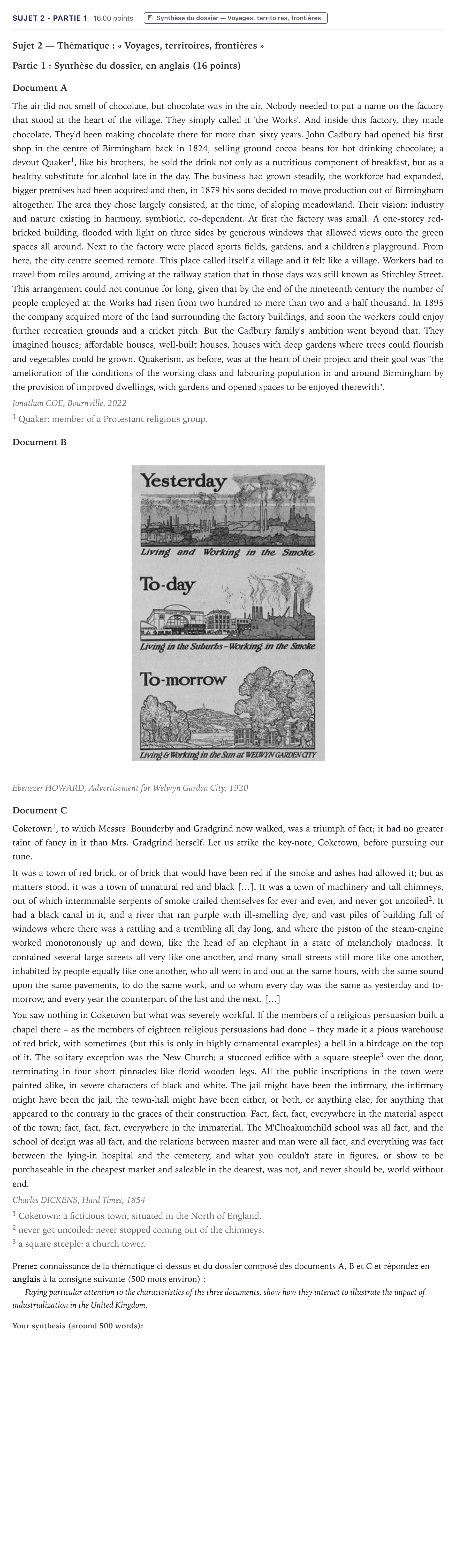
Ebenezer HOWARD, Advertisement for Welwyn Garden City, 1920
Document C
Coketown 1, to which Messrs. Bounderby and Gradgrind now walked, was a triumph of fact; it had no greater taint of fancy in it than Mrs. Gradgrind herself. Let us strike the key-note, Coketown, before pursuing our tune.
It was a town of red brick, or of brick that would have been red if the smoke and ashes had allowed it; but as matters stood, it was a town of unnatural red and black […]. It was a town of machinery and tall chimneys, out of which interminable serpents of smoke trailed themselves for ever and ever, and never got uncoiled 2. It had a black canal in it, and a river that ran purple with ill-smelling dye, and vast piles of building full of windows where there was a rattling and a trembling all day long, and where the piston of the steam-engine worked monotonously up and down, like the head of an elephant in a state of melancholy madness. It contained several large streets all very like one another, and many small streets still more like one another, inhabited by people equally like one another, who all went in and out at the same hours, with the same sound upon the same pavements, to do the same work, and to whom every day was the same as yesterday and to-morrow, and every year the counterpart of the last and the next. […]
You saw nothing in Coketown but what was severely workful. If the members of a religious persuasion built a chapel there – as the members of eighteen religious persuasions had done – they made it a pious warehouse of red brick, with sometimes (but this is only in highly ornamental examples) a bell in a birdcage on the top of it. The solitary exception was the New Church; a stuccoed edifice with a square steeple 3 over the door, terminating in four short pinnacles like florid wooden legs. All the public inscriptions in the town were painted alike, in severe characters of black and white. The jail might have been the infirmary, the infirmary might have been the jail, the town-hall might have been either, or both, or anything else, for anything that appeared to the contrary in the graces of their construction. Fact, fact, fact, everywhere in the material aspect of the town; fact, fact, fact, everywhere in the immaterial. The M'Choakumchild school was all fact, and the school of design was all fact, and the relations between master and man were all fact, and everything was fact between the lying-in hospital and the cemetery, and what you couldn't state in figures, or show to be purchaseable in the cheapest market and saleable in the dearest, was not, and never should be, world without end.
Charles DICKENS, Hard Times, 1854
1 Coketown: a fictitious town, situated in the North of England.
2 never got uncoiled: never stopped coming out of the chimneys.
3 a square steeple: a church tower.
Prenez connaissance de la thématique ci-dessus et du dossier composé des documents A, B et C et répondez en anglais à la consigne suivante (500 mots environ):
Paying particular attention to the characteristics of the three documents, show how they interact to illustrate the impact of industrialization in the United Kingdom.
Corrigé
Corrigé proposé par AprenAI (non officiel)
Paying particular attention to the characteristics of the three documents, show how they interact to illustrate the impact of industrialization in the United Kingdom.
Réponse : A structured synthesis (~500 words) organizing the three documents into a coherent analysis: contrasting the destructive, alienating impact of Victorian industrialization (Dickens's Coketown and Howard's 'Yesterday') with reformist and utopian projects (Bournville model village in Coe's novel and Howard's Garden City advertisement 'To-morrow').
L’explication pas à pas, faite avec l’IA, est réservée aux membres Premium. Premium
Résous-le ici : correction automatique, indices et corrigé détaillé.
‹ Sujet 1 - 1re partie · Métropole 2026 · Sujet 2 - Partie 1 · Métropole remplacement 2025 ›