Sujet 2 - Partie 1 · Bac Anglais Métropole remplacement 2024
Thème : Synthèse du dossier — Voyages, territoires, frontières · Tiré du sujet Métropole France remplacement (2024)
Énoncé
Document A
The scene takes place at Lady Hunstanton’s. Lady Hunstanton, Miss Hester Worsley, and other ladies are having a conversation.
LADY HUNSTANTON. I hear you have such pleasant society in America. Quite like our own in places, my son wrote to me.
HESTER. There are cliques in America as elsewhere, Lady Hunstanton. But true American society consists simply of all the good women and good men we have in our country.
LADY HUNSTANTON. What a sensible system, and I dare say quite pleasant too. I am afraid in England we have too many artificial social barriers. We don't see as much as we should of the middle and lower classes.
HESTER. In America we have no lower classes.
LADY HUNSTANTON. Really? What a very strange arrangement!
MRS. ALLONBY. What is that dreadful girl talking about?
LADY STUTFIELD. She is painfully natural, is she not?
LADY CAROLINE. There are a great many things you haven't got in America, I am told, Miss Worsley. They say you have no ruins, and no curiosities.
MRS. ALLONBY. [ To LADY STUTFIELD.] What nonsense! They have their mothers and their manners.
HESTER. The English aristocracy supply us with our curiosities, Lady Caroline. They are sent over to us every summer, regularly, in the steamers, and propose to us the day after they land. As for ruins, we are trying to build up something that will last longer than brick or stone. [ Gets up to take her fan from table. ]
LADY HUNSTANTON. What is that, dear? Ah, yes, an iron Exhibition, is it not, at that place that has the curious name?
HESTER. [ Standing by table. ] We are trying to build up life, Lady Hunstanton, on a better, truer, purer basis than life rests on here. This sounds strange to you all, no doubt. How could it sound other than strange? You rich people in England, you don't know how you are living. How could you know? You shut out from your society the gentle and the good. You laugh at the simple and the pure. Living, as you all do, on others and by them, you sneer at self-sacrifice, and if you throw bread to the poor, it is merely to keep them quiet for a season. With all your pomp and wealth and art you don't know how to live—you don't even know that. You love the beauty that you can see and touch and handle, the beauty that you can destroy, and do destroy, but of the unseen beauty of life, of the unseen beauty of a higher life, you know nothing. You have lost life's secret. Oh, your English society seems to me shallow, selfish, foolish. It has blinded its eyes, and stopped its ears.
Oscar WILDE, A Woman of No Importance, 1893.
Document B
Pulitzer Prize–winning historian Joseph Ellis recounted an exchange in his 2018 book, American Dialogue, between John Adams and his friend and rival Thomas Jefferson 1 about the state of aristocracy in the new republic.
Adams’ chief heresy was his direct refutation of Jefferson’s most famous words, that “all men are created equal.” Perhaps in some lofty humanistic sense this was true, Adams wrote, but “Inequalities of Mind and Body are so established by God Almighty in the constitution of Human Nature that no Art or policy can ever plain them down to a level.” Aristocracies, he therefore insisted, were an inevitable and permanent fixture in all human societies—including the young republic he and Jefferson had helped into being.
Jefferson wrote back to suggest his friend’s argument was true of Europe, where feudal privileges, inherited titles, and limited economic opportunities created conditions that sustained class distinctions. In America, though, the absence of laws such as primogeniture 2 and entail, and the existence of an unspoiled continent, meant “everyone may have land to labor for himself as he chooses,” and thus enduring elites were unlikely here. Given such favorable conditions, Jefferson argued, it was reasonable to expect that “rank, and birth, and tinsel-aristocracy will finally shrink into insignificance,” resulting in a roughly egalitarian, middle-class society.
Adams was unconvinced. “No Romance could be more amusing,” he replied, than the belief that the United States would prove an exception to the dominant pattern of economic inequality throughout history. “As long as Property exists,” he observed, “it will accumulate in Individuals and Families [...].”
During a subsequent interview for my new book about America’s superrich, I asked Gabriel Zucman, an economist and expert on economic inequality at the University of California, Berkeley, which founder’s 3 outlook he thought was more prescient. He replied that our situation in America today is arguably worse than the one Adams feared: not a hereditary aristocracy but an economic one “that can present itself as more legitimate than the old-world aristocracy, where you were rich and powerful for totally arbitrary reasons.”
Joseph J. ELLIS, American Dialogue, 2018.
1 John Adams and Thomas Jefferson belonged to a group of American leaders (the Founding Fathers) who signed the Declaration of Independence in 1776.
2 Primogeniture: inheritance to the eldest son.
3 Founder: a Founding Father.
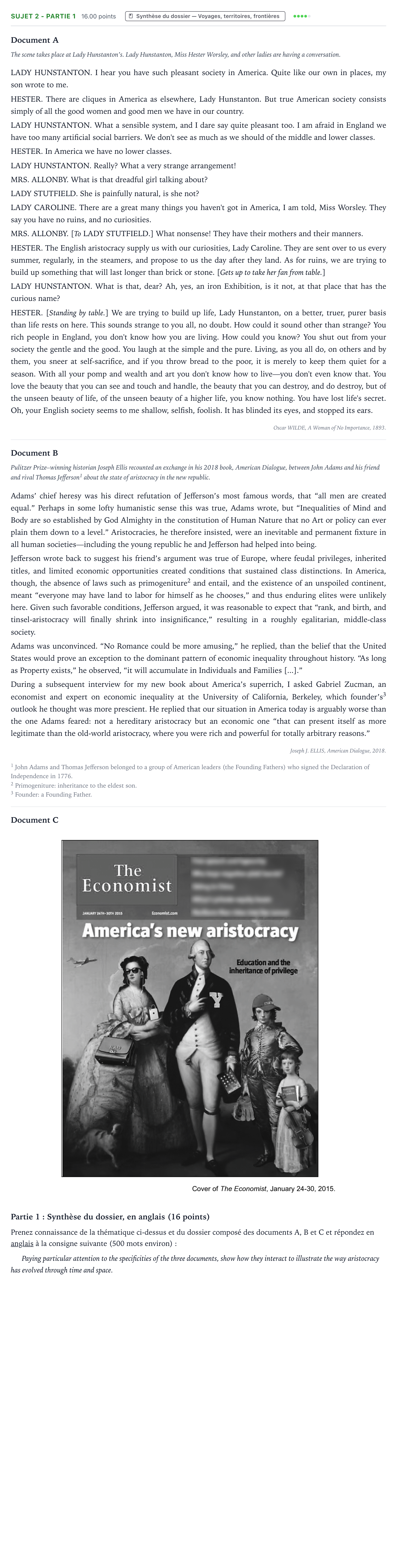
Document C
Partie 1: Synthèse du dossier, en anglais (16 points)
Prenez connaissance de la thématique ci-dessus et du dossier composé des documents A, B et C et répondez en anglais à la consigne suivante (500 mots environ):
Paying particular attention to the specificities of the three documents, show how they interact to illustrate the way aristocracy has evolved through time and space.
Corrigé
Corrigé proposé par AprenAI (non officiel)
Partie 1 : Synthèse du dossier, en anglais (16 points) - Paying particular attention to the specificities of the three documents, show how they interact to illustrate the way aristocracy has evolved through time and space.
Réponse : Sample Synthesis (approx. 500 words): Aristocracy is traditionally a ruling class defined by birth, landed wealth and hereditary titles, and it has long been seen as the opposite of American republicanism. The three documents show how the idea has changed across the Atlantic and from the founding of the United States to the 21st century. It moved from an open, hereditary hierarchy to a less visible elite based on money and education. In Oscar Wilde's satirical comedy *A Woman of No Importance* (1893, Document A), the clash between the Old World and the New is staged in an English drawing room. Complacent British ladies face Hester Worsley, an idealistic young American. Hester proudly claims that "in America we have no lower classes", and Lady Hunstanton finds this "a very strange arrangement". Hester then condemns English high society as "shallow, selfish, foolish", a class living "on others and by them". Wilde mocks the English aristocracy, which even crosses the ocean to marry American fortunes. Through Hester, America appears as a place where worth is moral rather than inherited. Document B, an account of an exchange recounted in Joseph J. Ellis's *American Dialogue* (2018), shows that this American self-image was already debated by the Founding Fathers. Thomas Jefferson believed aristocracy belonged to Europe. He argued that the absence of primogeniture and entail, together with an "unspoiled continent", would make "tinsel-aristocracy" shrink into insignificance and produce an egalitarian middle-class society. John Adams replied that natural inequalities and the accumulation of property "in Individuals and Families" would create aristocracies everywhere, America included. History seems to have proved Adams right, against both Jefferson's and Hester's optimism. The economist Gabriel Zucman argues that America today is arguably worse off than Adams feared. It now has an economic aristocracy rather than a hereditary one. This elite can present itself as "more legitimate than the old-world aristocracy", because its wealth seems earned rather than arbitrary. The 2015 cover of *The Economist* (Document C) turns this diagnosis into a striking visual satire. It takes an 18th-century aristocratic family portrait and adds modern status symbols: - the Yale "Y" on the father's coat and a Stanford cap on the son; - a sorority handbag, a smartphone and a tablet; - a private jet in the sky; - a violin and a book for the youngest child. The headline "America's new aristocracy" and the subtitle "Education and the inheritance of privilege" make the point clear. Elite universities have replaced coats of arms, and diplomas now pass status from one generation to the next under the appearance of merit. In conclusion, the documents chart a movement in both space and time: - Space: aristocracy, first presented as a European disease that America had escaped (Documents A and B), has crossed the Atlantic. - Time: it has changed form, from titles and land to wealth and educational credentials (Documents B and C). Wilde's idealistic American and Jefferson's hopes contrast with Adams's warning, Zucman's analysis and the ironic cover. Together they suggest that America did not abolish aristocracy but reinvented it. This new elite is more discreet and harder to challenge, because it claims to be the product of merit.
L’explication pas à pas, faite avec l’IA, est réservée aux membres Premium. Premium
Résous-le ici : correction automatique, indices et corrigé détaillé.
‹ Sujet 2 - Partie 1 · Métropole remplacement 2025 · Sujet 2 - 1re partie : Synthèse · Métropole 2022 ›