Sujet 1 - Partie 1 · Bac Anglais Métropole 2025
Thème : Synthèse du dossier — Expression et construction de soi · Tiré du sujet Métropole France (2025)
Énoncé
Document A
Isabel has just left home to go to work. She is at Grand Central station in New York.
Isabel should be in the office. She’s on her way. She is merely taking some extra time getting there from Grand Central.
Until this morning, she’s never walked unhastily through the Grand Central concourse. She’s always been in a rush to get to work, to get home again—and she realizes, as she walks slowly among the other travelers, that with the exception of student backpackers and baffled tourists, you are expected by Grand Central to be passing through on your way to urgent business elsewhere.
You are not encouraged to linger. There are no benches. There is no waiting room. Grand Central implies, with its august enormity and its unaccountable hush (people are, Isabel supposes, too rushed to make noise), that there is only motion, that your destination may promise rest and respite but here, in this monument to transit, you’d better keep moving.
Isabel pauses below the departure board.
9:45 Dobbs Ferry
10:01 Manitou
10:11 Cold Spring
What if she were the kind of person who could get on a train bound for an unfamiliar destination, who could vanish like the mythical man who goes out for a pack of cigarettes and is never heard from again? She considers what it would be like to be able to abandon all her gifts, all that’s been lavished upon her; to be that careless and callous; to abandon everyone and get on a train. Someone who could shed a life as if it were an old coat, who could find her way to another life without having to suffer the recriminations: subject to a form of reincarnation, the kind that allows people (some, there must be some such people) to rent an apartment in a small town on the Hudson, to become a waitress in a diner, wearing a nametag that bears the name you’ve given yourself. Pearl, or Jasmine or Naomi.
Michael CUNNINGHAM, Day, 2023
Document B
Eilis, an Irish American woman, her Italian American husband Tony, and their children are having a family lunch at Tony’s parents’ place with his brothers Enzo and Frank.
When, a few years earlier, the television had been showing news of student marches and sit-ins against the war in Vietnam, Eilis’s father-in-law had denounced the protestors and said that the police had been too lenient on them.
‘But aren’t they very brave, the protestors?’ Eilis asked.
‘I would like to see them all in uniform,’ her father-in-law said.
‘I would hate a son of mine having to go to war,’ Eilis said, ‘so I think they are protesting for me.’
By the time, most of the children had gone out to play. Tony put his head down. Enzo made signs to Eilis that she should stop.
‘I can’t think of anything that would make me more proud,’ her father-in-law said.
‘To have a son or a grandson in the war?’ she asked, looking at Frank whom she had heard denouncing the war many times.
‘Fighting for this country. That’s what I said. It would make me proud.’
Eilis hoped that someone else would speak. For a second, she thought it best to say nothing more but then she felt a flash of anger at Tony and Frank for not supporting her.
‘That is not an opinion many people would share,’ she said.
‘Do you mean Irish People?’ her father-in-law asked.
‘I mean Americans.’
‘What do you know about Americans?’
‘I am as American as you are. My children are Americans. And I would not want my son to be sent to fight in Vietnam.’
She looked directly at her father-in-law, forcing him to avert his eyes.
Enzo interrupted first by making a sound under his breath that rose into ‘Whoa’ and then became louder. He pointed at Eilis.
‘Keep quiet, you!’
Everyone watched Eilis except Tony and Frank who kept their heads down.
Francesca eventually, stood up.
‘I think it’s a day for grappa,’ she said.
‘We will all have a little something with our coffee. Now can someone help me get the glasses?’
Even though it was her turn to help, Eilis did not move. Both Lena and Clara seemed relieved to be able to stand up from the table.
‘Can you not control her?’ Enzo asked, as though she wasn’t there. […]
On the walk back to their house, with Rosella and Larry 1 coming behind them, Eilis felt almost sorry for Tony. Clearly, he should have supported her at the table, or moved the conversation to some other topic. But he could not go against his father.
Colm TÓIBÍN, Long Island, 2024
1 Rosella and Larry: Eilis and Tony’s children.
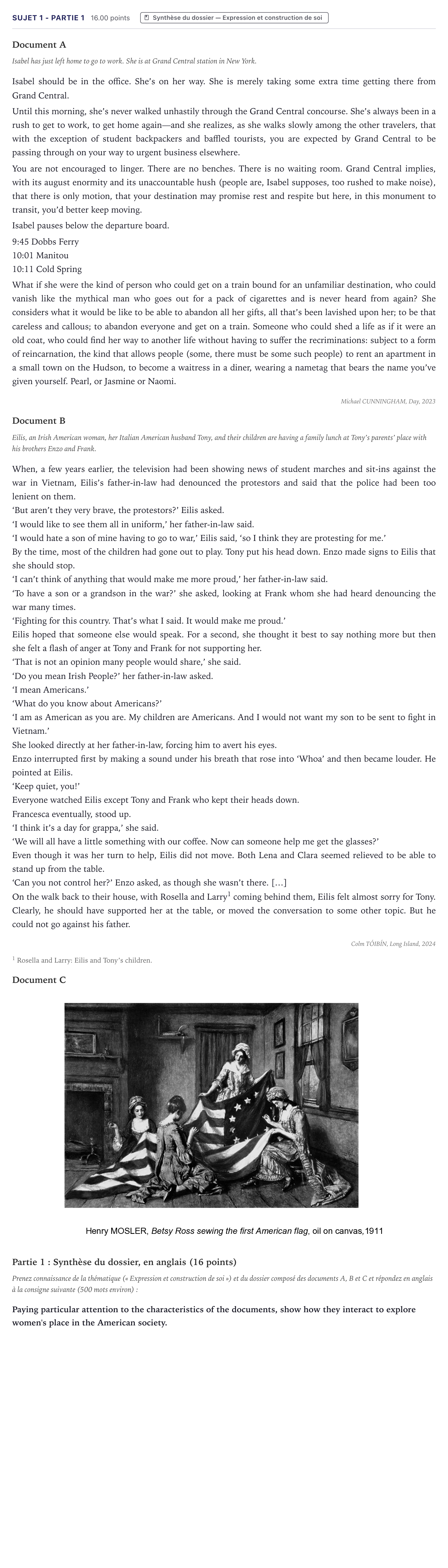
Document C
Partie 1: Synthèse du dossier, en anglais (16 points)
Prenez connaissance de la thématique (« Expression et construction de soi ») et du dossier composé des documents A, B et C et répondez en anglais à la consigne suivante (500 mots environ):
Paying particular attention to the characteristics of the documents, show how they interact to explore women's place in the American society.
Corrigé
Corrigé proposé par AprenAI (non officiel)
Paying particular attention to the characteristics of the documents, show how they interact to explore women's place in the American society.
Réponse : ### Sample Synthesis (approx. 500 words) The dossier brings together two contemporary novel extracts and an early twentieth-century painting. Document A is from Michael Cunningham's *Day* (2023), Document B from Colm Tóibín's *Long Island* (2024), and Document C is Henry Mosler's oil painting *Betsy Ross sewing the first American flag* (1911). Through different media and periods, they question the place assigned to women in American society and the ways women try to express and build themselves. First, the documents show women confined to roles defined by others. Mosler's painting is a historical, idealised scene set in a modest colonial interior. Betsy Ross and her companions sew the Stars and Stripes, so women appear at the heart of the nation's founding myth. Yet their contribution remains domestic and silent: needlework done indoors, away from the public sphere where history is made. Document B, set at the time of the Vietnam War, shows a family lunch dominated by men. The father-in-law imposes his militaristic patriotism. Enzo orders Eilis to "Keep quiet" and asks Tony, "Can you not control her?", as if she were not there. Even the end of the meal is gendered, since Francesca calls on the women to fetch the glasses. Second, the texts show women who refuse this place. Eilis openly contradicts her father-in-law. She looks at him directly until he averts his eyes, while Tony and Frank keep their heads down. By declaring "I am as American as you are," she claims both her voice as a woman and her legitimacy as an Irish immigrant. She redefines being American as the right, as a mother, to oppose sending her son to war. Her refusal to help with the glasses, although it is her turn, is another quiet act of rebellion. The extract, however, ends on her lonely position, since her husband "could not go against his father." Document A moves the conflict inside the mind. Through internal focalisation, Cunningham follows Isabel, a modern working woman. She slows down in Grand Central, a "monument to transit" that forbids lingering. The description of the station mirrors a society that demands constant efficiency. Her daydream of boarding a train, vanishing "like the mythical man who goes out for a pack of cigarettes" and becoming a waitress named "Pearl, or Jasmine or Naomi" is significant. She imagines claiming a freedom traditionally granted to men. She wants to escape the "gifts" and expectations "lavished upon her." Yet she fears the guilt of being "careless and callous," which shows how strongly duty still weighs on women. Finally, the documents interact as a dialogue across time. The painting builds a patriotic image of the dutiful woman serving the nation. Tóibín's novel stages a woman who uses her voice against patriarchal and nationalist authority. Cunningham's contemporary heroine has gained a professional life but still dreams of escaping to construct a self of her own. Together they suggest that women's place in America has evolved from silent contribution to open dissent and personal reinvention. The tension between social expectations and self-expression nevertheless remains unresolved.
L’explication pas à pas, faite avec l’IA, est réservée aux membres Premium. Premium
Résous-le ici : correction automatique, indices et corrigé détaillé.
Sujet 1 - Partie 1 · Métropole remplacement 2025 ›