Sujet 2 - Partie 1 · Bac Anglais Métropole Candidat libre 2021 (sujet 2)
Thème : Synthèse du dossier — Expression et construction de soi · Tiré du sujet Métropole Candidat libre 2 (2021)
Énoncé
SUJET 2
Le sujet porte sur la thématique « Expression et construction de soi ».
Partie 1. Synthèse en anglais (16 pts)
Prenez connaissance de la thématique ci-dessus et du dossier composé des documents A, B et C et répondez en anglais à la consigne suivante (500 mots environ):
Show how women are represented or represent themselves in the three documents, paying particular attention to the role of women artists.
Thématique: « Expression et construction de soi »
Document A
[...] Until the twentieth century, it was accepted that women were secondary to men, the mothers, daughters and wives whose value lay in their beauty, their modesty, their biddability 1, their usefulness to their families in terms of marital alliances. The line in Milton’s seventeenth-century epic poem sums it up: ‘he for God only, she for God in him’.
One result of these gender conventions is that when you look at portraits made in earlier centuries, you would be hard-pressed 2 to find a woman with anything much to say for herself. The men hold guns, wear their medals of state, look at globes, read books, point to plans. The women dangle their books in the folds of their skirts, look fetchingly off into the middle distance, stroke a little dog, wear costly clothes. The fact that we know that many of these women had talents and skills, were great letter writers or fine embroiderers, for example, or ran huge households, play instruments or paint to an impressive standard is not usually included in female portraits before the twentieth century. [...] A particularly interesting extension of the language of self-portraiture came from women artists of the past.
When I was writing a history of women’s self-portraits, I realised that some of them must have been dissatisfied with the masculine self-portrait patterns available to them. There was the artist with the tools of his trade. The artist looking like a gentleman. And several variations of the artist at work. But as women, they had a special problem: if they worked for money, they were not considered ladies. If they boasted of their skills they were not considered feminine. If they looked too arty or too industrious, they invited ridicule. So how to depict themselves as both feminine but professional? [...]
Women used the conventions of their times in an original way, showing off a sophistication to rival the men while never for a moment undercutting the modest femininity the age demanded of the weaker sex. [...] Portraiture is continually refreshing itself. At the start of the 1970s, the feminist artists who confidently marched on to art’s stage extended the concept of self-portraiture, turning it from a painter speaking about herself to an artist embodying ideas that mattered to women in general.
Many of these works have become classics, like Eleanor Antin’s 3 144 photographs of herself taken over 36 days in 1972 as she dieted to lose weight. Its witty title, Carving: A Traditional Sculpture, is a reference to the Michelangelesque idea that a sculptor chips away at the marble to release the body inside. Antin is using her body as a way to personify abstract ideas about the female search for the ideal shape, the constant dieting, the perpetual watching of oneself.
Frances BORZELLO, “Facing the Truth”,
Script of a talk given at the National Portrait Gallery of Australia, Canberra, July 11 th 2013
1 biddability: obedience
2 be hard-pressed: find it difficult
3 Eleanor Antin is an American artist.
Document B
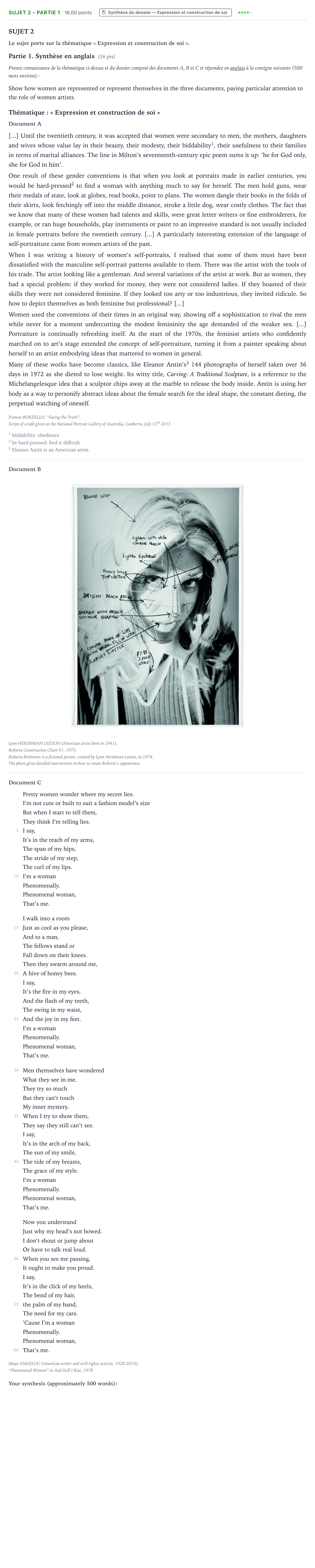
Lynn HERSHMAN LEESON (American artist born in 1941),
Roberta Construction Chart #1, 1975.
Roberta Breitmore is a fictional person, created by Lynn Hershman Leeson, in 1974.
The photo gives detailed instructions on how to create Roberta’s appearance.
Document C
Pretty women wonder where my secret lies.
I’m not cute or built to suit a fashion model’s size
But when I start to tell them,
They think I’m telling lies.
5 I say,
It’s in the reach of my arms,
The span of my hips,
The stride of my step,
The curl of my lips.
10 I’m a woman
Phenomenally.
Phenomenal woman,
That’s me.
I walk into a room
15 Just as cool as you please,
And to a man,
The fellows stand or
Fall down on their knees.
Then they swarm around me,
20 A hive of honey bees.
I say,
It’s the fire in my eyes,
And the flash of my teeth,
The swing in my waist,
25 And the joy in my feet.
I’m a woman
Phenomenally.
Phenomenal woman,
That’s me.
30 Men themselves have wondered
What they see in me.
They try so much
But they can’t touch
My inner mystery.
35 When I try to show them,
They say they still can’t see.
I say,
It’s in the arch of my back,
The sun of my smile,
40 The ride of my breasts,
The grace of my style.
I’m a woman
Phenomenally.
Phenomenal woman,
That’s me.
Now you understand
Just why my head’s not bowed.
I don’t shout or jump about
Or have to talk real loud.
50 When you see me passing,
It ought to make you proud.
I say,
It’s in the click of my heels,
The bend of my hair,
55 the palm of my hand,
The need for my care.
’Cause I’m a woman
Phenomenally.
Phenomenal woman,
60 That’s me.
Maya ANGELOU (American writer and civil-rights activist, 1928-2014),
“Phenomenal Woman” in And Still I Rise, 1978
Corrigé
Corrigé proposé par AprenAI (non officiel)
Show how women are represented or represent themselves in the three documents, paying particular attention to the role of women artists.
Réponse : This dossier, centered on the theme “Expression and the Construction of the Self”, explores how women negotiate the boundary between passive societal objectification and self-determined empowerment. It is composed of an art-history talk by Frances Borzello (Doc A), a conceptual artwork by Lynn Hershman Leeson (Doc B) and a poem by Maya Angelou (Doc C). Together, the documents reveal a progression from external patriarchal constraint toward radical artistic reclamation. Historically, female representation was defined by male expectations. As Borzello outlines in Document A, early portraits reflected gender conventions that reduced women to silent, decorative companions valued for their beauty, modesty and obedience, while men were depicted with emblems of intellect and power. Women's real talents, such as writing, music, painting or running a household, were left out of their portraits. When women attempted self-portraiture, they faced an acute dilemma: appearing professional made them seem unladylike, whereas adhering strictly to modesty constrained their artistic legitimacy. Document B visualises how this legacy translates into modern beauty standards. Leeson’s *Roberta Construction Chart #1* (1975) maps out cosmetic alterations on a female face with almost surgical precision. It exposes how female beauty is artificially engineered to conform to mass-media archetypes. Faced with these rigid conventions, women artists in the 1970s turned representation into a tool of political critique. In Document A, Borzello highlights feminist pioneers such as Eleanor Antin. Her 1972 photographic work *Carving: A Traditional Sculpture* documented a strict weight-loss regimen over 36 days. By equating dieting with sculpting marble, Antin used her own body to personify the female search for the ideal shape and the constant self-scrutiny imposed on women. Similarly, Leeson in Document B uses performance and photography to deconstruct identity. Roberta Breitmore is not an authentic self but a fictional persona fabricated through a blond wig, heavy make-up, contouring and a cheap $7.98 dress. Here, the female artist becomes an active creator rather than a passive muse, laying bare the mechanical, alienating construction behind the “ideal woman”. Finally, Document C offers a powerful poetic resolution through autonomous self-expression. In “Phenomenal Woman” (1978), Maya Angelou defiantly rejects conventional aesthetic standards: she is not “built to suit a fashion model’s size”. Instead of altering her body to satisfy external gazes, the speaker celebrates her physical presence, graceful vitality and inner confidence. Her head is “not bowed”, in sharp contrast with the modest, obedient women of Document A. Female identity is constructed here not through subservience (Doc A) or artificial masks (Doc B), but through self-love, self-possession and embodied pride. The repeated refrain “I’m a woman / Phenomenally” reclaims the female voice and turns the gaze of others into admiration for her authentic self. In conclusion, the three documents trace a decisive trajectory. Women were once silenced objects in classical portraiture. Particularly through feminist art and literature, they have turned the gaze back onto society. By exposing the synthetic nature of imposed beauty norms, artists like Antin and Hershman Leeson reveal femininity as a social construction. Angelou, for her part, proclaims a self-defined identity. Women artists thus play a crucial role: they transform representation into an act of self-construction and emancipation.
L’explication pas à pas, faite avec l’IA, est réservée aux membres Premium. Premium
Résous-le ici : correction automatique, indices et corrigé détaillé.
‹ Sujet 2 - 1re partie · Métropole remplacement 2022 · Sujet 2 - Partie 1 · Métropole remplacement 2021 ›