Sujet 2 - Partie 1 · Bac Anglais Métropole remplacement 2021
Thème : Synthèse du dossier — Expression et construction de soi · Tiré du sujet Métropole France remplacement (2021)
Énoncé
Thématique du sujet
« Expression et construction de soi »
Document A
Why this is a golden age for children's literature: 'Children's books are one of the most important forms of writing we have'
The first book I read to myself was Dr Seuss's The Cat in the Hat – something I still recommend to learners – and the Cat's wild anarchic humour has always struck me as the perfect analogy for what happens to a child who discovers books. We think it's about being good – remember how the kids in the story are made to "sit-sit-sit-sit / And we did not like it / Not one little bit"? 9 Reading involves sitting, and getting a child to stay still is one of the most unattractive aspects. But once you master this, everything changes. People who love reading are often called bookworms 10 – but that's the wrong way around. It's not you that worms into a book, it's books that worm into you.
And worm into us they have. Children's books, new and old, are actually what is keeping publishers in business. They are what parents and grandparents, aunts and uncles, teachers and godparents actually buy, and go on buying. […]
Children's books are, paradoxically, one of the most important forms of writing we have, and the most overlooked. It is children's authors who are what Shelley called "the unacknowledged legislators of the world". From them, as much as from parents, a child receives an idea of how the world could or should be. They are the first real visual and literary culture that an unformed person receives, and this is one reason why we tend to remember children's books as our favourites. But they also give a child a lever 11 with which to prise open the world. They tell us that life is much bigger and more complex than we might have imagined, and that it contains people who are both like and unlike ourselves. This may seem daunting, but a great children's book portrays an environment in which the young are not powerless. Such books confront our deepest fears of being lost, hungry or in mortal danger, and they reinforce a child's inner ability to cope with this fearfulness and to discover where true strength lies. Almost any great story which people enjoy conforms to this model, whether it is about David and Goliath, Alice in Wonderland or Varjak Paw. Yet for most of the time, children's books are treated as infantile, escapist or easy to write. Believe me, they are not.
Amanda CRAIG (born in 1959), The Independent, June 24, 2015
9 A quote from The Cat in the Hat.
10 a bookworm: someone who enjoys reading
11 a lever: a tool; an iron bar used to open (or prise open) a door, for example
Document B
Coraline discovered the door a little while after they moved into the house.
It was a very old house – it had an attic under the roof and a cellar under the ground and an overgrown garden with huge old trees on it.
Coraline's family didn't own all of the house, it was too big for that. Instead they owned part of it.
There were other people who lived in the old house.
Miss Spink and Miss Forcible lived in the flat below Coraline's, on the ground floor. They were both old and round, and they lived in their flat with a number of ageing Highland terriers who had names like Hamish and Andrew and Jock. Once upon a time Miss Spink and Miss Forcible had been actresses, as Miss Spink told Coraline the first time she met her.
'You see, Caroline,' Miss Spink said, getting Coraline's name wrong, 'both myself and Miss Forcible were famous actresses, in our time. We trod the boards, lovey. Oh, don't let Hamish eat the fruitcake, or he'll be up all night with his tummy.'
'It's Coraline. Not Caroline. Coraline,' said Coraline.
In the flat above Coraline's, under the roof, was a crazy old man with a big moustache. He was training a mouse circus. He wouldn't let anyone see it.
'One day, little Caroline, when they are all ready, everyone in the whole world will see the wonders of my mouse circus. You ask me why you cannot see it now. Is that what you asked me?'
'No,' said Coraline quietly, 'I asked you not to call me Caroline. It's Coraline.'
[…]
Coraline didn't think there really was a mouse circus. She thought the old man was probably making it up.
The day after they moved in, Coraline went exploring.
She explored the garden. It was a big garden: at the very back was an old tennis court, but no one in the house played tennis and the fence around the court had holes in it and the net had mostly rotted away; there was an old rose garden […].
There was also a well. On the first day Coraline's family moved in, Miss Spink and Miss Forcible made a point of telling Coraline how dangerous the well was, and they warned her to be sure she kept away from it. So Coraline set off to explore for it, so that she knew where it was, to keep away from it properly.
She found it on the third day, in an overgrown meadow beside the tennis court, behind the clump of trees – a low brink circle almost hidden in the high grass. The well had been covered over by wooden boards, and Coraline spent an afternoon dropping pebbles and acorns through the hole, and waiting, and counting, until she heard the plop as they hit the water, far below.
Neil GAIMAN (born in 1960), Coraline, 2002
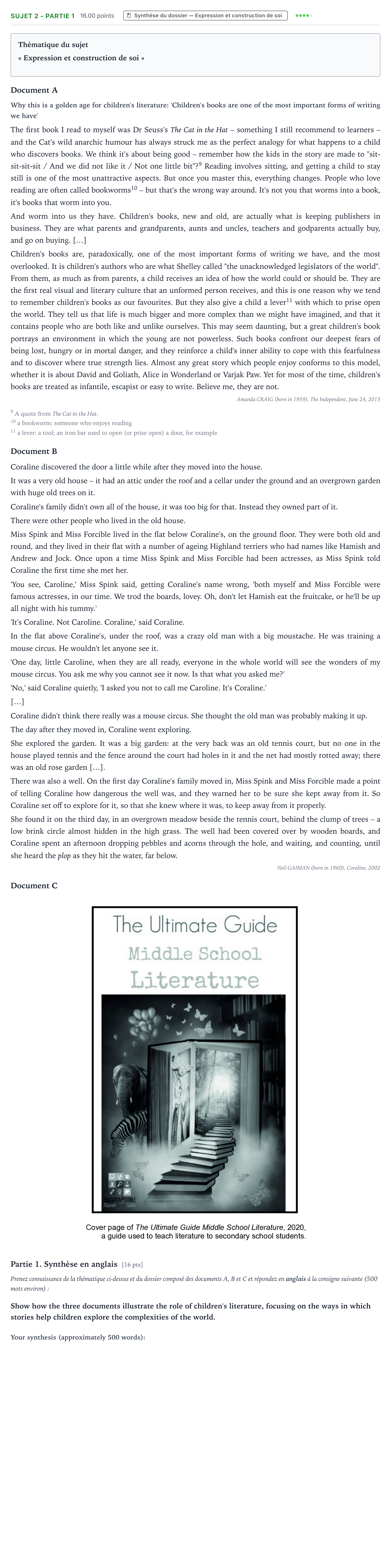
Document C
Partie 1. Synthèse en anglais [16 pts]
Prenez connaissance de la thématique ci-dessus et du dossier composé des documents A, B et C et répondez en anglais à la consigne suivante (500 mots environ):
Show how the three documents illustrate the role of children's literature, focusing on the ways in which stories help children explore the complexities of the world.
Corrigé
Corrigé proposé par AprenAI (non officiel)
Show how the three documents illustrate the role of children's literature, focusing on the ways in which stories help children explore the complexities of the world.
Réponse : ### Sample Synthesis The dossier revolves around the theme "Expression and Self-Construction" and explores how children's literature helps young people discover the realities, mysteries and trials of life. It contains three documents. Document A is an article by Amanda Craig published in *The Independent* (2015). Document B is an excerpt from Neil Gaiman's dark fantasy novel *Coraline* (2002). Document C is the cover of *The Ultimate Guide: Middle School Literature* (2020). Together, they show that children's literature is far from mere entertainment: it opens gateways to unknown worlds, confronts children with danger and with adults who do not understand them, and empowers them to build their own identity. First, stories act as a portal through which young readers step beyond familiar boundaries. In Document A, Craig writes that books give a child "a lever with which to prise open the world". They reveal that life is "much bigger and more complex" than imagined and full of people "both like and unlike ourselves". Document C turns this metaphor into an image: a huge open book forms a doorway onto a misty forest and a distant castle, and a staircase of stacked books invites the reader to climb into it. Document B dramatizes the same dynamic through Coraline. This curious girl immediately goes "exploring" the strange old house and its overgrown garden, with its attic, cellar, rotting tennis court and hidden well. Reading and exploring thus become synonymous with venturing into the unknown. Secondly, children's books teach readers to face fear, danger and the shortcomings of adults. In *Coraline*, the adults are eccentric and self-absorbed. They keep calling the girl "Caroline", which shows that they do not really see her. When her neighbours warn her about the dangerous well, Coraline does not simply obey. She looks for it "so that she knew where it was, to keep away from it properly", then measures its depth by dropping pebbles and counting. She turns danger into knowledge. This echoes Craig's claim that great children's books "confront our deepest fears of being lost, hungry or in mortal danger". Such books strengthen a child's "inner ability to cope", like David facing Goliath. The fog and shadows of Document C likewise suggest that the world of books is not only bright and reassuring but also mysterious. Finally, literature shapes children's identity and sense of agency. Craig calls children's authors "the unacknowledged legislators of the world", because a child learns from them "how the world could or should be". Stories thus contribute to the child's moral and cultural construction. Coraline's firm insistence on her real name ("It's Coraline. Not Caroline.") is an act of self-assertion. It illustrates Craig's point that in great children's books "the young are not powerless". In Document C, a guide meant for teachers shows that schools also see literature as a path to growth, and the butterflies made of printed words evoke transformation and freedom. In conclusion, the three documents converge in presenting children's literature as a demanding and essential form of writing. It is a door and a lever that lets children explore a complex and sometimes frightening world, confront their fears, and become active, confident individuals. As Craig insists, these books are anything but "infantile, escapist or easy to write".
L’explication pas à pas, faite avec l’IA, est réservée aux membres Premium. Premium
Résous-le ici : correction automatique, indices et corrigé détaillé.
‹ Sujet 2 - Partie 1 · Métropole Candidat libre 2021 (sujet 2)