Sujet 2 - 1re partie · Bac Anglais Métropole remplacement 2022
Thème : Synthèse du dossier — Expression et construction de soi · Tiré du sujet Métropole France remplacement (2022)
Énoncé
SUJET 2
Le sujet porte sur la thématique « Expression et construction de soi ».
Document A
It is with a kind of fear that I begin to write the history of my life. I have, as it were, a superstitious hesitation in lifting the veil that clings about my childhood like a golden mist. The task of writing an autobiography is a difficult one. When I try to classify my earliest impressions, I find that fact and fancy look alike across the years that link the past with the present. The woman paints the child's experiences in her own fantasy. A few impressions stand out vividly from the first years of my life; but "the shadows of the prison-house are on the rest." Besides, many of the joys and sorrows of childhood have lost their poignancy; and many incidents of vital importance in my early education have been forgotten in the excitement of great discoveries. In order, therefore, not to be tedious I shall try to present in a series of sketches only the episodes that seem to me to be the most interesting and important.
I was born on June 27, 1880, in Tuscumbia, a little town of northern Alabama. [...]
I lived, up to the time of the illness that deprived me of my sight and hearing, in a tiny house consisting of a large square room and a small one, in which the servant slept. It is a custom in the South to build a small house near the homestead as an annex to be used on occasion. Such a house my father built after the Civil War, and when he married my mother they went to live in it. It was completely covered with vines, climbing roses and honeysuckles. From the garden it looked like an arbor. The little porch was hidden from view by a screen of yellow roses and Southern smilax. It was the favourite haunt of humming-birds and bees.
The Keller homestead, where the family lived, was a few steps from our little rose-bower. It was called "Ivy Green" because the house and the surrounding trees and fences were covered with beautiful English ivy. Its old-fashioned garden was the paradise of my childhood.
Helen KELLER, The Story of My Life, 1903
Document B
How selfies became a global phenomenon
The smartphone self-portrait or 'selfie' has established itself a form of self-expression. Is it a harmless fad or a dangerous sign of western society's growing narcissism?
It starts with a certain angle: a smartphone tilted at 45 degrees just above your eyeline is generally deemed the most forgiving. Then a light source: the flattering beam of a backlit window or a bursting supernova of flash reflected in a bathroom mirror, as preparations are under way for a night out.
The pose is important. Knowing self-awareness is conveyed by the slight raise of an eyebrow, the sideways smile that says you're not taking it too seriously. A doe-eyed stare and mussed-up hair denotes natural beauty, as if you've just woken up and can't help looking like this. Sexiness is suggested by sucked-in cheeks, pouting lips, a nonchalant cock of the head and a hint of bare flesh just below the clavicle. Snap!
Afterwards, a flattering filter is applied. Outlines are blurred, colours are softened, a sepia tint soaks through to imply a simpler era of vinyl records and VW camper vans.
All of this is the work of an instant. Then, with a single tap, you are ready to upload: to Twitter, to Facebook, to Instagram, each likeness accompanied by a self-referential hashtag. Your image is retweeted and tagged and shared. Your screen fills with thumbs-up signs and heart-shaped emoticons. You are "liked" several times over. You feel a shiver of – what, exactly? Approbation? Reassurance? Existential calm? Whatever it is, it's addictive. Soon, you repeat the whole process, trying out a different pose. Again and again, you offer yourself up for public consumption.
This, then, is the selfie: the self-portrait of the digital age. We are all at it. Just type "selfie" into the Twitter search bar. Or take a look at Instagram, where over 90m photos are currently posted with the hashtag #me.
Adolescent pop poppet Justin Bieber constantly Tweets photos of himself with his shirt off to the shrieking delight of his huge online following. [...]
The political classes have started doing it too. President Obama's daughters, Sasha and Malia, took selfies at his second inauguration. In June, Hillary Clinton got in on the act after her daughter, Chelsea, tweeted a joint picture of them taken on her phone at arm's length. [...]
"The selfie is revolutionising how we gather autobiographical information about ourselves and our friends," says Dr Mariann Hardey, a lecturer in marketing at Durham University who specialises in digital social networks. "It's about continuously rewriting yourself. It's an extension of our natural construction of self. It's about presenting yourself in the best way... [similar to] when women put on makeup or men who bodybuild to look a certain way: it's an aspect of performance that's about knowing yourself and being vulnerable."
Elizabeth DAY, www.theguardian.com, July 14, 2013
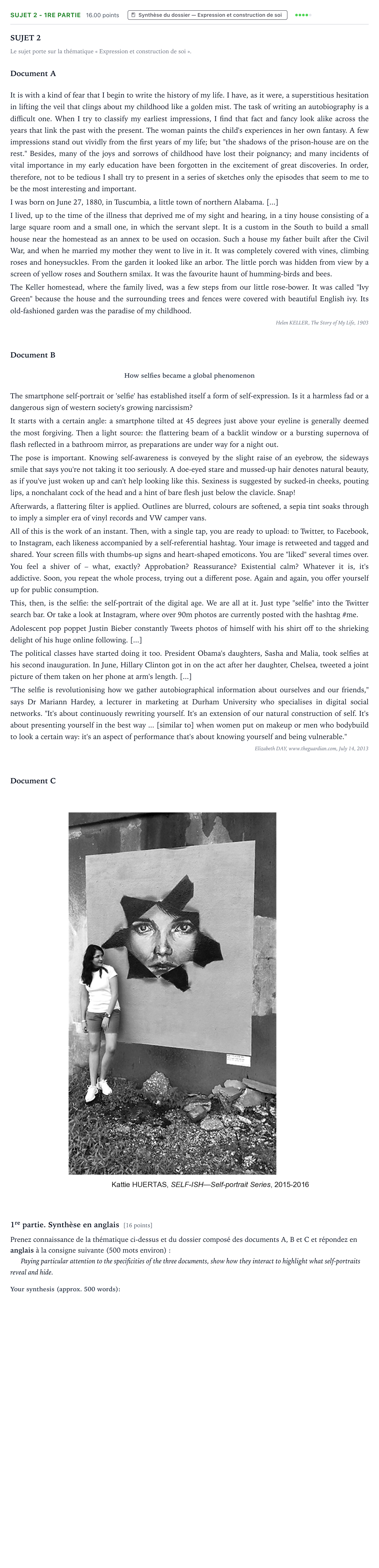
Document C
1 re partie. Synthèse en anglais [16 points]
Prenez connaissance de la thématique ci-dessus et du dossier composé des documents A, B et C et répondez en anglais à la consigne suivante (500 mots environ):
Paying particular attention to the specificities of the three documents, show how they interact to highlight what self-portraits reveal and hide.
Corrigé
Corrigé proposé par AprenAI (non officiel)
Paying particular attention to the specificities of the three documents, show how they interact to highlight what self-portraits reveal and hide.
Réponse : Sample Synthesis (~500 words): The dossier explores the theme "Expression and Construction of the Self" through three distinct media: an excerpt from Helen Keller's 1903 autobiography *The Story of My Life* (Document A), an article by Elizabeth Day published in *The Guardian* in 2013 about the rise of digital selfies (Document B), and a photograph of a work from Kattie Huertas's series *SELF-ISH—Self-portrait Series* (2015-2016), showing the artist standing beside her painted face (Document C). Together, these works address the paradoxical nature of self-portraiture: capturing the self is always an interplay between genuine disclosure and deliberate concealment. ### I. Revealing the Self: Intimacy, Identity and Vulnerability Each document shows that self-representation is an exploration of personal truth. For Helen Keller, writing an autobiography means "lifting the veil" over the "golden mist" of childhood in order to retrieve her earliest impressions and to tell the story of an identity later shaped by the loss of sight and hearing. Her lyrical description of the rose-covered house and of "Ivy Green", "the paradise of my childhood", reveals the roots of her inner world. In Document B, Day presents the selfie as a contemporary form of life-writing. Quoting Dr Mariann Hardey, she explains that it is "revolutionising how we gather autobiographical information" and is "an extension of our natural construction of self". Sharing one's image online exposes the individual to others' judgement, which makes it an act of "being vulnerable". Similarly, Huertas's work (Document C) exposes interiority. The painted face, with its intense, lifelike eyes staring at the viewer, seems to burst through the blank surface, as if the true self were tearing through a facade. The presence of the artist beside her own image underlines the link between the real person and her represented self. ### II. Hiding, Filtering and Staging Identity Yet all three documents show that self-portraits are never an unmediated reality: they select, embellish or mask. Keller admits that "fact and fancy look alike" and that "the woman paints the child's experiences in her own fantasy". Memory is selective: many episodes have been forgotten, and she deliberately keeps only "the most interesting and important" ones so as not to be "tedious". Her narrative is therefore a construction rather than an objective record. Day deconstructs the artifice of the selfie: a carefully chosen angle, flattering light, codified poses and filters that blur outlines and soften colours. The selfie becomes an idealised product offered "for public consumption" in exchange for "likes", a quest for approbation that may hide insecurity and raises the question of narcissism. Finally, Huertas's artwork visually embodies concealment. The face is fragmented, partly swallowed by jagged black shapes, so that only part of the self is shown. The title *SELF-ISH* suggests that the self-portrait is only "self-ish", an approximation of the self, while also hinting at the self-centredness of the genre. ### Conclusion Whether written, digital or painted, the self-portrait is a performance in which the subject both reveals and hides. Keller's autobiography relies on reconstructed memory, the selfie on staging and filters, and Huertas's painting on fragmentation. The three documents thus converge to show that representing oneself is less about recording a fixed identity than about continuously constructing it, the hidden part being as meaningful as what is shown.
L’explication pas à pas, faite avec l’IA, est réservée aux membres Premium. Premium
Résous-le ici : correction automatique, indices et corrigé détaillé.
‹ Sujet 1 - 1re partie · Métropole 2023 · Sujet 2 - Partie 1 · Métropole Candidat libre 2021 (sujet 2) ›