Sujet 1 - 1re partie · Bac Anglais Métropole 2023
Thème : Synthèse du dossier — Expression et construction de soi · Tiré du sujet Métropole France (2023)
Énoncé
SUJET 1
Le sujet porte sur la thématique « Expression et construction de soi ».
Document A
"May I ask who I'm talking to?"
"My name is Ifemelu."
He repeated her name with exaggerated care. "Is it a French name?"
"No. Nigerian."
5 "That where your family came from?"
"Yes." She scooped the eggs onto a plate. "I grew up there."
"Oh, really? How long have you been in the US?"
"Three years."
"Wow. Cool. You sound totally American."
10 "Thank you."
Only after she hung up did she begin to feel the stain of a burgeoning shame spreading all over her, for thanking him, for crafting his words "You sound American" into a garland that she hung around her own neck. Why was it a compliment, an accomplishment, to sound American? She had won; Cristina Tomas, pallid-faced 15 Cristina Tomas under whose gaze she had shrunk like a small, defeated animal, would speak to her normally now. She had won, indeed, but her triumph was full of air. Her fleeting victory had left in its wake a vast, echoing space, because she had taken on, for too long, a pitch of voice and a way of being that was not hers. And so she finished 20 eating her eggs and resolved to stop faking the American accent. She first spoke without the American accent that afternoon at Thirtieth Street Station, leaning towards the woman behind the Amtrak counter.
"Could I have a round-trip to Haverhill, please? Returning Sunday afternoon. I have a Student Advantage card," she said, and felt a rush of pleasure from giving the t its 25 full due in "advantage", from not rolling her r in "Haverhill". This was truly her; this was the voice with which she would speak if she were woken up from a deep sleep during an earthquake. Still, she resolved that if the Amtrak woman responded to her accent by speaking too slowly as though to an idiot, then she would put on her Mr Agbo Voice, 30 the mannered, overcareful pronunciations she had learned during debate meetings in secondary school when the bearded Mr Agbo, tugging at his frayed tie, played BBC recordings on his cassette player and then made all the students pronounce words over and over until he beamed and cried "Correct!" She would also affect, with the Mr Agbo Voice, a slight raising of her eyebrows in what she imagined was a haughty 35 foreigner pose. But there was no need to do any of these because the Amtrak woman spoke normally. "Can I see an ID, miss?"
And so she did not use her Mr Agbo Voice until she met Blaine. The train was crowded. The seat next to Blaine was the only empty one in that car, as far as she could see, and the newspaper and bottle of juice placed on it seemed to be his. She 40 stopped, gesturing towards the seat, but he kept his gaze levelly ahead. Behind her, a woman was pulling along a heavy suitcase and the conductor was announcing that all personal belongings had to be moved from free seats and Blaine saw her standing there—how could he possibly not see her?—and still he did nothing. So her Mr Agbo Voice emerged. "Excuse me. Are these yours? Could you possibly move them?"
45 She placed her bag on the overhead rack and settled onto the seat, stiffly, holding her magazine, her body aligned towards the aisle and away from him. The train had begun to move when he said, "I'm really sorry I didn't see you standing there."
His apologizing surprised her, his expression so earnest and sincere that it seemed as though he had done something more offensive. "It's okay," she said, and smiled. 50 "How are you?" he asked.
She had learned to say "Good-how-are-you?" in that sing-song American way, but now she said, "I'm well, thank you."
Chimamanda NGOZI ADICHIE, Americanah, 2014.
Document B
The World Is Witnessing Nigeria's Creative Golden Age
It is the most populous black nation in the world—and now, thanks to a formidable cast of creatives in art, fashion, music, and literature, Nigeria is on track to be one of the most influential.
Nigerians, of course, saw it all along. The infiltration of world culture by the sounds, images, and styles of their country has been building for some time. The author and photographer Teju Cole notices Nigerian pop music when he travels—recently, in a taxi in Peru. The journalist Bim Adewunmi remembers finding a group of white British kids in London singing "Oliver Twist," a hit by D'Banj, down to the artist's Nigerian accent: OH-lee-vah. "D'Banj trumped 1 Charles Dickens in that moment," Adewunmi says. "And that made me feel good!"
Perhaps the breakout moment came in 2013, when Beyoncé placed a spoken passage by the Nigerian novelist Chimamanda Ngozi Adichie, excerpted from an essay on the social conditioning of girls, at the center of "Flawless," her empowerment manifesto set to a bouncing Houston funk groove. Queen Bey's validation turbocharged the ascent of the author of Americanah to her status as a cross-cultural (and stylish) feminist icon. [...]
It's been a seeping, decentralized thing; to call it a takeover would be hyperbole. But the assertive Nigerian global influence today cannot be denied, whether it's in literature, music, fashion, or art, with new talents appearing at a relentless pace.
Siddhartha MITTER, wmagazine.com, October 3, 2018.
1 trumped: surpassed.
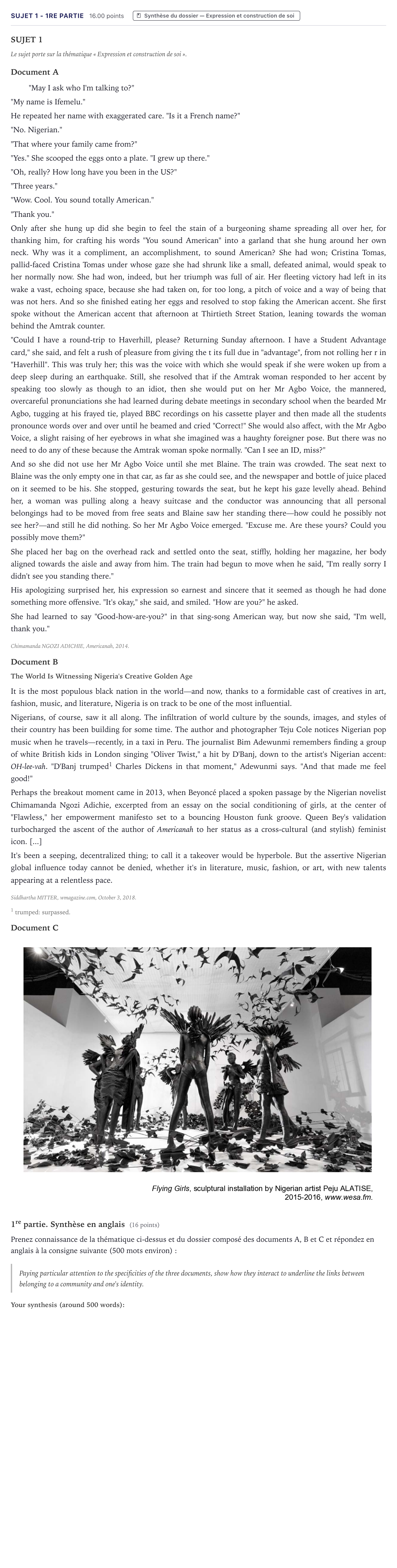
Document C
1 re partie. Synthèse en anglais (16 points)
Prenez connaissance de la thématique ci-dessus et du dossier composé des documents A, B et C et répondez en anglais à la consigne suivante (500 mots environ):
Paying particular attention to the specificities of the three documents, show how they interact to underline the links between belonging to a community and one's identity.
Corrigé
Corrigé proposé par AprenAI (non officiel)
Paying particular attention to the specificities of the three documents, show how they interact to underline the links between belonging to a community and one's identity.
Réponse : Sample synthesis (around 500 words): The three documents explore the intricate relationship between individual identity and community belonging through different artistic and cultural lenses. Document A is an excerpt from Chimamanda Ngozi Adichie's novel *Americanah* (2014). Document B is a press article by Siddhartha Mitter published on *wmagazine.com* in 2018. Document C is a sculptural installation entitled *Flying Girls* by Nigerian artist Peju Alatise (2015-2016). Together, they show that identity is neither fixed nor isolated. It is shaped by the pressures of host societies, reinforced through pride in one's cultural heritage, and expressed as a vehicle for collective emancipation. First, belonging to a minority or immigrant group often entails linguistic and cultural alienation. In Document A, Ifemelu embodies the pressure to assimilate. When a stranger on the phone compliments her on sounding "totally American", her initial satisfaction quickly turns into "a burgeoning shame". She realizes that faking an American accent means adopting "a pitch of voice and a way of being that was not hers" simply to be accepted, notably by people like Cristina Tomas who once made her feel "like a small, defeated animal". She therefore decides to speak with her own Nigerian voice, which gives her "a rush of pleasure". However, she keeps her mannered, BBC-inspired "Mr Agbo Voice" as a defensive mask, which she uses with Blaine. Language thus becomes a battleground of self-definition. Changing one's voice can be a survival strategy, but it is also a betrayal of one's authentic roots. Conversely, Document B shows that belonging to a cultural community can be a source of pride and global recognition. It describes Nigeria's "creative golden age" in music, fashion, literature and art. Far from imitating Western codes, Nigerian creators assert their own identity, and the rest of the world now imitates them. White British children sing D'Banj's hit "down to the artist's Nigerian accent". Beyoncé places Adichie's feminist words at the heart of "Flawless". The Nigerian accent that Ifemelu once hid is now copied abroad, reversing the traditional dynamic of cultural domination. As journalist Bim Adewunmi says, this "made me feel good": the community's success strengthens each member's self-esteem. Interestingly, Adichie herself, the author of Document A, has become a "cross-cultural feminist icon". Finally, Document C presents community as a space of solidarity and freedom in the face of shared hardship. Peju Alatise's installation shows a group of winged girls standing together beneath a flock of birds taking flight. The work refers to the plight of young Nigerian girls, notably domestic servants deprived of their childhood and their dreams. Yet it transforms their vulnerability into a poetic vision of escape and sisterhood. The wings suggest that the girls can build and express their identity, and imagine a freer self, through a collective and artistic dimension. In conclusion, the documents first show that the pressure of a dominant group can lead individuals to hide or compromise their identity in order to belong. They then show that authentic identity is built by reconnecting with one's own community. Shared cultural pride, as celebrated in Document B, and collective solidarity, as embodied in Document C, enable individuals to accept their roots, voice who they are, and even influence the world. Identity is therefore both personal and collective: we construct ourselves through, and sometimes against, the communities we belong to.
L’explication pas à pas, faite avec l’IA, est réservée aux membres Premium. Premium
Résous-le ici : correction automatique, indices et corrigé détaillé.
‹ Sujet 2 - Partie 1 · Métropole 2024 · Sujet 2 - 1re partie · Métropole remplacement 2022 ›