Aufgabe HT 1 · Abitur NRW Sozialwissenschaften GK · Haupttermin · bilingual Englisch 2021
Thema: Wirtschaftspolitische Konzeptionen, Staatsverschuldung und Fiskalpolitik · Aus der Prüfung GK · Haupttermin · bilingual Englisch (2021)
Aufgabenstellung
Abiturprüfung 2021 – Sozialwissenschaften bilingual-englisch, Grundkurs
Aufgabenstellung · SW BIL-E GK HT 1
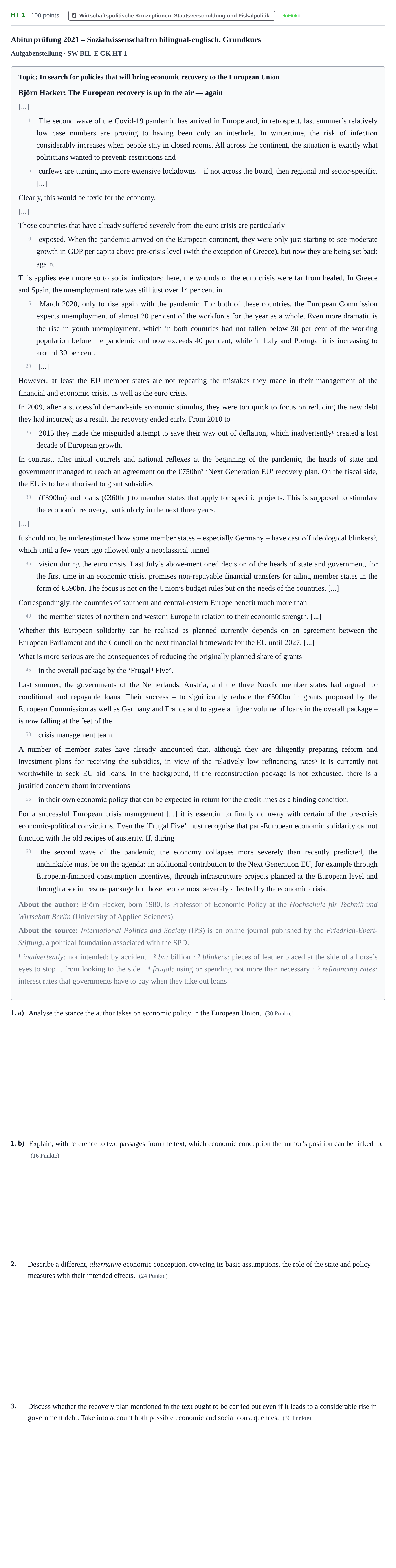
Topic: In search for policies that will bring economic recovery to the European Union
Björn Hacker: The European recovery is up in the air — again
[...]
1 The second wave of the Covid-19 pandemic has arrived in Europe and, in retrospect, last summer’s relatively low case numbers are proving to having been only an interlude. In wintertime, the risk of infection considerably increases when people stay in closed rooms. All across the continent, the situation is exactly what politicians wanted to prevent: restrictions and
5 curfews are turning into more extensive lockdowns – if not across the board, then regional and sector-specific. [...]
Clearly, this would be toxic for the economy.
[...]
Those countries that have already suffered severely from the euro crisis are particularly
10 exposed. When the pandemic arrived on the European continent, they were only just starting to see moderate growth in GDP per capita above pre-crisis level (with the exception of Greece), but now they are being set back again.
This applies even more so to social indicators: here, the wounds of the euro crisis were far from healed. In Greece and Spain, the unemployment rate was still just over 14 per cent in
15 March 2020, only to rise again with the pandemic. For both of these countries, the European Commission expects unemployment of almost 20 per cent of the workforce for the year as a whole. Even more dramatic is the rise in youth unemployment, which in both countries had not fallen below 30 per cent of the working population before the pandemic and now exceeds 40 per cent, while in Italy and Portugal it is increasing to around 30 per cent.
20 [...]
However, at least the EU member states are not repeating the mistakes they made in their management of the financial and economic crisis, as well as the euro crisis.
In 2009, after a successful demand-side economic stimulus, they were too quick to focus on reducing the new debt they had incurred; as a result, the recovery ended early. From 2010 to
25 2015 they made the misguided attempt to save their way out of deflation, which inadvertently¹ created a lost decade of European growth.
In contrast, after initial quarrels and national reflexes at the beginning of the pandemic, the heads of state and government managed to reach an agreement on the €750bn² ‘Next Generation EU’ recovery plan. On the fiscal side, the EU is to be authorised to grant subsidies
30 (€390bn) and loans (€360bn) to member states that apply for specific projects. This is supposed to stimulate the economic recovery, particularly in the next three years.
[...]
It should not be underestimated how some member states – especially Germany – have cast off ideological blinkers³, which until a few years ago allowed only a neoclassical tunnel
35 vision during the euro crisis. Last July’s above-mentioned decision of the heads of state and government, for the first time in an economic crisis, promises non-repayable financial transfers for ailing member states in the form of €390bn. The focus is not on the Union’s budget rules but on the needs of the countries. [...]
Correspondingly, the countries of southern and central-eastern Europe benefit much more than
40 the member states of northern and western Europe in relation to their economic strength. [...]
Whether this European solidarity can be realised as planned currently depends on an agreement between the European Parliament and the Council on the next financial framework for the EU until 2027. [...]
What is more serious are the consequences of reducing the originally planned share of grants
45 in the overall package by the ‘Frugal⁴ Five’.
Last summer, the governments of the Netherlands, Austria, and the three Nordic member states had argued for conditional and repayable loans. Their success – to significantly reduce the €500bn in grants proposed by the European Commission as well as Germany and France and to agree a higher volume of loans in the overall package – is now falling at the feet of the
50 crisis management team.
A number of member states have already announced that, although they are diligently preparing reform and investment plans for receiving the subsidies, in view of the relatively low refinancing rates⁵ it is currently not worthwhile to seek EU aid loans. In the background, if the reconstruction package is not exhausted, there is a justified concern about interventions
55 in their own economic policy that can be expected in return for the credit lines as a binding condition.
For a successful European crisis management [...] it is essential to finally do away with certain of the pre-crisis economic-political convictions. Even the ‘Frugal Five’ must recognise that pan-European economic solidarity cannot function with the old recipes of austerity. If, during
60 the second wave of the pandemic, the economy collapses more severely than recently predicted, the unthinkable must be on the agenda: an additional contribution to the Next Generation EU, for example through European-financed consumption incentives, through infrastructure projects planned at the European level and through a social rescue package for those people most severely affected by the economic crisis.
About the author: Björn Hacker, born 1980, is Professor of Economic Policy at the Hochschule für Technik und Wirtschaft Berlin (University of Applied Sciences).
About the source: International Politics and Society (IPS) is an online journal published by the Friedrich-Ebert-Stiftung, a political foundation associated with the SPD.
¹ inadvertently: not intended; by accident · ² bn: billion · ³ blinkers: pieces of leather placed at the side of a horse’s eyes to stop it from looking to the side · ⁴ frugal: using or spending not more than necessary · ⁵ refinancing rates: interest rates that governments have to pay when they take out loans
1. a)
Analyse the stance the author takes on economic policy in the European Union. (30 Punkte)
1. b)
Explain, with reference to two passages from the text, which economic conception the author’s position can be linked to. (16 Punkte)
2.
Describe a different, alternative economic conception, covering its basic assumptions, the role of the state and policy measures with their intended effects. (24 Punkte)
3.
Discuss whether the recovery plan mentioned in the text ought to be carried out even if it leads to a considerable rise in government debt. Take into account both possible economic and social consequences. (30 Punkte)
Lösung
Nach den offiziellen Korrekturhinweisen
1. a) Analyse the stance the author takes on economic policy in the European Union.
Lösung: Comprehensive textual analysis identifying the author's position, line of reasoning, argumentative techniques, and communicative intention.
1. b) Explain, with reference to two passages from the text, which economic conception the author’s position can be linked to.
Lösung: Reference of the position to Keynesian economic conception (demand-side policy / deficit spending / multiplier effect) via two distinct text passages.
2. Describe a different, alternative economic conception, covering its basic assumptions, the role of the state and policy measures with their intended effects.
Lösung: Description of another conception (e.g. supply-side / neoclassical approach) covering basic assumptions, the role of the state, and specific measures with intended effects.
3. Discuss whether the recovery plan mentioned in the text ought to be carried out even if it leads to a considerable rise in government debt. Take into account both possible economic and social consequences.
Lösung: Balanced discussion examining economic and social consequences using appropriate criteria, concluding in a differentiated personal judgment.
Die ausführliche Erklärung Schritt für Schritt (mit KI) gibt es mit Premium. Premium
Löse sie direkt hier: automatische Korrektur, Hinweise und Lösung Schritt für Schritt.
‹ Aufgabe 1 · GK · Haupttermin 2021 · Aufgabe HT 3 - Wirtschaftspolitische Konzeptionen · GK · Haupttermin · bilingual Englisch 2021 ›
Mehr Aufgaben zu Wirtschaftspolitische Konzeptionen, Staatsverschuldung und Fiskalpolitik
- Aufgabe 2 - Wirtschaftspolitische Konzeptionen · GK · Nachtermin · Wirtschaft 2022
- Aufgabe HT 1 · LK · Haupttermin 2022
- Aufgabe 1 · LK · Haupttermin · Wirtschaft 2022
- Aufgabe 4 - Wirtschaftspolitische Konzeptionen un… · LK · Nachtermin · Wirtschaft 2022
- Aufgabe 1 · GK · Haupttermin 2021
- Aufgabe HT 3 - Wirtschaftspolitische Konzeptionen · GK · Haupttermin · bilingual Englisch 2021
- Aufgabe HT 1 · GK · Haupttermin · Wirtschaft 2021
- Aufgabe HT 3 - Fiskalpolitik · GK · Haupttermin · Wirtschaft 2021
- Aufgabe NT 1 - Aufgabe 1 · GK · Nachtermin 2021
- Aufgabe NT 1 - Aufgabe 3 · GK · Nachtermin 2021