Aufgabe HT 2 · Abitur NRW Sozialwissenschaften GK · Haupttermin · bilingual Englisch 2023
Thema: Internationale Friedens- und Sicherheitspolitik, Global Governance · Aus der Prüfung GK · Haupttermin · bilingual Englisch (2023)
Aufgabenstellung
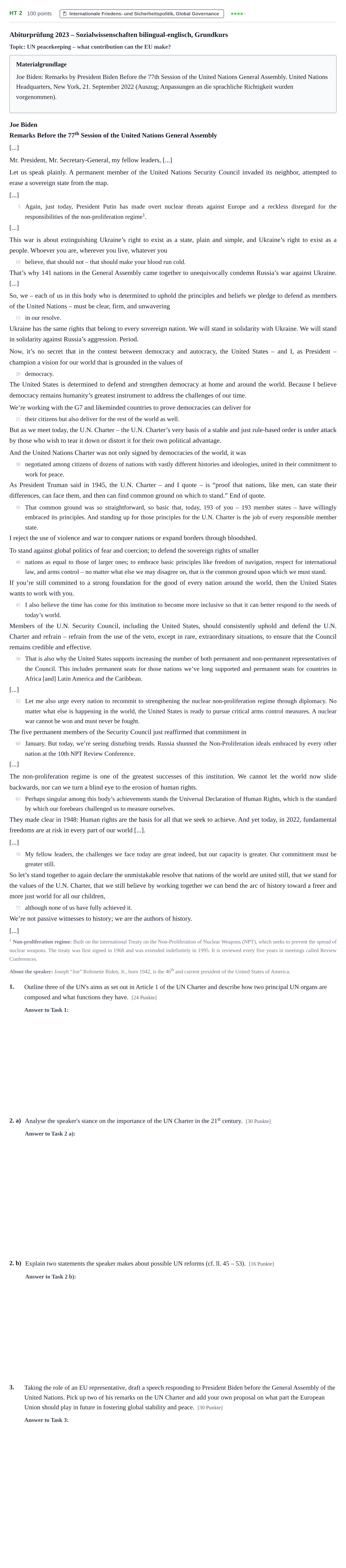
Abiturprüfung 2023 – Sozialwissenschaften bilingual-englisch, Grundkurs
Topic: UN peacekeeping – what contribution can the EU make?
Materialgrundlage
Joe Biden: Remarks by President Biden Before the 77th Session of the United Nations General Assembly. United Nations Headquarters, New York, 21. September 2022 (Auszug; Anpassungen an die sprachliche Richtigkeit wurden vorgenommen).
Joe Biden
Remarks Before the 77 th Session of the United Nations General Assembly
[...]
Mr. President, Mr. Secretary-General, my fellow leaders, [...]
Let us speak plainly. A permanent member of the United Nations Security Council invaded its neighbor, attempted to erase a sovereign state from the map.
[...]
5 Again, just today, President Putin has made overt nuclear threats against Europe and a reckless disregard for the responsibilities of the non-proliferation regime 1.
[...]
This war is about extinguishing Ukraine’s right to exist as a state, plain and simple, and Ukraine’s right to exist as a people. Whoever you are, wherever you live, whatever you
10 believe, that should not – that should make your blood run cold.
That’s why 141 nations in the General Assembly came together to unequivocally condemn Russia’s war against Ukraine. [...]
So, we – each of us in this body who is determined to uphold the principles and beliefs we pledge to defend as members of the United Nations – must be clear, firm, and unwavering
15 in our resolve.
Ukraine has the same rights that belong to every sovereign nation. We will stand in solidarity with Ukraine. We will stand in solidarity against Russia’s aggression. Period.
Now, it’s no secret that in the contest between democracy and autocracy, the United States – and I, as President – champion a vision for our world that is grounded in the values of
20 democracy.
The United States is determined to defend and strengthen democracy at home and around the world. Because I believe democracy remains humanity’s greatest instrument to address the challenges of our time.
We’re working with the G7 and likeminded countries to prove democracies can deliver for
25 their citizens but also deliver for the rest of the world as well.
But as we meet today, the U.N. Charter – the U.N. Charter’s very basis of a stable and just rule-based order is under attack by those who wish to tear it down or distort it for their own political advantage.
And the United Nations Charter was not only signed by democracies of the world, it was
30 negotiated among citizens of dozens of nations with vastly different histories and ideologies, united in their commitment to work for peace.
As President Truman said in 1945, the U.N. Charter – and I quote – is “proof that nations, like men, can state their differences, can face them, and then can find common ground on which to stand.” End of quote.
35 That common ground was so straightforward, so basic that, today, 193 of you – 193 member states – have willingly embraced its principles. And standing up for those principles for the U.N. Charter is the job of every responsible member state.
I reject the use of violence and war to conquer nations or expand borders through bloodshed.
To stand against global politics of fear and coercion; to defend the sovereign rights of smaller
40 nations as equal to those of larger ones; to embrace basic principles like freedom of navigation, respect for international law, and arms control – no matter what else we may disagree on, that is the common ground upon which we must stand.
If you’re still committed to a strong foundation for the good of every nation around the world, then the United States wants to work with you.
45 I also believe the time has come for this institution to become more inclusive so that it can better respond to the needs of today’s world.
Members of the U.N. Security Council, including the United States, should consistently uphold and defend the U.N. Charter and refrain – refrain from the use of the veto, except in rare, extraordinary situations, to ensure that the Council remains credible and effective.
50 That is also why the United States supports increasing the number of both permanent and non-permanent representatives of the Council. This includes permanent seats for those nations we’ve long supported and permanent seats for countries in Africa [and] Latin America and the Caribbean.
[...]
55 Let me also urge every nation to recommit to strengthening the nuclear non-proliferation regime through diplomacy. No matter what else is happening in the world, the United States is ready to pursue critical arms control measures. A nuclear war cannot be won and must never be fought.
The five permanent members of the Security Council just reaffirmed that commitment in
60 January. But today, we’re seeing disturbing trends. Russia shunned the Non-Proliferation ideals embraced by every other nation at the 10th NPT Review Conference.
[...]
The non-proliferation regime is one of the greatest successes of this institution. We cannot let the world now slide backwards, nor can we turn a blind eye to the erosion of human rights.
65 Perhaps singular among this body’s achievements stands the Universal Declaration of Human Rights, which is the standard by which our forebears challenged us to measure ourselves.
They made clear in 1948: Human rights are the basis for all that we seek to achieve. And yet today, in 2022, fundamental freedoms are at risk in every part of our world [...].
[...]
70 My fellow leaders, the challenges we face today are great indeed, but our capacity is greater. Our commitment must be greater still.
So let’s stand together to again declare the unmistakable resolve that nations of the world are united still, that we stand for the values of the U.N. Charter, that we still believe by working together we can bend the arc of history toward a freer and more just world for all our children,
75 although none of us have fully achieved it.
We’re not passive witnesses to history; we are the authors of history.
[...]
1 Non-proliferation regime: Built on the international Treaty on the Non-Proliferation of Nuclear Weapons (NPT), which seeks to prevent the spread of nuclear weapons. The treaty was first signed in 1968 and was extended indefinitely in 1995. It is reviewed every five years in meetings called Review Conferences.
About the speaker: Joseph “Joe” Robinette Biden, Jr., born 1942, is the 46 th and current president of the United States of America.
1.
Outline three of the UN's aims as set out in Article 1 of the UN Charter and describe how two principal UN organs are composed and what functions they have. [24 Punkte]
2. a)
Analyse the speaker's stance on the importance of the UN Charter in the 21 st century. [30 Punkte]
2. b)
Explain two statements the speaker makes about possible UN reforms (cf. ll. 45 – 53). [16 Punkte]
3.
Taking the role of an EU representative, draft a speech responding to President Biden before the General Assembly of the United Nations. Pick up two of his remarks on the UN Charter and add your own proposal on what part the European Union should play in future in fostering global stability and peace. [30 Punkte]
Lösung
Nach den offiziellen Korrekturhinweisen
1. Outline three of the UN's aims as set out in Article 1 of the UN Charter and describe how two principal UN organs are composed and what functions they have.
Lösung: Three objectives according to Art. 1 of the UN Charter (e.g. maintaining international peace and security, developing friendly relations based on equal rights, achieving international cooperation, serving as a center for harmonizing actions) and description of composition and functions of two UN main organs (e.g. Security Council and General Assembly).
2. a) Analyse the speaker's stance on the importance of the UN Charter in the 21st century.
Lösung: Comprehensive analysis of Biden's position on the significance of the UN Charter in the 21st century, structured by context/theme, central position, line of reasoning, argumentative strategies, and intention.
2. b) Explain two statements the speaker makes about possible UN reforms (cf. ll. 45 – 53).
Lösung: Explanation of two reform statements from lines 45–53, addressing inclusivity, restraint regarding the veto power, or expanding the Security Council's membership.
3. Taking the role of an EU representative, draft a speech responding to President Biden before the General Assembly of the United Nations. Pick up two of his remarks on the UN Charter and add your own proposal on what part the European Union should play in future in fostering global stability and peace.
Lösung: A drafted speech in role as an EU representative to the UN General Assembly addressing President Biden's remarks, reflecting on the UN Charter, proposing an expanded future role for the EU in global peacekeeping, and employing persuasive rhetorical techniques.
Die ausführliche Erklärung Schritt für Schritt (mit KI) gibt es mit Premium. Premium
Löse sie direkt hier: automatische Korrektur, Hinweise und Lösung Schritt für Schritt.
Aufgabe 2 · GK · Nachtermin 2023 ›
Mehr Aufgaben zu Internationale Friedens- und Sicherheitspolitik, Global Governance
- Aufgabe 2 · GK · Nachtermin 2023
- Aufgabe 2 (HT 2) · LK · Haupttermin 2023
- Aufgabe HT 2 - Aufgabe 2 b) · LK · Haupttermin · Wirtschaft 2023
- Aufgabe HT 4 - 1 · GK · Haupttermin · bilingual Englisch 2022
- Aufgabe HT 4 · GK · Haupttermin · bilingual Englisch 2022
- Aufgabe NT 2 - Friedens- und Sicherheitspolitik der EU · GK · Nachtermin 2022
- Aufgabe NT 4 - Internationale Friedens- und Sicherheitspo… · GK · Nachtermin 2022
- Aufgabe 4 - Internationale Friedens- und Sicherhe… · GK · Nachtermin · Wirtschaft 2022
- Aufgabe 4 (SW LK NT 4) · LK · Nachtermin 2022
- Aufgabe NT 2 - Aufgabe 3 · GK · Nachtermin 2021