Aufgabe HT 2 - 4 · Abitur NRW Englisch GK · Haupttermin (2) 2023
Thema: Sprachmittlung Deutsch → Englisch (Mediation) · Aus der Prüfung GK · Haupttermin (2) (2023)
Aufgabenstellung
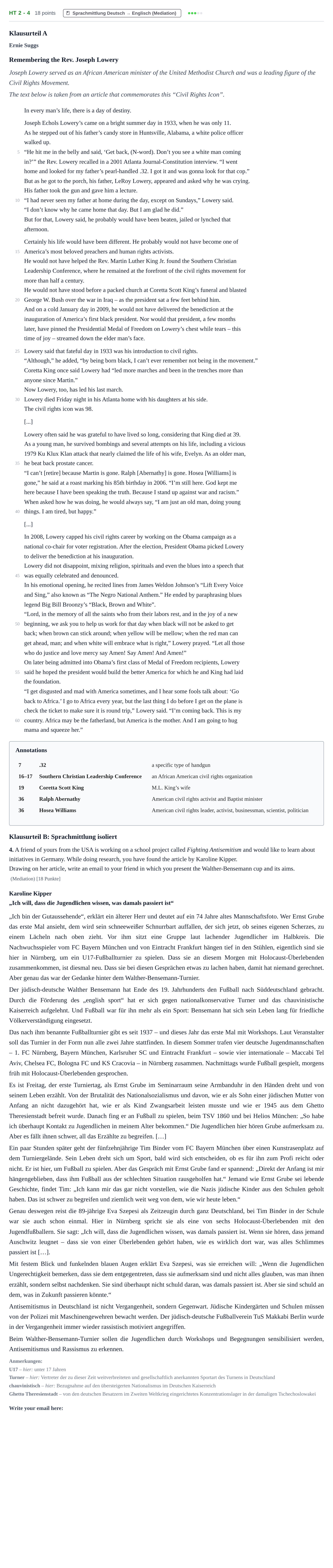
Klausurteil A
Ernie Suggs
Remembering the Rev. Joseph Lowery
Joseph Lowery served as an African American minister of the United Methodist Church and was a leading figure of the Civil Rights Movement.
The text below is taken from an article that commemorates this “Civil Rights Icon”.
In every man’s life, there is a day of destiny.
Joseph Echols Lowery’s came on a bright summer day in 1933, when he was only 11.
As he stepped out of his father’s candy store in Huntsville, Alabama, a white police officer
walked up.
5 “He hit me in the belly and said, ‘Get back, (N-word). Don’t you see a white man coming
in?’” the Rev. Lowery recalled in a 2001 Atlanta Journal-Constitution interview. “I went
home and looked for my father’s pearl-handled.32. I got it and was gonna look for that cop.”
But as he got to the porch, his father, LeRoy Lowery, appeared and asked why he was crying.
His father took the gun and gave him a lecture.
10 “I had never seen my father at home during the day, except on Sundays,” Lowery said.
“I don’t know why he came home that day. But I am glad he did.”
But for that, Lowery said, he probably would have been beaten, jailed or lynched that
afternoon.
Certainly his life would have been different. He probably would not have become one of
15 America’s most beloved preachers and human rights activists.
He would not have helped the Rev. Martin Luther King Jr. found the Southern Christian
Leadership Conference, where he remained at the forefront of the civil rights movement for
more than half a century.
He would not have stood before a packed church at Coretta Scott King’s funeral and blasted
20 George W. Bush over the war in Iraq – as the president sat a few feet behind him.
And on a cold January day in 2009, he would not have delivered the benediction at the
inauguration of America’s first black president. Nor would that president, a few months
later, have pinned the Presidential Medal of Freedom on Lowery’s chest while tears – this
time of joy – streamed down the elder man’s face.
25 Lowery said that fateful day in 1933 was his introduction to civil rights.
“Although,” he added, “by being born black, I can’t ever remember not being in the movement.”
Coretta King once said Lowery had “led more marches and been in the trenches more than
anyone since Martin.”
Now Lowery, too, has led his last march.
30 Lowery died Friday night in his Atlanta home with his daughters at his side.
The civil rights icon was 98.
[...]
Lowery often said he was grateful to have lived so long, considering that King died at 39.
As a young man, he survived bombings and several attempts on his life, including a vicious
1979 Ku Klux Klan attack that nearly claimed the life of his wife, Evelyn. As an older man,
35 he beat back prostate cancer.
“I can’t [retire] because Martin is gone. Ralph [Abernathy] is gone. Hosea [Williams] is
gone,” he said at a roast marking his 85th birthday in 2006. “I’m still here. God kept me
here because I have been speaking the truth. Because I stand up against war and racism.”
When asked how he was doing, he would always say, “I am just an old man, doing young
40 things. I am tired, but happy.”
[...]
In 2008, Lowery capped his civil rights career by working on the Obama campaign as a
national co-chair for voter registration. After the election, President Obama picked Lowery
to deliver the benediction at his inauguration.
Lowery did not disappoint, mixing religion, spirituals and even the blues into a speech that
45 was equally celebrated and denounced.
In his emotional opening, he recited lines from James Weldon Johnson’s “Lift Every Voice
and Sing,” also known as “The Negro National Anthem.” He ended by paraphrasing blues
legend Big Bill Broonzy’s “Black, Brown and White”.
“Lord, in the memory of all the saints who from their labors rest, and in the joy of a new
50 beginning, we ask you to help us work for that day when black will not be asked to get
back; when brown can stick around; when yellow will be mellow; when the red man can
get ahead, man; and when white will embrace what is right,” Lowery prayed. “Let all those
who do justice and love mercy say Amen! Say Amen! And Amen!”
On later being admitted into Obama’s first class of Medal of Freedom recipients, Lowery
55 said he hoped the president would build the better America for which he and King had laid
the foundation.
“I get disgusted and mad with America sometimes, and I hear some fools talk about: ‘Go
back to Africa.’ I go to Africa every year, but the last thing I do before I get on the plane is
check the ticket to make sure it is round trip,” Lowery said. “I’m coming back. This is my
60 country. Africa may be the fatherland, but America is the mother. And I am going to hug
mama and squeeze her.”
Annotations
7 ·.32 · a specific type of handgun
16–17 · Southern Christian Leadership Conference · an African American civil rights organization
19 · Coretta Scott King · M.L. King’s wife
36 · Ralph Abernathy · American civil rights activist and Baptist minister
36 · Hosea Williams · American civil rights leader, activist, businessman, scientist, politician
Klausurteil B: Sprachmittlung isoliert
4. A friend of yours from the USA is working on a school project called Fighting Antisemitism and would like to learn about initiatives in Germany. While doing research, you have found the article by Karoline Kipper.
Drawing on her article, write an email to your friend in which you present the Walther-Bensemann cup and its aims.
(Mediation) [18 Punkte]
Karoline Kipper
„Ich will, dass die Jugendlichen wissen, was damals passiert ist“
„Ich bin der Gutaussehende“, erklärt ein älterer Herr und deutet auf ein 74 Jahre altes Mannschaftsfoto. Wer Ernst Grube das erste Mal ansieht, dem wird sein schneeweißer Schnurrbart auffallen, der sich jetzt, ob seines eigenen Scherzes, zu einem Lächeln nach oben zieht. Vor ihm sitzt eine Gruppe laut lachender Jugendlicher im Halbkreis. Die Nachwuchsspieler vom FC Bayern München und von Eintracht Frankfurt hängen tief in den Stühlen, eigentlich sind sie hier in Nürnberg, um ein U17-Fußballturnier zu spielen. Dass sie an diesem Morgen mit Holocaust-Überlebenden zusammenkommen, ist diesmal neu. Dass sie bei diesen Gesprächen etwas zu lachen haben, damit hat niemand gerechnet. Aber genau das war der Gedanke hinter dem Walther-Bensemann-Turnier.
Der jüdisch-deutsche Walther Bensemann hat Ende des 19. Jahrhunderts den Fußball nach Süddeutschland gebracht. Durch die Förderung des „english sport“ hat er sich gegen nationalkonservative Turner und das chauvinistische Kaiserreich aufgelehnt. Und Fußball war für ihn mehr als ein Sport: Bensemann hat sich sein Leben lang für friedliche Völkerverständigung eingesetzt.
Das nach ihm benannte Fußballturnier gibt es seit 1937 – und dieses Jahr das erste Mal mit Workshops. Laut Veranstalter soll das Turnier in der Form nun alle zwei Jahre stattfinden. In diesem Sommer trafen vier deutsche Jugendmannschaften – 1. FC Nürnberg, Bayern München, Karlsruher SC und Eintracht Frankfurt – sowie vier internationale – Maccabi Tel Aviv, Chelsea FC, Bologna FC und KS Cracovia – in Nürnberg zusammen. Nachmittags wurde Fußball gespielt, morgens früh mit Holocaust-Überlebenden gesprochen.
Es ist Freitag, der erste Turniertag, als Ernst Grube im Seminarraum seine Armbanduhr in den Händen dreht und von seinem Leben erzählt. Von der Brutalität des Nationalsozialismus und davon, wie er als Sohn einer jüdischen Mutter von Anfang an nicht dazugehört hat, wie er als Kind Zwangsarbeit leisten musste und wie er 1945 aus dem Ghetto Theresienstadt befreit wurde. Danach fing er an Fußball zu spielen, beim TSV 1860 und bei Helios München: „So habe ich überhaupt Kontakt zu Jugendlichen in meinem Alter bekommen.“ Die Jugendlichen hier hören Grube aufmerksam zu. Aber es fällt ihnen schwer, all das Erzählte zu begreifen. […]
Ein paar Stunden später geht der fünfzehnjährige Tim Binder vom FC Bayern München über einen Kunstrasenplatz auf dem Turniergelände. Sein Leben dreht sich um Sport, bald wird sich entscheiden, ob es für ihn zum Profi reicht oder nicht. Er ist hier, um Fußball zu spielen. Aber das Gespräch mit Ernst Grube fand er spannend: „Direkt der Anfang ist mir hängengeblieben, dass ihm Fußball aus der schlechten Situation rausgeholfen hat.“ Jemand wie Ernst Grube sei lebende Geschichte, findet Tim: „Ich kann mir das gar nicht vorstellen, wie die Nazis jüdische Kinder aus den Schulen geholt haben. Das ist schwer zu begreifen und ziemlich weit weg von dem, wie wir heute leben.“
Genau deswegen reist die 89-jährige Eva Szepesi als Zeitzeugin durch ganz Deutschland, bei Tim Binder in der Schule war sie auch schon einmal. Hier in Nürnberg spricht sie als eine von sechs Holocaust-Überlebenden mit den Jugendfußballern. Sie sagt: „Ich will, dass die Jugendlichen wissen, was damals passiert ist. Wenn sie hören, dass jemand Auschwitz leugnet – dass sie von einer Überlebenden gehört haben, wie es wirklich dort war, was alles Schlimmes passiert ist […].
Mit festem Blick und funkelnden blauen Augen erklärt Eva Szepesi, was sie erreichen will: „Wenn die Jugendlichen Ungerechtigkeit bemerken, dass sie dem entgegentreten, dass sie aufmerksam sind und nicht alles glauben, was man ihnen erzählt, sondern selbst nachdenken. Sie sind überhaupt nicht schuld daran, was damals passiert ist. Aber sie sind schuld an dem, was in Zukunft passieren könnte.“
Antisemitismus in Deutschland ist nicht Vergangenheit, sondern Gegenwart. Jüdische Kindergärten und Schulen müssen von der Polizei mit Maschinengewehren bewacht werden. Der jüdisch-deutsche Fußballverein TuS Makkabi Berlin wurde in der Vergangenheit immer wieder rassistisch motiviert angegriffen.
Beim Walther-Bensemann-Turnier sollen die Jugendlichen durch Workshops und Begegnungen sensibilisiert werden, Antisemitismus und Rassismus zu erkennen.
Anmerkungen:
U17 – hier: unter 17 Jahren
Turner – hier: Vertreter der zu dieser Zeit weitverbreiteten und gesellschaftlich anerkannten Sportart des Turnens in Deutschland
chauvinistisch – hier: Bezugnahme auf den übersteigerten Nationalismus im Deutschen Kaiserreich
Ghetto Theresienstadt – von den deutschen Besatzern im Zweiten Weltkrieg eingerichtetes Konzentrationslager in der damaligen Tschechoslowakei
Lösung
Nach den offiziellen Korrekturhinweisen
4. Drawing on her article, write an email to your friend in which you present the Walther-Bensemann cup and its aims. (Mediation)
Lösung: Subject: Example for your project: Walther-Bensemann Cup Hi [Friend's Name], I heard you're looking for initiatives from Germany for your school project on fighting antisemitism. I just came across an inspiring article about a youth soccer tournament here called the Walther-Bensemann Cup, and I think it would be a great example for you! The tournament is named after Walther Bensemann, a German-Jewish pioneer who introduced soccer to southern Germany in the late 19th century and dedicated his life to promoting peaceful international understanding through sports. The competition has taken place since 1937, but in 2022 it was redesigned: from now on, every two years, U17 teams from both Germany (like Bayern Munich and Eintracht Frankfurt) and international clubs (such as Maccabi Tel Aviv, Chelsea, and Bologna) meet in Nuremberg. What makes it unique is that the sporting competition is combined with educational workshops and personal discussions with Holocaust survivors. The project pursues several crucial goals: - Educating young people about the Holocaust through direct, personal encounters and open conversations with survivors. - Keeping the memory of the Holocaust alive and preventing distorted or revisionist representations of history (such as Holocaust denial). - Raising awareness among young adults to recognize and actively confront modern antisemitism, discrimination, and marginalization in society and sports. I hope this initiative gives you some valuable insights for your project! Let me know if you need more details. Best, [Your Name]
Die ausführliche Erklärung Schritt für Schritt (mit KI) gibt es mit Premium. Premium
Löse sie direkt hier: automatische Korrektur, Hinweise und Lösung Schritt für Schritt.
‹ Aufgabe HT 1 - 4 · GK · Haupttermin (2) 2023 · Aufgabe 1 · GK · Hunger: Jugend. Macht. Politik 2023 ›
Mehr Aufgaben zu Sprachmittlung Deutsch → Englisch (Mediation)
- Aufgabe HT 1 - Klausurteil B - 4 · GK · Haupttermin 2023
- Aufgabe HT 2 - Klausurteil B - 4 · GK · Haupttermin 2023
- Aufgabe HT 1 - Task 4 · GK · Haupttermin · Weiterbildungskolleg 2023
- Aufgabe HT 2 - Task 4 · GK · Haupttermin · Weiterbildungskolleg 2023
- Aufgabe HT 1 - 4 · GK · Haupttermin (2) 2023
- Aufgabe 1 · GK · Hunger: Jugend. Macht. Politik 2023
- Aufgabe NT 1 - Task 4 · GK · Nachtermin · Weiterbildungskolleg 2023
- Aufgabe NT 2 - Task 4 · GK · Nachtermin · Weiterbildungskolleg 2023
- Aufgabe · GK · Stiftung Jugend forscht e. V.: Hist 2023
- Aufgabe 1 · LK · Freudenberg: Von Sittenwächtern zu 2023