Aufgabe HT 1 - Task 4 · Abitur NRW Englisch GK · Haupttermin · Weiterbildungskolleg 2023
Thema: Sprachmittlung Deutsch → Englisch (Mediation) · Aus der Prüfung GK · Haupttermin · Weiterbildungskolleg (2023)
Aufgabenstellung
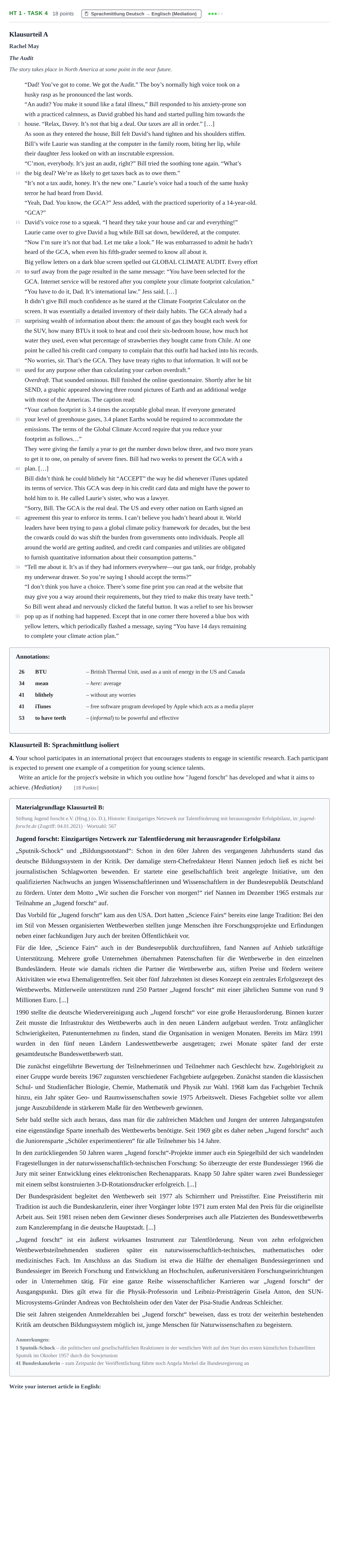
Klausurteil A
Rachel May
The Audit
The story takes place in North America at some point in the near future.
“Dad! You’ve got to come. We got the Audit.” The boy’s normally high voice took on a
husky rasp as he pronounced the last words.
“An audit? You make it sound like a fatal illness,” Bill responded to his anxiety-prone son
with a practiced calmness, as David grabbed his hand and started pulling him towards the
5 house. “Relax, Davey. It’s not that big a deal. Our taxes are all in order.” […]
As soon as they entered the house, Bill felt David’s hand tighten and his shoulders stiffen.
Bill’s wife Laurie was standing at the computer in the family room, biting her lip, while
their daughter Jess looked on with an inscrutable expression.
“C’mon, everybody. It’s just an audit, right?” Bill tried the soothing tone again. “What’s
10 the big deal? We’re as likely to get taxes back as to owe them.”
“It’s not a tax audit, honey. It’s the new one.” Laurie’s voice had a touch of the same husky
terror he had heard from David.
“Yeah, Dad. You know, the GCA?” Jess added, with the practiced superiority of a 14-year-old.
“GCA?”
15 David’s voice rose to a squeak. “I heard they take your house and car and everything!”
Laurie came over to give David a hug while Bill sat down, bewildered, at the computer.
“Now I’m sure it’s not that bad. Let me take a look.” He was embarrassed to admit he hadn’t
heard of the GCA, when even his fifth-grader seemed to know all about it.
Big yellow letters on a dark blue screen spelled out GLOBAL CLIMATE AUDIT. Every effort
20 to surf away from the page resulted in the same message: “You have been selected for the
GCA. Internet service will be restored after you complete your climate footprint calculation.”
“You have to do it, Dad. It’s international law.” Jess said. […]
It didn’t give Bill much confidence as he stared at the Climate Footprint Calculator on the
screen. It was essentially a detailed inventory of their daily habits. The GCA already had a
25 surprising wealth of information about them: the amount of gas they bought each week for
the SUV, how many BTUs it took to heat and cool their six-bedroom house, how much hot
water they used, even what percentage of strawberries they bought came from Chile. At one
point he called his credit card company to complain that this outfit had hacked into his records.
“No worries, sir. That’s the GCA. They have treaty rights to that information. It will not be
30 used for any purpose other than calculating your carbon overdraft.”
Overdraft. That sounded ominous. Bill finished the online questionnaire. Shortly after he hit
SEND, a graphic appeared showing three round pictures of Earth and an additional wedge
with most of the Americas. The caption read:
“Your carbon footprint is 3.4 times the acceptable global mean. If everyone generated
35 your level of greenhouse gases, 3.4 planet Earths would be required to accommodate the
emissions. The terms of the Global Climate Accord require that you reduce your
footprint as follows…”
They were giving the family a year to get the number down below three, and two more years
to get it to one, on penalty of severe fines. Bill had two weeks to present the GCA with a
40 plan. […]
Bill didn’t think he could blithely hit “ACCEPT” the way he did whenever iTunes updated
its terms of service. This GCA was deep in his credit card data and might have the power to
hold him to it. He called Laurie’s sister, who was a lawyer.
“Sorry, Bill. The GCA is the real deal. The US and every other nation on Earth signed an
45 agreement this year to enforce its terms. I can’t believe you hadn’t heard about it. World
leaders have been trying to pass a global climate policy framework for decades, but the best
the cowards could do was shift the burden from governments onto individuals. People all
around the world are getting audited, and credit card companies and utilities are obligated
to furnish quantitative information about their consumption patterns.”
50 “Tell me about it. It’s as if they had informers everywhere—our gas tank, our fridge, probably
my underwear drawer. So you’re saying I should accept the terms?”
“I don’t think you have a choice. There’s some fine print you can read at the website that
may give you a way around their requirements, but they tried to make this treaty have teeth.”
So Bill went ahead and nervously clicked the fateful button. It was a relief to see his browser
55 pop up as if nothing had happened. Except that in one corner there hovered a blue box with
yellow letters, which periodically flashed a message, saying “You have 14 days remaining
to complete your climate action plan.”
Annotations:
26 · BTU · – British Thermal Unit, used as a unit of energy in the US and Canada
34 · mean · – here: average
41 · blithely · – without any worries
41 · iTunes · – free software program developed by Apple which acts as a media player
53 · to have teeth · – ( informal) to be powerful and effective
Klausurteil B: Sprachmittlung isoliert
4. Your school participates in an international project that encourages students to engage in scientific research. Each participant is expected to present one example of a competition for young science talents.
Write an article for the project's website in which you outline how "Jugend forscht" has developed and what it aims to achieve. (Mediation) [18 Punkte]
Materialgrundlage Klausurteil B:
Stiftung Jugend forscht e.V. (Hrsg.) (o. D.), Historie: Einzigartiges Netzwerk zur Talentförderung mit herausragender Erfolgsbilanz, in: jugend-forscht.de (Zugriff: 04.01.2021) · Wortzahl: 567
Jugend forscht: Einzigartiges Netzwerk zur Talentförderung mit herausragender Erfolgsbilanz
„Sputnik-Schock“ und „Bildungsnotstand“: Schon in den 60er Jahren des vergangenen Jahrhunderts stand das deutsche Bildungssystem in der Kritik. Der damalige stern-Chefredakteur Henri Nannen jedoch ließ es nicht bei journalistischen Schlagworten bewenden. Er startete eine gesellschaftlich breit angelegte Initiative, um den qualifizierten Nachwuchs an jungen Wissenschaftlerinnen und Wissenschaftlern in der Bundesrepublik Deutschland zu fördern. Unter dem Motto „Wir suchen die Forscher von morgen!“ rief Nannen im Dezember 1965 erstmals zur Teilnahme an „Jugend forscht“ auf.
Das Vorbild für „Jugend forscht“ kam aus den USA. Dort hatten „Science Fairs“ bereits eine lange Tradition: Bei den im Stil von Messen organisierten Wettbewerben stellten junge Menschen ihre Forschungsprojekte und Erfindungen neben einer fachkundigen Jury auch der breiten Öffentlichkeit vor.
Für die Idee, „Science Fairs“ auch in der Bundesrepublik durchzuführen, fand Nannen auf Anhieb tatkräftige Unterstützung. Mehrere große Unternehmen übernahmen Patenschaften für die Wettbewerbe in den einzelnen Bundesländern. Heute wie damals richten die Partner die Wettbewerbe aus, stiften Preise und fördern weitere Aktivitäten wie etwa Ehemaligentreffen. Seit über fünf Jahrzehnten ist dieses Konzept ein zentrales Erfolgsrezept des Wettbewerbs. Mittlerweile unterstützen rund 250 Partner „Jugend forscht“ mit einer jährlichen Summe von rund 9 Millionen Euro. [...]
1990 stellte die deutsche Wiedervereinigung auch „Jugend forscht“ vor eine große Herausforderung. Binnen kurzer Zeit musste die Infrastruktur des Wettbewerbs auch in den neuen Ländern aufgebaut werden. Trotz anfänglicher Schwierigkeiten, Patenunternehmen zu finden, stand die Organisation in wenigen Monaten. Bereits im März 1991 wurden in den fünf neuen Ländern Landeswettbewerbe ausgetragen; zwei Monate später fand der erste gesamtdeutsche Bundeswettbewerb statt.
Die zunächst eingeführte Bewertung der Teilnehmerinnen und Teilnehmer nach Geschlecht bzw. Zugehörigkeit zu einer Gruppe wurde bereits 1967 zugunsten verschiedener Fachgebiete aufgegeben. Zunächst standen die klassischen Schul- und Studienfächer Biologie, Chemie, Mathematik und Physik zur Wahl. 1968 kam das Fachgebiet Technik hinzu, ein Jahr später Geo- und Raumwissenschaften sowie 1975 Arbeitswelt. Dieses Fachgebiet sollte vor allem junge Auszubildende in stärkerem Maße für den Wettbewerb gewinnen.
Sehr bald stellte sich auch heraus, dass man für die zahlreichen Mädchen und Jungen der unteren Jahrgangsstufen eine eigenständige Sparte innerhalb des Wettbewerbs benötigte. Seit 1969 gibt es daher neben „Jugend forscht“ auch die Juniorensparte „Schüler experimentieren“ für alle Teilnehmer bis 14 Jahre.
In den zurückliegenden 50 Jahren waren „Jugend forscht“-Projekte immer auch ein Spiegelbild der sich wandelnden Fragestellungen in der naturwissenschaftlich-technischen Forschung: So überzeugte der erste Bundessieger 1966 die Jury mit seiner Entwicklung eines elektronischen Rechenapparats. Knapp 50 Jahre später waren zwei Bundessieger mit einem selbst konstruierten 3-D-Rotationsdrucker erfolgreich. [...]
Der Bundespräsident begleitet den Wettbewerb seit 1977 als Schirmherr und Preisstifter. Eine Preisstifterin mit Tradition ist auch die Bundeskanzlerin, einer ihrer Vorgänger lobte 1971 zum ersten Mal den Preis für die originellste Arbeit aus. Seit 1981 reisen neben dem Gewinner dieses Sonderpreises auch alle Platzierten des Bundeswettbewerbs zum Kanzlerempfang in die deutsche Hauptstadt. [...]
„Jugend forscht“ ist ein äußerst wirksames Instrument zur Talentförderung. Neun von zehn erfolgreichen Wettbewerbsteilnehmenden studieren später ein naturwissenschaftlich-technisches, mathematisches oder medizinisches Fach. Im Anschluss an das Studium ist etwa die Hälfte der ehemaligen Bundessiegerinnen und Bundessieger im Bereich Forschung und Entwicklung an Hochschulen, außeruniversitären Forschungseinrichtungen oder in Unternehmen tätig. Für eine ganze Reihe wissenschaftlicher Karrieren war „Jugend forscht“ der Ausgangspunkt. Dies gilt etwa für die Physik-Professorin und Leibniz-Preisträgerin Gisela Anton, den SUN-Microsystems-Gründer Andreas von Bechtolsheim oder den Vater der Pisa-Studie Andreas Schleicher.
Die seit Jahren steigenden Anmeldezahlen bei „Jugend forscht“ beweisen, dass es trotz der weiterhin bestehenden Kritik am deutschen Bildungssystem möglich ist, junge Menschen für Naturwissenschaften zu begeistern.
Anmerkungen:
1 Sputnik-Schock – die politischen und gesellschaftlichen Reaktionen in der westlichen Welt auf den Start des ersten künstlichen Erdsatelliten Sputnik im Oktober 1957 durch die Sowjetunion
41 Bundeskanzlerin – zum Zeitpunkt der Veröffentlichung führte noch Angela Merkel die Bundesregierung an
Lösung
Nach den offiziellen Korrekturhinweisen
Write an article for the project's website in which you outline how "Jugend forscht" has developed and what it aims to achieve.
Lösung: Sample outline / criteria for the internet article: Headline / Introduction: An engaging title suitable for an internet article (e.g. *Fostering Tomorrow’s Scientists: Germany’s 'Jugend forscht'*), establishing the purpose for the international project website. Development of 'Jugend forscht': - Initiated in 1965 by Henri Nannen (editor-in-chief of *stern*) in response to public criticism of the German education system ("Sputnik crisis" / "educational crisis"). - Modelled after American science fairs where young people present projects to a jury and the general public. - Immediate strong support and sponsorship from major companies providing financial funding and organizing regional contests (today ~250 partners with ~€9 million annually). - Swift integration of East German federal states after reunification in 1990/1991. - Categorization by subject discipline (initially biology, chemistry, maths, physics; later tech, earth/space sciences, and in 1975 the world of work to attract apprentices) rather than gender/group. - In 1969, establishment of the junior division 'Schüler experimentieren' for pupils up to age 14. - Long-standing political patronage by the Federal President (since 1977) and Chancellor (annual reception). Goals of 'Jugend forscht': - Promote young scientific talent early while still at school. - Publicly recognize and reward outstanding early scientific and technical achievements. - Spark interest in STEM/medical questions and encourage future university studies and careers in science/research.
Die ausführliche Erklärung Schritt für Schritt (mit KI) gibt es mit Premium. Premium
Löse sie direkt hier: automatische Korrektur, Hinweise und Lösung Schritt für Schritt.
‹ Aufgabe HT 2 - Klausurteil B - 4 · GK · Haupttermin 2023 · Aufgabe HT 2 - Task 4 · GK · Haupttermin · Weiterbildungskolleg 2023 ›
Mehr Aufgaben zu Sprachmittlung Deutsch → Englisch (Mediation)
- Aufgabe · LK · Scholz: Auf sich gestellt 2024
- Aufgabe 1 · LK · von Brackel: Es krabbelt noch viel 2024
- Aufgabe 1 · GK · Dernbach: Tief Ahmet, Hoch Dragica 2023
- Aufgabe HT 1 - Klausurteil B - 4 · GK · Haupttermin 2023
- Aufgabe HT 2 - Klausurteil B - 4 · GK · Haupttermin 2023
- Aufgabe HT 2 - Task 4 · GK · Haupttermin · Weiterbildungskolleg 2023
- Aufgabe HT 1 - 4 · GK · Haupttermin (2) 2023
- Aufgabe HT 2 - 4 · GK · Haupttermin (2) 2023
- Aufgabe 1 · GK · Hunger: Jugend. Macht. Politik 2023
- Aufgabe NT 1 - Task 4 · GK · Nachtermin · Weiterbildungskolleg 2023