Aufgabe 1 - Teilaufgabe 1: Umweltfaktoren und öko… · Abitur NRW Biologie GK · Haupttermin · bilingual Englisch 2023
Thema: Umweltfaktoren und ökologische Nische · Aus der Prüfung GK · Haupttermin · bilingual Englisch (2023)
Aufgabenstellung
Material A: The Genus Ariamnes on the Hawaii Archipelago
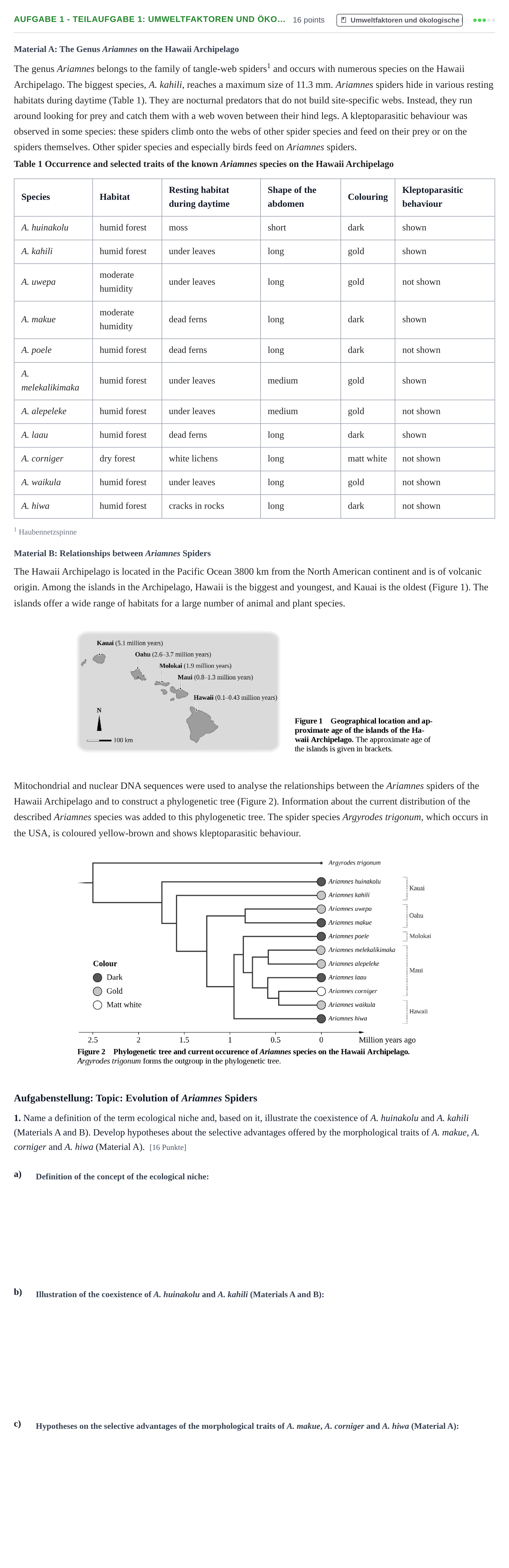
The genus Ariamnes belongs to the family of tangle-web spiders 1 and occurs with numerous species on the Hawaii Archipelago. The biggest species, A. kahili, reaches a maximum size of 11.3 mm. Ariamnes spiders hide in various resting habitats during daytime (Table 1). They are nocturnal predators that do not build site-specific webs. Instead, they run around looking for prey and catch them with a web woven between their hind legs. A kleptoparasitic behaviour was observed in some species: these spiders climb onto the webs of other spider species and feed on their prey or on the spiders themselves. Other spider species and especially birds feed on Ariamnes spiders.
Table 1 Occurrence and selected traits of the known Ariamnes species on the Hawaii Archipelago
Species · Habitat · Resting habitat during daytime · Shape of the abdomen · Colouring · Kleptoparasitic behaviour
A. huinakolu · humid forest · moss · short · dark · shown
A. kahili · humid forest · under leaves · long · gold · shown
A. uwepa · moderate humidity · under leaves · long · gold · not shown
A. makue · moderate humidity · dead ferns · long · dark · shown
A. poele · humid forest · dead ferns · long · dark · not shown
A. melekalikimaka · humid forest · under leaves · medium · gold · shown
A. alepeleke · humid forest · under leaves · medium · gold · not shown
A. laau · humid forest · dead ferns · long · dark · shown
A. corniger · dry forest · white lichens · long · matt white · not shown
A. waikula · humid forest · under leaves · long · gold · not shown
A. hiwa · humid forest · cracks in rocks · long · dark · not shown
1 Haubennetzspinne
Material B: Relationships between Ariamnes Spiders
The Hawaii Archipelago is located in the Pacific Ocean 3800 km from the North American continent and is of volcanic origin. Among the islands in the Archipelago, Hawaii is the biggest and youngest, and Kauai is the oldest (Figure 1). The islands offer a wide range of habitats for a large number of animal and plant species.
Mitochondrial and nuclear DNA sequences were used to analyse the relationships between the Ariamnes spiders of the Hawaii Archipelago and to construct a phylogenetic tree (Figure 2). Information about the current distribution of the described Ariamnes species was added to this phylogenetic tree. The spider species Argyrodes trigonum, which occurs in the USA, is coloured yellow-brown and shows kleptoparasitic behaviour.
Aufgabenstellung: Topic: Evolution of Ariamnes Spiders
1. Name a definition of the term ecological niche and, based on it, illustrate the coexistence of A. huinakolu and A. kahili (Materials A and B). Develop hypotheses about the selective advantages offered by the morphological traits of A. makue, A. corniger and A. hiwa (Material A). [16 Punkte]
a)
b)
c)
Lösung
Nach den offiziellen Korrekturhinweisen
Name a definition of the term ecological niche
Lösung: Die ökologische Nische beschreibt die Gesamtheit der Beziehungen zwischen einer Art und ihrer Umwelt, wobei sowohl biotische als auch abiotische Faktoren berücksichtigt werden (Gesamtheit aller Umweltfaktoren, die das Überleben und die Fortpflanzung einer Art ermöglichen).
Illustrate the coexistence of A. huinakolu and A. kahili (Materials A and B)
Lösung: Beide Arten kommen sympatrisch in Feuchtwäldern auf der Insel Kauai vor. Eine dauerhafte Koexistenz wird durch Konkurrenzvermeidung (Einnischung) ermöglicht, da sie sich in ihren ökologischen Nischen unterscheiden: A. huinakolu nutzt tagsüber Moos als Ruhehabitat und besitzt einen kurzen Hinterleib, während sich A. kahili unter Blättern versteckt und einen langen, goldenen Hinterleib besitzt.
Develop hypotheses about the selective advantages offered by the morphological traits of A. makue, A. corniger and A. hiwa (Material A)
Lösung: Die Färbung und Körperform bieten in den jeweiligen Ruhehabitaten Schutz vor optisch jagenden Räubern (Vögeln): - *A. makue*: Die dunkle Färbung tarnt zwischen abgestorbenen Farnen. - *A. corniger*: Die matt-weiße Färbung tarnt auf/zwischen weißen Flechten im trockenen Wald. - *A. hiwa*: Die dunkle Färbung tarnt in dunklen Felsspalten. - Der langgestreckte Hinterleib aller drei Arten imitiert Pflanzenteile (Mimese von Zweigen/Bodenstreu) und erleichtert bei *A. hiwa* das Hineinschlüpfen in schmale Felsspalten.
Die ausführliche Erklärung Schritt für Schritt (mit KI) gibt es mit Premium. Premium
Löse sie direkt hier: automatische Korrektur, Hinweise und Lösung Schritt für Schritt.
‹ Aufgabe 1 - Umweltfaktoren und ökologische Nische · GK · Haupttermin 2023 · Aufgabe 1 - Ökologische Nische · GK · Haupttermin · Weiterbildungskolleg 2023 ›
Mehr Aufgaben zu Umweltfaktoren und ökologische Nische
- Aufgabe 2 bis 4 - Umweltfaktoren und ökologische Nische · LK · Ostsee 2025
- Aufgabe 1 · LK · Salztoleranz-EN 2025
- Aufgabe 4 · LK · Salztoleranz-EN 2025
- Teilaufgabe 2 - Umweltfaktoren und ökologische Ni… · LK · Seetang-Wälder 2025
- Aufgabe 1 - Umweltfaktoren und ökologische Nische · GK · Haupttermin 2023
- Aufgabe 1 - Ökologische Nische · GK · Haupttermin · Weiterbildungskolleg 2023
- Aufgabe 3 - Teilaufgabe 2: Umweltfaktoren und öko… · GK · Nachtermin 2023
- Aufgabe 1 - Ökologische Nische · GK · Nachtermin · Weiterbildungskolleg 2023
- Aufgabe 3 - Umweltfaktoren und ökologische Nische · GK · Nachtermin · Weiterbildungskolleg 2023
- Aufgabe 1 - Umweltfaktoren und ökologische Nische · LK · Haupttermin 2023