Aufgabe 2 - Nervenzelle: Membranpotenziale und Er… · Abitur NRW Biologie GK · Haupttermin · bilingual Englisch 2021
Thema: Nervenzelle: Membranpotenziale und Erregungsleitung · Aus der Prüfung GK · Haupttermin · bilingual Englisch (2021)
Aufgabenstellung
Material A: Sense of Smell in Lobesia botrana
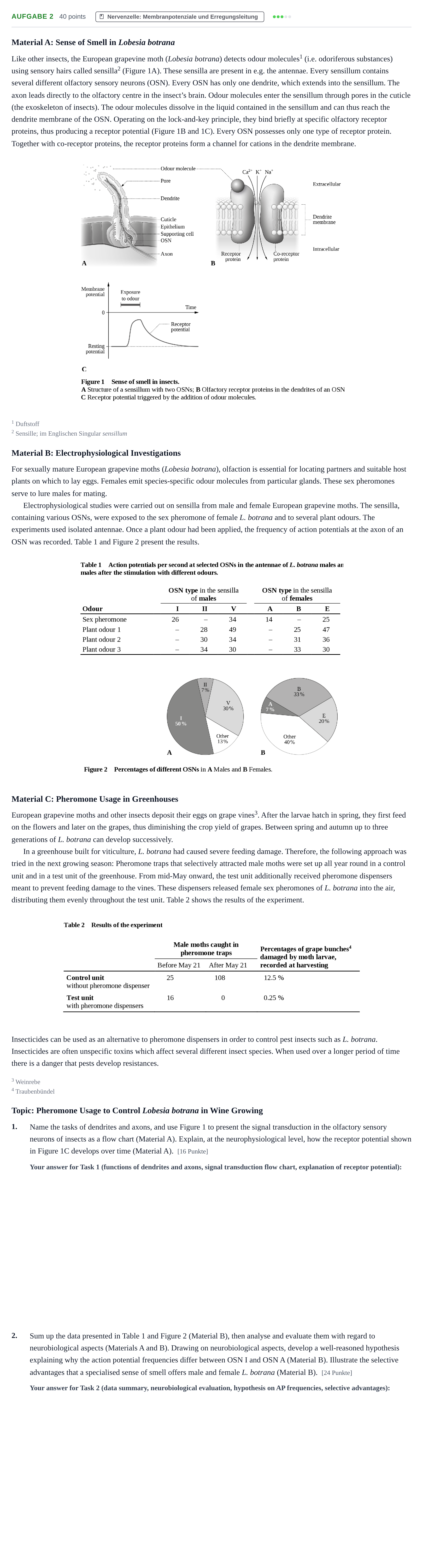
Like other insects, the European grapevine moth ( Lobesia botrana) detects odour molecules 1 (i.e. odoriferous substances) using sensory hairs called sensilla 2 (Figure 1A). These sensilla are present in e.g. the antennae. Every sensillum contains several different olfactory sensory neurons (OSN). Every OSN has only one dendrite, which extends into the sensillum. The axon leads directly to the olfactory centre in the insect’s brain. Odour molecules enter the sensillum through pores in the cuticle (the exoskeleton of insects). The odour molecules dissolve in the liquid contained in the sensillum and can thus reach the dendrite membrane of the OSN. Operating on the lock-and-key principle, they bind briefly at specific olfactory receptor proteins, thus producing a receptor potential (Figure 1B and 1C). Every OSN possesses only one type of receptor protein. Together with co-receptor proteins, the receptor proteins form a channel for cations in the dendrite membrane.
1 Duftstoff
2 Sensille; im Englischen Singular sensillum
Material B: Electrophysiological Investigations
For sexually mature European grapevine moths ( Lobesia botrana), olfaction is essential for locating partners and suitable host plants on which to lay eggs. Females emit species-specific odour molecules from particular glands. These sex pheromones serve to lure males for mating.
Electrophysiological studies were carried out on sensilla from male and female European grapevine moths. The sensilla, containing various OSNs, were exposed to the sex pheromone of female L. botrana and to several plant odours. The experiments used isolated antennae. Once a plant odour had been applied, the frequency of action potentials at the axon of an OSN was recorded. Table 1 and Figure 2 present the results.
Material C: Pheromone Usage in Greenhouses
European grapevine moths and other insects deposit their eggs on grape vines 3. After the larvae hatch in spring, they first feed on the flowers and later on the grapes, thus diminishing the crop yield of grapes. Between spring and autumn up to three generations of L. botrana can develop successively.
In a greenhouse built for viticulture, L. botrana had caused severe feeding damage. Therefore, the following approach was tried in the next growing season: Pheromone traps that selectively attracted male moths were set up all year round in a control unit and in a test unit of the greenhouse. From mid-May onward, the test unit additionally received pheromone dispensers meant to prevent feeding damage to the vines. These dispensers released female sex pheromones of L. botrana into the air, distributing them evenly throughout the test unit. Table 2 shows the results of the experiment.
Insecticides can be used as an alternative to pheromone dispensers in order to control pest insects such as L. botrana. Insecticides are often unspecific toxins which affect several different insect species. When used over a longer period of time there is a danger that pests develop resistances.
3 Weinrebe
4 Traubenbündel
Topic: Pheromone Usage to Control Lobesia botrana in Wine Growing
1.
Name the tasks of dendrites and axons, and use Figure 1 to present the signal transduction in the olfactory sensory neurons of insects as a flow chart (Material A). Explain, at the neurophysiological level, how the receptor potential shown in Figure 1C develops over time (Material A). [16 Punkte]
2.
Sum up the data presented in Table 1 and Figure 2 (Material B), then analyse and evaluate them with regard to neurobiological aspects (Materials A and B). Drawing on neurobiological aspects, develop a well-reasoned hypothesis explaining why the action potential frequencies differ between OSN I and OSN A (Material B). Illustrate the selective advantages that a specialised sense of smell offers male and female L. botrana (Material B). [24 Punkte]
Lösung
Nach den offiziellen Korrekturhinweisen
1. Name the tasks of dendrites and axons, and use Figure 1 to present the signal transduction in the olfactory sensory neurons of insects as a flow chart (Material A). Explain, at the neurophysiological level, how the receptor potential shown in Figure 1C develops over time (Material A).
Lösung: 1. Funktionen: - Dendriten nehmen Reize bzw. Signale auf und leiten diese zum Soma (Zellkörper) weiter. - Axone empfangen elektrische Erregung vom Soma/Axonhügel und leiten diese in Form von Aktionspotenzialen weiter. 2. Fließschema zur Signaltransduktion: Duftstoffmolekül (aus der Luft / Pore) Bindung an spezifisches Geruchsrezeptorprotein in der Dendritenmembran Konformationsänderung / Öffnung des Kationenkanals (Rezeptor- und Co-Rezeptor-Komplex) Einstrom von Kationen () ins Zellinnere Depolarisation der Membran Entstehung eines Rezeptorpotenzials. 3. Verlauf des Rezeptorpotenzials (Abb. 1C): - Verzögerung: Nach Zugabe des Duftstoffes erfolgt die Depolarisation mit einer leichten zeitlichen Verzögerung, da die Diffusion der Duftstoffmoleküle durch die Poren der Cuticula in die Sensillenflüssigkeit und zu den Rezeptorproteinen Zeit benötigt. - Rascher Anstieg: Mit zunehmender Bindung von Duftstoffmolekülen an Rezeptoren öffnen sich immer mehr Kationenkanäle. Der Einstrom positiv geladener Ionen bewirkt eine schnelle Depolarisation (Rezeptorpotenzial als abgestuftes Potenzial). - Repolarisation / Abklingen: Nach Beendigung des Reizes lösen sich die Moleküle von den Rezeptoren (oder werden enzymatisch inaktiviert/abtransportiert), die Ionenkanäle schließen sich und über Transportmechanismen (z. B. Ionenpumpen) wird das Ruhepotenzial wiederhergestellt.
2. Sum up the data presented in Table 1 and Figure 2 (Material B), then analyse and evaluate them with regard to neurobiological aspects (Materials A and B). Drawing on neurobiological aspects, develop a well-reasoned hypothesis explaining why the action potential frequencies differ between OSN I and OSN A (Material B). Illustrate the selective advantages that a specialised sense of smell offers male and female L. botrana (Material B).
Lösung: 1. Zusammenfassung der Daten (Tab. 1, Abb. 2): - OSN I (Männchen) und OSN A (Weibchen) feuern ausschließlich bei Reizung mit dem weiblichen Sexualpheromon (26 bzw. 14 AP/s), nicht bei Pflanzendüften. - OSN II (Männchen) und OSN B (Weibchen) feuern ausschließlich bei Pflanzendüften (28–34 bzw. 25–33 AP/s), nicht beim Sexualpheromon. - OSN V (Männchen) und OSN E (Weibchen) reagieren unspezifisch auf alle getesteten Düfte. - Häufigkeitsverteilung: Bei Männchen machen die phero-spezifischen OSN I die Hälfte (50 %) aller OSNs aus (OSN II nur 7 %). Bei Weibchen stellen die pflanzenduft-spezifischen OSN B 33 % dar, während OSN A nur 7 % ausmacht. 2. Neurobiologische Auswertung: - Die Spezifität beruht auf den jeweiligen spezifischen Rezeptorproteinen in den OSN-Dendriten. - Bindung führt zu Depolarisation und Aktionspotenzialfolgen im Axon. Die Gesamtempfindlichkeit eines Individuums für einen Duft steigt mit der relativen Anzahl der entsprechenden Sinneszellen. - Männchen sind daher hochgradig auf die Wahrnehmung des Sexualpheromons optimiert, Weibchen stärker auf Wirtspflanzendüfte. 3. Hypothese zu den Frequenzen (OSN I vs. OSN A): - OSN I bei Männchen bildet bei gleicher Pheromonreizung 26 AP/s, OSN A bei Weibchen nur 14 AP/s. - *Hypothese:* OSN I besitzt eine höhere Dichte an spezifischen Pheromon-Rezeptorproteinen (oder sensitivere Rezeptoren/Kopplung) in der Dendritenmembran als OSN A. Bei gleicher Duftstoffmenge strömen somit mehr Kationen ein, was zu einer stärkeren Depolarisation des Rezeptorpotenzials und damit zu einer höheren AP-Frequenz am Axonhügel führt. 4. Selektionsvorteile: - Männchen: Müssen flugfähige, seltene Weibchen über weite Distanzen anhand geringster Pheromonspuren lokalisieren. Hohe Sensitivität (50 % OSN I, höhere AP-Frequenz) sichert schnelles Auffinden und Fortpflanzungserfolg. - Weibchen: Das eigene Pheromon muss nicht hochempfindlich wahrgenommen werden. Wichtiger ist das Auffinden geeigneter Wirtspflanzen zur Eiablage, damit die Nachkommen Nahrung finden. Daher ist der hohe Anteil an OSN B (33 %) selektiv vorteilhaft.
Die ausführliche Erklärung Schritt für Schritt (mit KI) gibt es mit Premium. Premium
Löse sie direkt hier: automatische Korrektur, Hinweise und Lösung Schritt für Schritt.
‹ Aufgabe 2 (1–2) - Nervenzelle: Membranpotenziale… · GK · Haupttermin 2021 · Aufgabe 2 - Teilaufgaben 1 und 2 · GK · Haupttermin · Weiterbildungskolleg 2021 ›
Mehr Aufgaben zu Nervenzelle: Membranpotenziale und Erregungsleitung
- Aufgabe 1 - Nervenzelle: Membranpotenziale und Er… · LK · Nachtermin 2022
- Aufgabe 2 - Nervenzelle: Membranpotenziale und Er… · LK · Nachtermin 2022
- Aufgabe 1 - Nervenzelle: Membranpotenziale und Er… · LK · Nachtermin · Weiterbildungskolleg 2022
- Aufgabe 2 - Nervenzelle: Membranpotenziale und Er… · LK · Nachtermin · Weiterbildungskolleg 2022
- Aufgabe 2 (1–2) - Nervenzelle: Membranpotenziale… · GK · Haupttermin 2021
- Aufgabe 2 - Teilaufgaben 1 und 2 · GK · Haupttermin · Weiterbildungskolleg 2021
- Aufgabe 2 - Nervenzelle: Membranpotenziale und Er… · GK · Nachtermin 2021
- Aufgabe 3 - Nervenzelle: Membranpotenziale und Er… · GK · Nachtermin 2021
- Aufgabe 1 - Neurobiologie · LK · Haupttermin · Weiterbildungskolleg 2021
- Aufgabe 3 - Neurobiologie · LK · Haupttermin · Weiterbildungskolleg 2021