Aufgabe 3 - Humangenetik, Gendiagnostik und Gente… · Abitur NRW Biologie GK · Haupttermin · bilingual Englisch 2021
Thema: Humangenetik, Gendiagnostik und Gentechnik · Aus der Prüfung GK · Haupttermin · bilingual Englisch (2021)
Aufgabenstellung
Material A: Warmblood Fragile Foal Syndrome in Horse Breeding
Warmblood fragile foal syndrome (WFFS) is a hereditary disease in horses which leads to an incurable connective tissue disorder. Foals affected by WFFS show symptoms immediately after birth. Already in the first hours of life, they contract injuries in the ligaments, tendons and bones, which hardly heal and are eventually fatal. WFFS is inherited in an autosomal recessive pattern.
Although WFFS has been in existence for an estimated 170 years, an increase in cases has been documented since 2011. Between six and eleven percent of all horses are carriers of this gene defect. Horses which have been bred for equestrian sports 1 are especially affected. In breeding, one breeding stallion 2 is mated with several female horses. Scientists suspect a connection between the mutation underlying WFFS and the traits desired in the breeding of sports horses, such as a high level of agility.
1 Pferdesport
2 Zuchthengst
Material B: Molecular genetic causes of WFFS
Connective tissue consists mostly of collagen. Collagen is a fibrous protein which is involved in the production of connective tissues – such as in the skin, blood vessels, tendons and cartilage – as well as in the production of bones and teeth. Up to 25 % of the protein in a human or animal body consists of collagen. The gene PLOD1 codes for the enzyme lysyl-hydroxylase 1 (LH1), which is involved in an intermediate step in the synthesis of stable collagen fibres. In order to gain insights into the molecular genetic causes of WFFS, the PLOD1 gene was sequenced (Table 1).
Table 1 Section of the non-template strand of the PLOD1 gene of a healthy foal and a foal affected by WFFS. · Number of triplet
691 · 692 · 693 · 694 · 695 · 696 · 697
Normal allele · TAC · GAG · GGC · GGG · GGC · TGT · CGG · 5' → 3'
Mutated allele · TAC · GAG · GGC · AGG · GGC · TGT · CGG · 5' → 3'
Material C: Detecting WFFS
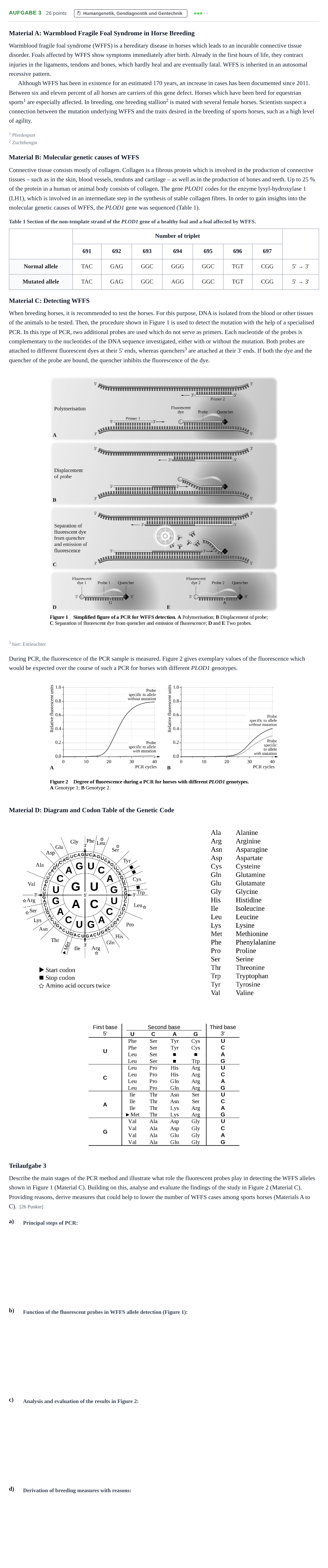
When breeding horses, it is recommended to test the horses. For this purpose, DNA is isolated from the blood or other tissues of the animals to be tested. Then, the procedure shown in Figure 1 is used to detect the mutation with the help of a specialised PCR. In this type of PCR, two additional probes are used which do not serve as primers. Each nucleotide of the probes is complementary to the nucleotides of the DNA sequence investigated, either with or without the mutation. Both probes are attached to different fluorescent dyes at their 5' ends, whereas quenchers 3 are attached at their 3' ends. If both the dye and the quencher of the probe are bound, the quencher inhibits the fluorescence of the dye.
3 hier: Entleuchter
During PCR, the fluorescence of the PCR sample is measured. Figure 2 gives exemplary values of the fluorescence which would be expected over the course of such a PCR for horses with different PLOD1 genotypes.
Material D: Diagram and Codon Table of the Genetic Code
Teilaufgabe 3
Describe the main stages of the PCR method and illustrate what role the fluorescent probes play in detecting the WFFS alleles shown in Figure 1 (Material C). Building on this, analyse and evaluate the findings of the study in Figure 2 (Material C). Providing reasons, derive measures that could help to lower the number of WFFS cases among sports horses (Materials A to C). [26 Punkte]
a)
b)
c)
d)
Lösung
Nach den offiziellen Korrekturhinweisen
Describe the main stages of the PCR method
Lösung: - Der PCR-Prozess umfasst etwa 20 bis 40 Zyklen. Jeder Zyklus besteht aus drei Schritten: Denaturierung, (Primer-)Hybridisierung sowie Polymerisation. - Denaturierung: Die doppelsträngige DNA wird auf etwa 95 °C erhitzt, wodurch die Wasserstoffbrücken zwischen den beiden DNA-Strängen gelöst und die DNA in Einzelstränge getrennt wird. - Hybridisierung: Der PCR-Ansatz wird auf eine Temperatur zwischen 40 und 55 °C abgekühlt, sodass die Primer komplementär an je einen der Einzelstränge binden. - Polymerisation: Eine hitzestabile DNA-Polymerase synthetisiert einen neuen DNA-Einzelstrang, indem sie komplementär zum Vorlagenstrang Nukleotide an das 3'-Ende der Primer anfügt.
Illustrate what role the fluorescent probes play in detecting the WFFS alleles shown in Figure 1 (Material C)
Lösung: - Die eingesetzten Sonden, die entweder komplementär zu der Sequenz mit Mutation oder zu derjenigen ohne Mutation sind, sind mit unterschiedlichen Fluoreszenz-Farbstoffen markiert. - Stößt die DNA-Polymerase bei der Synthese auf die Sonde, wird der Fluoreszenz-Farbstoff abgespalten und seine Fluoreszenz somit nicht mehr durch den ebenfalls an die Sonde gebundenen Entleuchter unterdrückt. Das Fluoreszenzsignal kann aufgezeichnet werden. - Da die jeweilige Sonde nukleotidgenau mit ihrem komplementär passenden Allelausschnitt hybridisiert, zeigt die Fluoreszenz ihres Farbstoffs das Vorliegen der nukleotidgenau passenden Bindungsstelle auf der amplifizierten DNA an.
Analyse and evaluate the findings of the study in Figure 2 (Material C)
Lösung: - Abbildung 2A: In diesem PCR-Ansatz wurde ab ungefähr dem 20. PCR-Zyklus eine starke Zunahme fluoreszierenden Lichts hinsichtlich der Sonde für das Allel ohne Mutation gemessen. Das ist damit zu erklären, dass ein in Bezug auf WFFS homozygot gesundes Pferd nur das normale PLOD1-Allel besitzt. Folglich konnte nur die für das Normalallel spezifische Sonde komplementär binden und während der PCR der an sie gekoppelte Fluoreszenzfarbstoff freigesetzt werden. - Abbildung 2B: In diesem PCR-Ansatz konnten Fluoreszenzsignale beider Farbstoffe gemessen werden. Das ist damit zu erklären, dass ein in Bezug auf WFFS heterozygotes Pferd ein normales sowie ein mutiertes PLOD1-Allel besitzt, sodass beide Sonden am jeweiligen Allel binden und der jeweilige Farbstoff freigesetzt werden konnte. - Die ermittelte Signalstärke der Sonde für das Allel mit Mutation ist in Abbildung 2B deutlich stärker als in Abbildung 2A, was durch die Heterozygotie zu begründen ist.
Providing reasons, derive measures that could help to lower the number of WFFS cases among sports horses (Materials A to C)
Lösung: - Ein positiv getestetes Pferd sollte entweder nicht mehr zur weiteren Zucht eingesetzt oder nur noch mit Pferden verpaart werden, die ihrerseits auf WFFS getestet wurden und sich als homozygot gesund erwiesen haben. - Nur wenn Konduktoren der Krankheit konsequent von der Zucht ausgeschlossen werden, besteht die Möglichkeit, eine weitere Verbreitung des WFFS-Allels unter Pferden zu verhindern und das Allel langfristig aus dem Genpool der Pferdepopulationen zu eliminieren.
Die ausführliche Erklärung Schritt für Schritt (mit KI) gibt es mit Premium. Premium
Löse sie direkt hier: automatische Korrektur, Hinweise und Lösung Schritt für Schritt.
‹ Aufgabe 3 (3) - Humangenetik, Gendiagnostik und G… · GK · Haupttermin 2021 · Aufgabe 3 - Teilaufgabe 3 · GK · Haupttermin · Weiterbildungskolleg 2021 ›
Mehr Aufgaben zu Humangenetik, Gendiagnostik und Gentechnik
- Aufgabe HT 3 - 3: Humangenetik, Gendiagnostik und Gentech… · GK · Haupttermin · Weiterbildungskolleg 2022
- Aufgabe 3 - Teilaufgabe 2: Humangenetik, Gendiagn… · GK · Nachtermin 2022
- Aufgabe 2 - Humangenetik, Gendiagnostik und Gente… · LK · Nachtermin 2022
- Aufgabe 2 - Humangenetik, Gendiagnostik und Gente… · LK · Nachtermin · Weiterbildungskolleg 2022
- Aufgabe 3 (3) - Humangenetik, Gendiagnostik und G… · GK · Haupttermin 2021
- Aufgabe 3 - Teilaufgabe 3 · GK · Haupttermin · Weiterbildungskolleg 2021
- Aufgabe 1 - Gentechnik · GK · Haupttermin · Weiterbildungskolleg 2021
- Aufgabe 2 - Humangenetik und Gentechnik · GK · Haupttermin · Weiterbildungskolleg 2021
- Aufgabe 3 - Humangenetik, Gendiagnostik und Gente… · GK · Nachtermin 2021
- Aufgabe 2 - Genetik · LK · Haupttermin · Weiterbildungskolleg 2021