Aufgabe 3 - Evolutionsfaktoren und Artbildung · Abitur NRW Biologie GK · Haupttermin · bilingual Englisch 2021
Thema: Evolutionsfaktoren und Artbildung · Aus der Prüfung GK · Haupttermin · bilingual Englisch (2021)
Aufgabenstellung
Material A: Warmblood Fragile Foal Syndrome in Horse Breeding
Warmblood fragile foal syndrome (WFFS) is a hereditary disease in horses which leads to an incurable connective tissue disorder. Foals affected by WFFS show symptoms immediately after birth. Already in the first hours of life, they contract injuries in the ligaments, tendons and bones, which hardly heal and are eventually fatal. WFFS is inherited in an autosomal recessive pattern.
Although WFFS has been in existence for an estimated 170 years, an increase in cases has been documented since 2011. Between six and eleven percent of all horses are carriers of this gene defect. Horses which have been bred for equestrian sports 1 are especially affected. In breeding, one breeding stallion 2 is mated with several female horses. Scientists suspect a connection between the mutation underlying WFFS and the traits desired in the breeding of sports horses, such as a high level of agility.
1 Pferdesport
2 Zuchthengst
Material B: Molecular genetic causes of WFFS
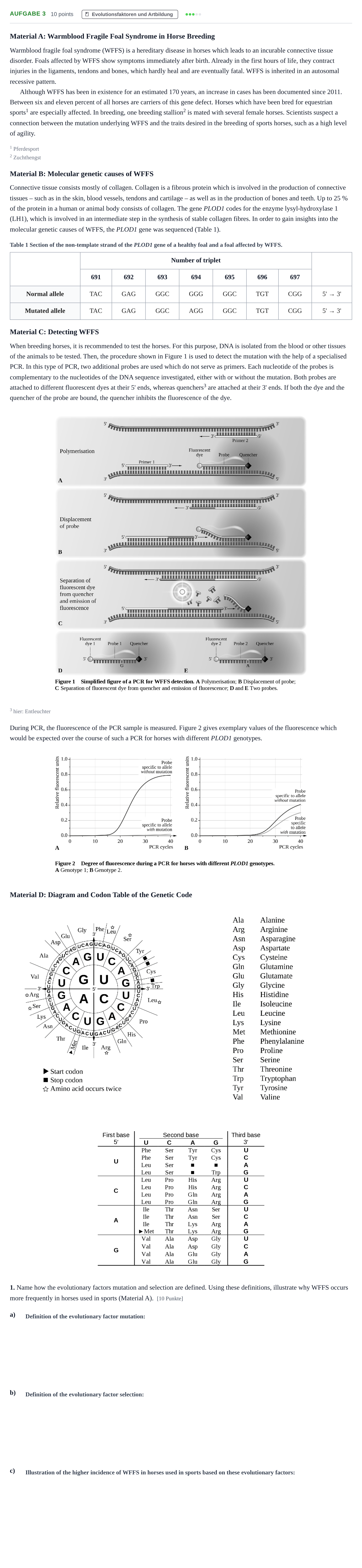
Connective tissue consists mostly of collagen. Collagen is a fibrous protein which is involved in the production of connective tissues – such as in the skin, blood vessels, tendons and cartilage – as well as in the production of bones and teeth. Up to 25 % of the protein in a human or animal body consists of collagen. The gene PLOD1 codes for the enzyme lysyl-hydroxylase 1 (LH1), which is involved in an intermediate step in the synthesis of stable collagen fibres. In order to gain insights into the molecular genetic causes of WFFS, the PLOD1 gene was sequenced (Table 1).
Table 1 Section of the non-template strand of the PLOD1 gene of a healthy foal and a foal affected by WFFS. · Number of triplet
691 · 692 · 693 · 694 · 695 · 696 · 697
Normal allele · TAC · GAG · GGC · GGG · GGC · TGT · CGG · 5' → 3'
Mutated allele · TAC · GAG · GGC · AGG · GGC · TGT · CGG · 5' → 3'
Material C: Detecting WFFS
When breeding horses, it is recommended to test the horses. For this purpose, DNA is isolated from the blood or other tissues of the animals to be tested. Then, the procedure shown in Figure 1 is used to detect the mutation with the help of a specialised PCR. In this type of PCR, two additional probes are used which do not serve as primers. Each nucleotide of the probes is complementary to the nucleotides of the DNA sequence investigated, either with or without the mutation. Both probes are attached to different fluorescent dyes at their 5' ends, whereas quenchers 3 are attached at their 3' ends. If both the dye and the quencher of the probe are bound, the quencher inhibits the fluorescence of the dye.
3 hier: Entleuchter
During PCR, the fluorescence of the PCR sample is measured. Figure 2 gives exemplary values of the fluorescence which would be expected over the course of such a PCR for horses with different PLOD1 genotypes.
Material D: Diagram and Codon Table of the Genetic Code
1. Name how the evolutionary factors mutation and selection are defined. Using these definitions, illustrate why WFFS occurs more frequently in horses used in sports (Material A).
[10 Punkte]
a)
b)
c)
Lösung
Nach den offiziellen Korrekturhinweisen
Name how the evolutionary factor mutation is defined.
Lösung: Mutations are spontaneous/random changes in the genetic material of an organism.
Name how the evolutionary factor selection is defined.
Lösung: Selection is a process that leads to the differential survival and reproductive success of individuals best adapted to their environment.
Using these definitions, illustrate why WFFS occurs more frequently in horses used in sports (Material A).
Lösung: - Under natural conditions, lethal WFFS confers a strong selective disadvantage, which would typically decrease allele frequency over time. - In breeding, artificial selection favours desired traits (e.g. high agility/mobility). - If the WFFS mutation is genetically linked to, or pleiotropically associated with, these desired traits, it is maintained or its allele frequency increases. - Prominent breeding stallions sire many offspring, spreading their alleles widely across the gene pool (if a stallion is a carrier, on average 50 % of his offspring receive the defective allele).
Die ausführliche Erklärung Schritt für Schritt (mit KI) gibt es mit Premium. Premium
Löse sie direkt hier: automatische Korrektur, Hinweise und Lösung Schritt für Schritt.
‹ Aufgabe 1 - Evolutionsfaktoren und Artbildung · GK · Haupttermin · bilingual Englisch 2021 · Aufgabe 1 - Teilaufgabe 3 · GK · Haupttermin · Weiterbildungskolleg 2021 ›
Mehr Aufgaben zu Evolutionsfaktoren und Artbildung
- Aufgabe 1 - Evolutionsfaktoren und Artbildung · LK · Nachtermin · Weiterbildungskolleg 2022
- Aufgabe 3 - Evolutionsfaktoren und Artbildung · LK · Nachtermin · Weiterbildungskolleg 2022
- Aufgabe 1 (3) - Evolutionsfaktoren und Artbildung · GK · Haupttermin 2021
- Aufgabe 3 (1) - Evolutionsfaktoren und Artbildung · GK · Haupttermin 2021
- Aufgabe 1 - Evolutionsfaktoren und Artbildung · GK · Haupttermin · bilingual Englisch 2021
- Aufgabe 1 - Teilaufgabe 3 · GK · Haupttermin · Weiterbildungskolleg 2021
- Aufgabe 3 - Teilaufgabe 1 · GK · Haupttermin · Weiterbildungskolleg 2021
- Aufgabe 1 - Evolutionsfaktoren · GK · Haupttermin · Weiterbildungskolleg 2021
- Aufgabe 3 - Koevolution · GK · Haupttermin · Weiterbildungskolleg 2021
- Aufgabe 1 - Evolutionsfaktoren und Artbildung · GK · Nachtermin 2021