Aufgabe 1 - Evolutionsfaktoren und Artbildung · Abitur NRW Biologie GK · Haupttermin · bilingual Englisch 2021
Thema: Evolutionsfaktoren und Artbildung · Aus der Prüfung GK · Haupttermin · bilingual Englisch (2021)
Aufgabenstellung
Material A: The Grape as a Habitat
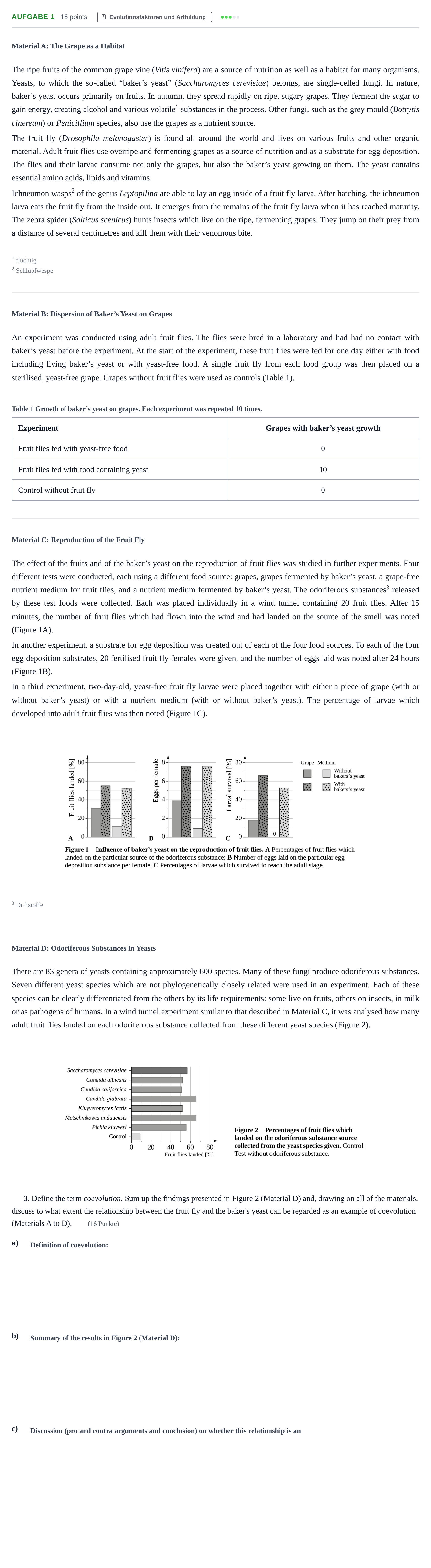
The ripe fruits of the common grape vine ( Vitis vinifera) are a source of nutrition as well as a habitat for many organisms. Yeasts, to which the so-called “baker’s yeast” ( Saccharomyces cerevisiae) belongs, are single-celled fungi. In nature, baker’s yeast occurs primarily on fruits. In autumn, they spread rapidly on ripe, sugary grapes. They ferment the sugar to gain energy, creating alcohol and various volatile 1 substances in the process. Other fungi, such as the grey mould ( Botrytis cinereum) or Penicillium species, also use the grapes as a nutrient source.
The fruit fly ( Drosophila melanogaster) is found all around the world and lives on various fruits and other organic material. Adult fruit flies use overripe and fermenting grapes as a source of nutrition and as a substrate for egg deposition. The flies and their larvae consume not only the grapes, but also the baker’s yeast growing on them. The yeast contains essential amino acids, lipids and vitamins.
Ichneumon wasps 2 of the genus Leptopilina are able to lay an egg inside of a fruit fly larva. After hatching, the ichneumon larva eats the fruit fly from the inside out. It emerges from the remains of the fruit fly larva when it has reached maturity. The zebra spider ( Salticus scenicus) hunts insects which live on the ripe, fermenting grapes. They jump on their prey from a distance of several centimetres and kill them with their venomous bite.
1 flüchtig
2 Schlupfwespe
Material B: Dispersion of Baker’s Yeast on Grapes
An experiment was conducted using adult fruit flies. The flies were bred in a laboratory and had had no contact with baker’s yeast before the experiment. At the start of the experiment, these fruit flies were fed for one day either with food including living baker’s yeast or with yeast-free food. A single fruit fly from each food group was then placed on a sterilised, yeast-free grape. Grapes without fruit flies were used as controls (Table 1).
Table 1 Growth of baker’s yeast on grapes. Each experiment was repeated 10 times. Experiment · Grapes with baker’s yeast growth
Fruit flies fed with yeast-free food · 0
Fruit flies fed with food containing yeast · 10
Control without fruit fly · 0
Material C: Reproduction of the Fruit Fly
The effect of the fruits and of the baker’s yeast on the reproduction of fruit flies was studied in further experiments. Four different tests were conducted, each using a different food source: grapes, grapes fermented by baker’s yeast, a grape-free nutrient medium for fruit flies, and a nutrient medium fermented by baker’s yeast. The odoriferous substances 3 released by these test foods were collected. Each was placed individually in a wind tunnel containing 20 fruit flies. After 15 minutes, the number of fruit flies which had flown into the wind and had landed on the source of the smell was noted (Figure 1A).
In another experiment, a substrate for egg deposition was created out of each of the four food sources. To each of the four egg deposition substrates, 20 fertilised fruit fly females were given, and the number of eggs laid was noted after 24 hours (Figure 1B).
In a third experiment, two-day-old, yeast-free fruit fly larvae were placed together with either a piece of grape (with or without baker’s yeast) or with a nutrient medium (with or without baker’s yeast). The percentage of larvae which developed into adult fruit flies was then noted (Figure 1C).
3 Duftstoffe
Material D: Odoriferous Substances in Yeasts
There are 83 genera of yeasts containing approximately 600 species. Many of these fungi produce odoriferous substances. Seven different yeast species which are not phylogenetically closely related were used in an experiment. Each of these species can be clearly differentiated from the others by its life requirements: some live on fruits, others on insects, in milk or as pathogens of humans. In a wind tunnel experiment similar to that described in Material C, it was analysed how many adult fruit flies landed on each odoriferous substance collected from these different yeast species (Figure 2).
3. Define the term coevolution. Sum up the findings presented in Figure 2 (Material D) and, drawing on all of the materials, discuss to what extent the relationship between the fruit fly and the baker's yeast can be regarded as an example of coevolution (Materials A to D). (16 Punkte)
a)
b)
c)
Lösung
Nach den offiziellen Korrekturhinweisen
Define the term coevolution.
Lösung: Coevolution is the reciprocal evolutionary change in two or more interacting species, which exert mutual selective pressures on each other (die wechselseitige Beeinflussung der Evolution zweier Arten, die in einer engen Beziehung miteinander stehen, durch gegenseitigen Selektionsdruck).
Sum up the findings presented in Figure 2 (Material D).
Lösung: In the experiment, the vast majority of fruit flies (around 50% to 66%) landed on the odor samples of all tested yeast species, including baker's yeast (*Saccharomyces cerevisiae*), whereas the control without odoriferous substances was visited very rarely (under 10%).
Drawing on all of the materials, discuss to what extent the relationship between the fruit fly and the baker's yeast can be regarded as an example of coevolution (Materials A to D).
Lösung: Pro-arguments: - The fruit fly uses baker's yeast as a food source, and the yeast is necessary for larval development, thereby exerting selection pressure on the fruit fly. - The yeast is dispersed by fruit flies to new food sources (grapes), so the fruit fly also exerts selection pressure on the yeast. - The attraction of fruit flies by volatile odoriferous substances of baker's yeast could appear to be a reciprocal adaptation driven by mutual selective pressure. Contra-arguments: - Odoriferous substances of many different yeast species attract fruit flies, including phylogenetically distantly related species with completely different ecological niches (living on insects, in milk, or as human pathogens). - Odor production in yeasts and the attraction of fruit flies to these scents appear to be widespread, general traits rather than a specific, reciprocal evolutionary adaptation between *Drosophila melanogaster* and *Saccharomyces cerevisiae*. Conclusion: Therefore, this relationship is not a specific example of coevolution between the fruit fly and baker's yeast.
Die ausführliche Erklärung Schritt für Schritt (mit KI) gibt es mit Premium. Premium
Löse sie direkt hier: automatische Korrektur, Hinweise und Lösung Schritt für Schritt.
‹ Aufgabe 3 (1) - Evolutionsfaktoren und Artbildung · GK · Haupttermin 2021 · Aufgabe 3 - Evolutionsfaktoren und Artbildung · GK · Haupttermin · bilingual Englisch 2021 ›
Mehr Aufgaben zu Evolutionsfaktoren und Artbildung
- Aufgabe 3 - Evolutionsfaktoren und Artbildung · LK · Nachtermin 2022
- Aufgabe 1 - Evolutionsfaktoren und Artbildung · LK · Nachtermin · Weiterbildungskolleg 2022
- Aufgabe 3 - Evolutionsfaktoren und Artbildung · LK · Nachtermin · Weiterbildungskolleg 2022
- Aufgabe 1 (3) - Evolutionsfaktoren und Artbildung · GK · Haupttermin 2021
- Aufgabe 3 (1) - Evolutionsfaktoren und Artbildung · GK · Haupttermin 2021
- Aufgabe 3 - Evolutionsfaktoren und Artbildung · GK · Haupttermin · bilingual Englisch 2021
- Aufgabe 1 - Teilaufgabe 3 · GK · Haupttermin · Weiterbildungskolleg 2021
- Aufgabe 3 - Teilaufgabe 1 · GK · Haupttermin · Weiterbildungskolleg 2021
- Aufgabe 1 - Evolutionsfaktoren · GK · Haupttermin · Weiterbildungskolleg 2021
- Aufgabe 3 - Koevolution · GK · Haupttermin · Weiterbildungskolleg 2021