Aufgabe Vorschlag D - NS-Diktatur: Ideologie, Volksgemein… · Abitur Hessen Geschichte GK · bilingual Englisch 2022
Thema: NS-Diktatur: Ideologie, Volksgemeinschaft, Terror und Verfolgung · Aus der Prüfung GK · bilingual Englisch (2022)
Aufgabenstellung
Material
John H. Herz: The Fiasco of Denazification (1948)
John H. Herz (1908–2005) was a political scientist who had to leave Germany in 1935 as he was Jewish. He eventually became a professor in the USA. The text at hand is an extract from an essay for an American journal.
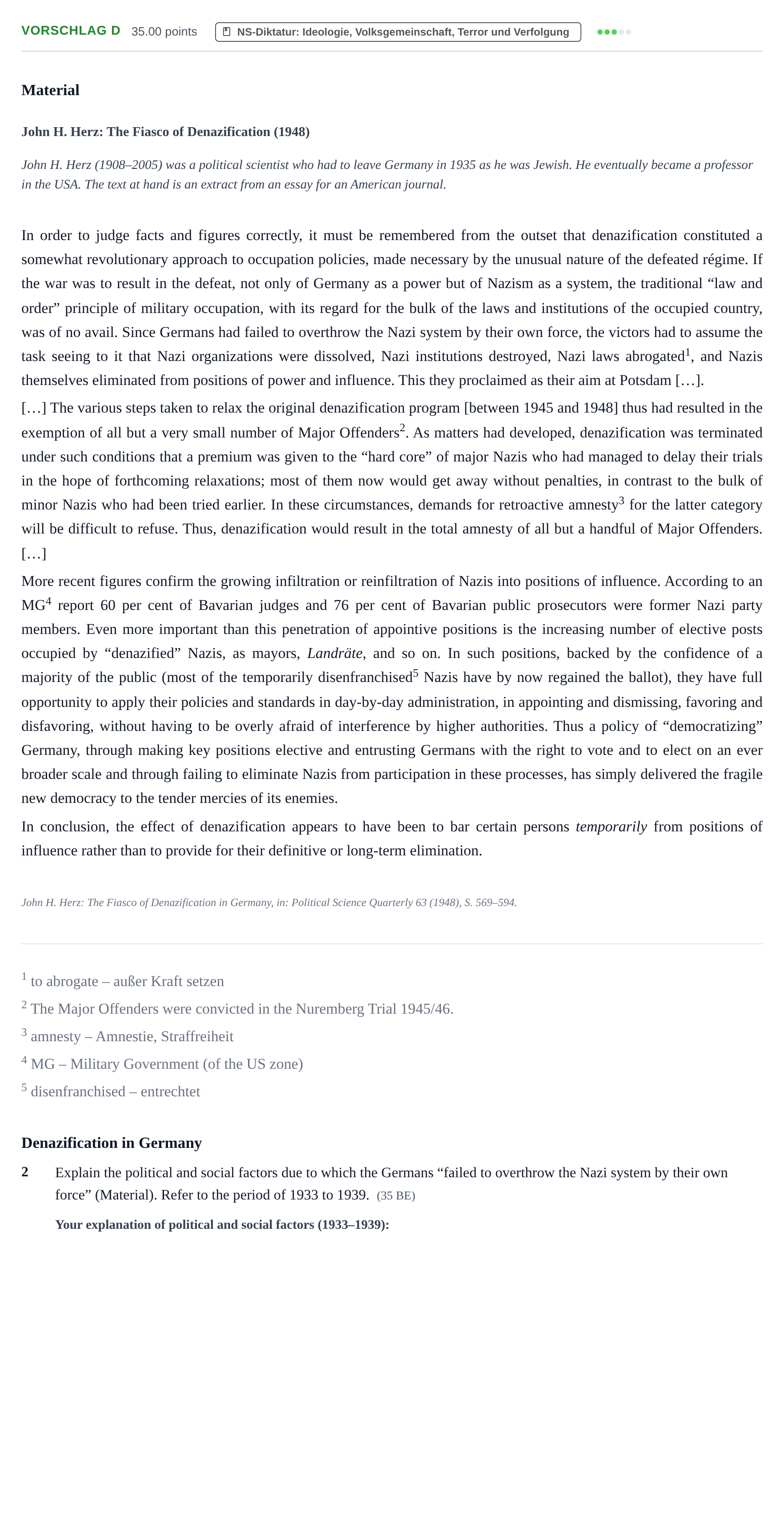
In order to judge facts and figures correctly, it must be remembered from the outset that denazification constituted a somewhat revolutionary approach to occupation policies, made necessary by the unusual nature of the defeated régime. If the war was to result in the defeat, not only of Germany as a power but of Nazism as a system, the traditional “law and order” principle of military occupation, with its regard for the bulk of the laws and institutions of the occupied country, was of no avail. Since Germans had failed to overthrow the Nazi system by their own force, the victors had to assume the task seeing to it that Nazi organizations were dissolved, Nazi institutions destroyed, Nazi laws abrogated 1, and Nazis themselves eliminated from positions of power and influence. This they proclaimed as their aim at Potsdam […].
[…] The various steps taken to relax the original denazification program [between 1945 and 1948] thus had resulted in the exemption of all but a very small number of Major Offenders 2. As matters had developed, denazification was terminated under such conditions that a premium was given to the “hard core” of major Nazis who had managed to delay their trials in the hope of forthcoming relaxations; most of them now would get away without penalties, in contrast to the bulk of minor Nazis who had been tried earlier. In these circumstances, demands for retroactive amnesty 3 for the latter category will be difficult to refuse. Thus, denazification would result in the total amnesty of all but a handful of Major Offenders. […]
More recent figures confirm the growing infiltration or reinfiltration of Nazis into positions of influence. According to an MG 4 report 60 per cent of Bavarian judges and 76 per cent of Bavarian public prosecutors were former Nazi party members. Even more important than this penetration of appointive positions is the increasing number of elective posts occupied by “denazified” Nazis, as mayors, Landräte, and so on. In such positions, backed by the confidence of a majority of the public (most of the temporarily disenfranchised 5 Nazis have by now regained the ballot), they have full opportunity to apply their policies and standards in day-by-day administration, in appointing and dismissing, favoring and disfavoring, without having to be overly afraid of interference by higher authorities. Thus a policy of “democratizing” Germany, through making key positions elective and entrusting Germans with the right to vote and to elect on an ever broader scale and through failing to eliminate Nazis from participation in these processes, has simply delivered the fragile new democracy to the tender mercies of its enemies.
In conclusion, the effect of denazification appears to have been to bar certain persons temporarily from positions of influence rather than to provide for their definitive or long-term elimination.
John H. Herz: The Fiasco of Denazification in Germany, in: Political Science Quarterly 63 (1948), S. 569–594.
1 to abrogate – außer Kraft setzen
2 The Major Offenders were convicted in the Nuremberg Trial 1945/46.
3 amnesty – Amnestie, Straffreiheit
4 MG – Military Government (of the US zone)
5 disenfranchised – entrechtet
Denazification in Germany
2
Explain the political and social factors due to which the Germans “failed to overthrow the Nazi system by their own force” (Material). Refer to the period of 1933 to 1939. (35 BE)
Lösung
Nach den offiziellen Korrekturhinweisen
2 Explain the political and social factors due to which the Germans “failed to overthrow the Nazi system by their own force” (Material). Refer to the period of 1933 to 1939.
Lösung: Erklärung der Stabilität des NS-Systems zwischen 1933 und 1939 anhand politischer und sozialer Faktoren (Terror, Repression, Gleichschaltung, Konsens, Volksgemeinschaft und wirtschaftliche Vorteile).
Die ausführliche Erklärung Schritt für Schritt (mit KI) gibt es mit Premium. Premium
Löse sie direkt hier: automatische Korrektur, Hinweise und Lösung Schritt für Schritt.
‹ Aufgabe Vorschlag D - Aufgaben 1 und 2 · GK 2022 · Aufgabe Vorschlag B - Aufgabe 1 · GK · bilingual Englisch 2021 ›