Aufgabe Vorschlag B - Aufgabe 2 · Abitur Hessen Geschichte GK · bilingual Englisch 2021
Thema: NS-Diktatur: Ideologie, Volksgemeinschaft, Terror und Verfolgung · Aus der Prüfung GK · bilingual Englisch (2021)
Aufgabenstellung
Material
Franz Neumann: Anti-Semitism – Spearhead of Universal Terror (1943)
Franz Neumann (1900–1954), a Social Democratic lawyer, emigrated from Germany in 1933 and later on served as an adviser to the US government in World War II. The text was written as an internal document for the US administration.
In one of the recent issues of Das Reich, Dr. Goebbels pledges the extermination of the Jews in the
East. The Voelkischer Beobachter in a recent issue equally threatens the complete extermination of the
Jews in Poland. The New York Herald Tribune of May 15, 1943, reports the complete liquidation of
the Warsaw ghetto, and a large number of reports indicate that the threats are being realized.
5 The most recent stage in the long process of the extermination of the Jews makes it mandatory to re-
examine the function of anti-Semitism within the framework of the Nazi system. Anti-Semitism has
been, from the very foundation of the Nazi Party, the most constant single ideology of the Nazi Party.
No other element has so constantly figured in the forefront of Nazi ideologies and Nazi activities. We
may, indeed, say that anti-Semitism is the sole ideology that can possibly cement the Nazi Party, and it
10 is this unique function of anti-Semitism that gives it its peculiar character. [...]
The expropriation of the Jews, for instance, is followed by that of the Poles, Czechs, Dutchmen,
Frenchmen, anti-Nazi Germans, and middle classes. Not only Jews are put into concentration camps
but pacifists, conservatives, Socialists, Catholics, Protestants, Free Thinkers, and members of the
occupied peoples. Not only Jews fall under the executioner’s ax but countless others of many races,
15 nationalities, beliefs, and religions. Anti-Semitism is thus the spearhead of terror. The Jews are used as
guinea pigs in testing a method of repression. It is, however, only the Jews who can possibly play this
role. National Socialism, which has allegedly abolished the class struggle, needs an enemy who, by his
very existence, can integrate the antagonistic groups within this society. This foe must not be too
weak. If he were too weak, one could not justify in the eyes of the peoples to make him the supreme
20 foe. He must clearly not be too strong because otherwise the Nazis would become involved in a
serious struggle with a powerful enemy. [...]
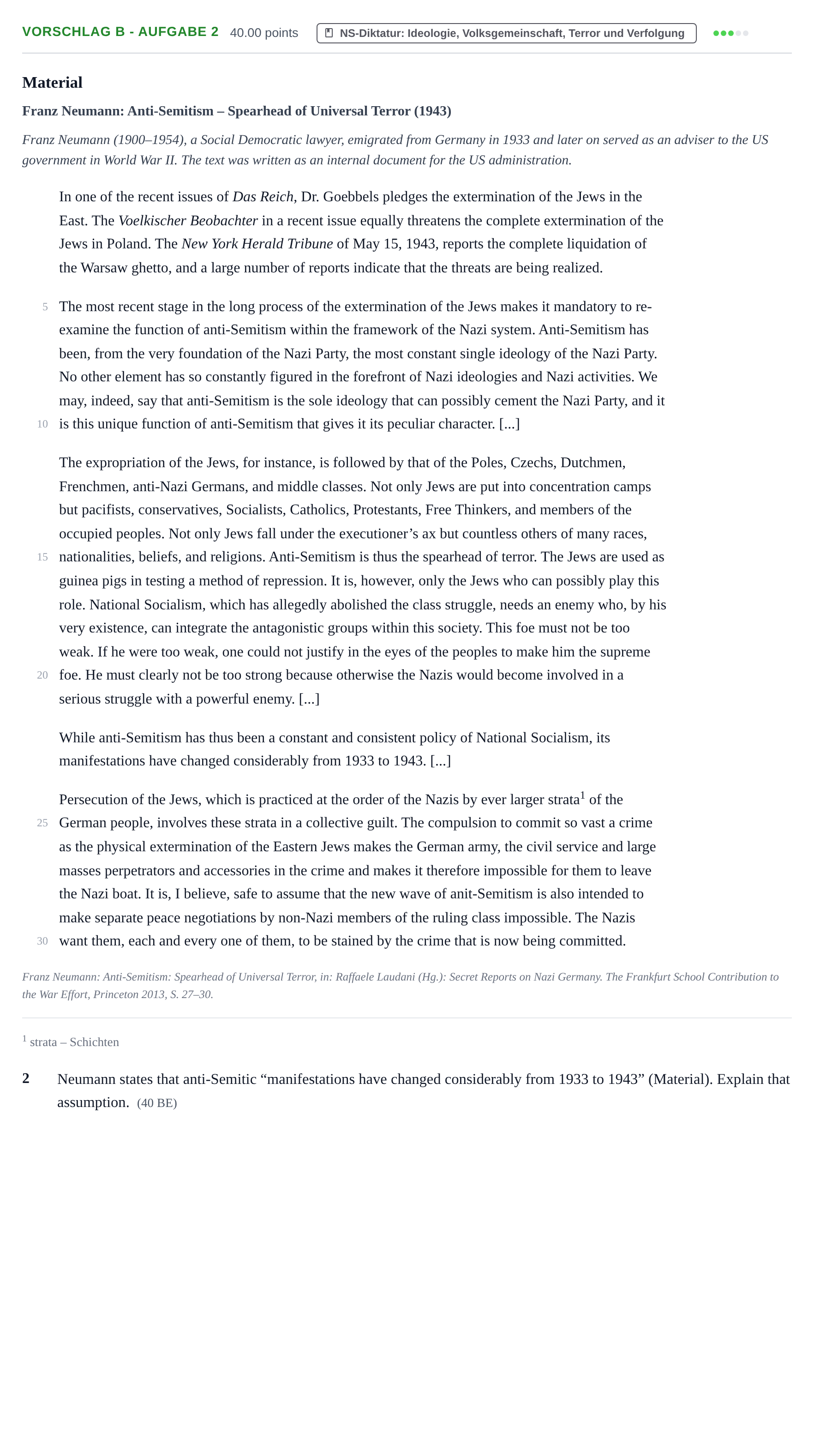
While anti-Semitism has thus been a constant and consistent policy of National Socialism, its
manifestations have changed considerably from 1933 to 1943. [...]
Persecution of the Jews, which is practiced at the order of the Nazis by ever larger strata 1 of the
25 German people, involves these strata in a collective guilt. The compulsion to commit so vast a crime
as the physical extermination of the Eastern Jews makes the German army, the civil service and large
masses perpetrators and accessories in the crime and makes it therefore impossible for them to leave
the Nazi boat. It is, I believe, safe to assume that the new wave of anit-Semitism is also intended to
make separate peace negotiations by non-Nazi members of the ruling class impossible. The Nazis
30 want them, each and every one of them, to be stained by the crime that is now being committed.
Franz Neumann: Anti-Semitism: Spearhead of Universal Terror, in: Raffaele Laudani (Hg.): Secret Reports on Nazi Germany. The Frankfurt School Contribution to the War Effort, Princeton 2013, S. 27–30.
1 strata – Schichten
2
Neumann states that anti-Semitic “manifestations have changed considerably from 1933 to 1943” (Material). Explain that assumption. (40 BE)
Lösung
Nach den offiziellen Korrekturhinweisen
2 Neumann states that anti-Semitic “manifestations have changed considerably from 1933 to 1943” (Material). Explain that assumption.
Lösung: Historical development and escalation from 1933 to 1943: 1. 1933 – Initial exclusion and economic boycott: - April 1933: Nationwide boycott of Jewish businesses, doctors, and lawyers organized by the regime. - 'Gesetz zur Wiederherstellung des Berufsbeamtentums' (April 1933): Removal of Jewish civil servants from office. 2. 1935 – Legal degradation and institutionalized racism: - Nuremberg Laws (September 1935): 'Reichsbürgergesetz' reduces Jews to subjects without political rights; 'Blutschutzgesetz' bans intermarriage and sexual relations between Jews and non-Jews; subsequent decrees curtail economic and civil rights. 3. 1938 – Violent radicalization: - November Pogroms (9 November 1938): State-directed destruction of synagogues, homes, and businesses by SA and SS; financial penalties imposed on the Jewish population; intensified forced 'Aryanization' and emigration. 4. 1939–1941 – War, ghettoization, and mass shootings: - Invasion of Poland (1939): Systematic murders and mass shootings by Einsatzgruppen; forced deportation into overcrowded ghettos. - September 1941: Mandatory wearing of the Yellow Badge ('Judenstern'); ban on emigration. 5. 1941–1943 – Systematic genocide ('Final Solution'): - Decision to exterminate European Jews; Wannsee Conference (January 1942) coordinates administrative and logistical machinery. - Mass extermination using gas chambers in extermination camps in occupied Poland (Auschwitz-Birkenau, Treblinka, Sobibor, Belzec); liquidation of ghettos (e.g., Warsaw Ghetto, 1943). Conclusion: Anti-Semitic policy escalated from social exclusion and legal discrimination to open violence, forced expulsion, and ultimately systematic industrial mass murder.
Die ausführliche Erklärung Schritt für Schritt (mit KI) gibt es mit Premium. Premium
Löse sie direkt hier: automatische Korrektur, Hinweise und Lösung Schritt für Schritt.
‹ Aufgabe Vorschlag B - Aufgabe 1 · GK · bilingual Englisch 2021