Aufgabe Vorschlag D - Aufgabe 3 · Abitur Hessen Geschichte GK · bilingual Englisch 2021
Thema: Liberal-nationale Bewegung, Revolution 1848/49 und Reichsgründung · Aus der Prüfung GK · bilingual Englisch (2021)
Aufgabenstellung
Material
Lord Callaghan: Prospect of German Unification (1990)
James Callaghan (1912–2005) was the leader of the Labour Party 1976–1980 and British Prime Minister 1976–1979. He gave this speech to the House of Lords on 17 January, 1990.
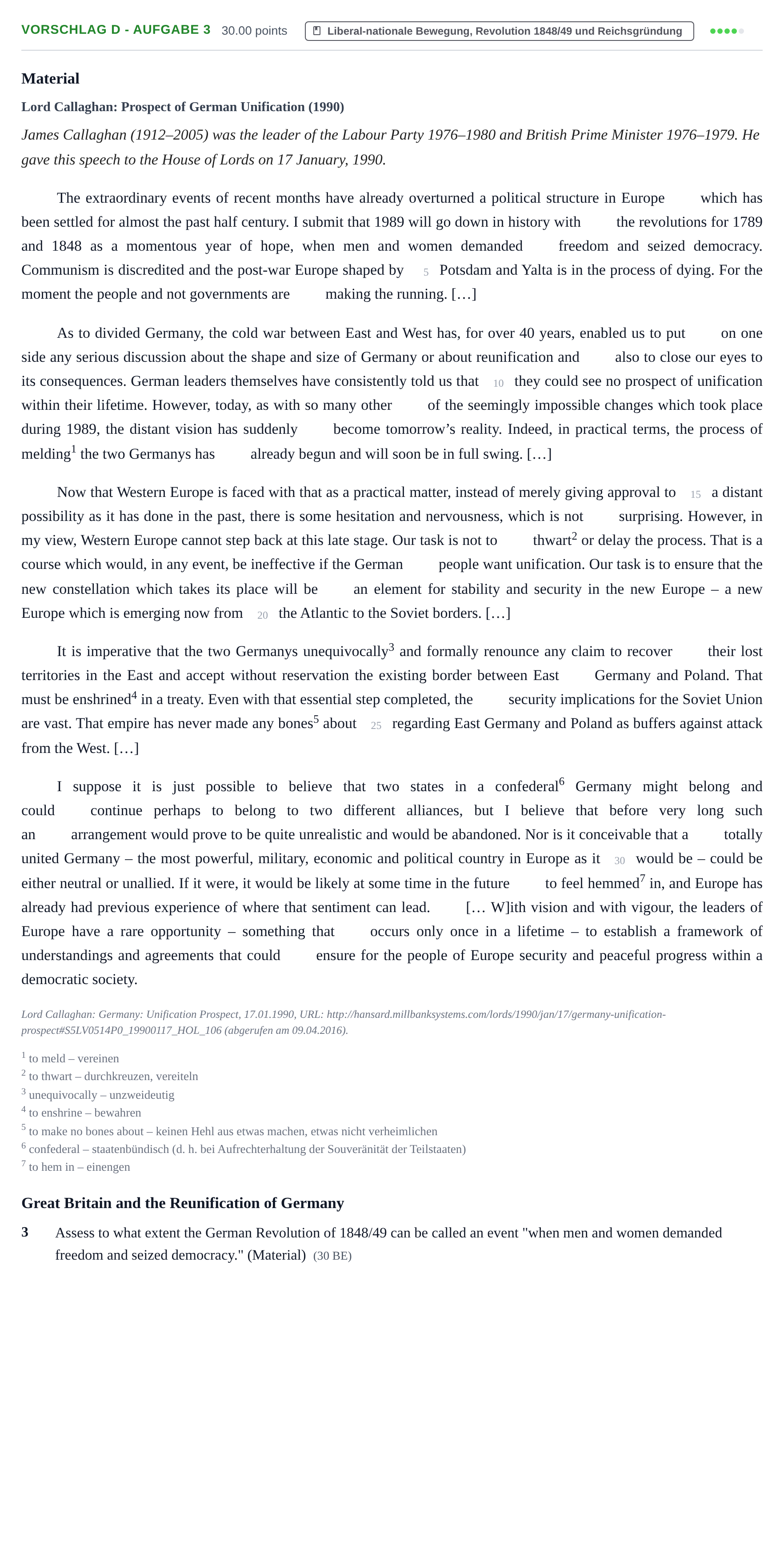
The extraordinary events of recent months have already overturned a political structure in Europe which has been settled for almost the past half century. I submit that 1989 will go down in history with the revolutions for 1789 and 1848 as a momentous year of hope, when men and women demanded freedom and seized democracy. Communism is discredited and the post-war Europe shaped by 5 Potsdam and Yalta is in the process of dying. For the moment the people and not governments are making the running. […]
As to divided Germany, the cold war between East and West has, for over 40 years, enabled us to put on one side any serious discussion about the shape and size of Germany or about reunification and also to close our eyes to its consequences. German leaders themselves have consistently told us that 10 they could see no prospect of unification within their lifetime. However, today, as with so many other of the seemingly impossible changes which took place during 1989, the distant vision has suddenly become tomorrow’s reality. Indeed, in practical terms, the process of melding 1 the two Germanys has already begun and will soon be in full swing. […]
Now that Western Europe is faced with that as a practical matter, instead of merely giving approval to 15 a distant possibility as it has done in the past, there is some hesitation and nervousness, which is not surprising. However, in my view, Western Europe cannot step back at this late stage. Our task is not to thwart 2 or delay the process. That is a course which would, in any event, be ineffective if the German people want unification. Our task is to ensure that the new constellation which takes its place will be an element for stability and security in the new Europe – a new Europe which is emerging now from 20 the Atlantic to the Soviet borders. […]
It is imperative that the two Germanys unequivocally 3 and formally renounce any claim to recover their lost territories in the East and accept without reservation the existing border between East Germany and Poland. That must be enshrined 4 in a treaty. Even with that essential step completed, the security implications for the Soviet Union are vast. That empire has never made any bones 5 about 25 regarding East Germany and Poland as buffers against attack from the West. […]
I suppose it is just possible to believe that two states in a confederal 6 Germany might belong and could continue perhaps to belong to two different alliances, but I believe that before very long such an arrangement would prove to be quite unrealistic and would be abandoned. Nor is it conceivable that a totally united Germany – the most powerful, military, economic and political country in Europe as it 30 would be – could be either neutral or unallied. If it were, it would be likely at some time in the future to feel hemmed 7 in, and Europe has already had previous experience of where that sentiment can lead. [… W]ith vision and with vigour, the leaders of Europe have a rare opportunity – something that occurs only once in a lifetime – to establish a framework of understandings and agreements that could ensure for the people of Europe security and peaceful progress within a democratic society.
Lord Callaghan: Germany: Unification Prospect, 17.01.1990, URL: http://hansard.millbanksystems.com/lords/1990/jan/17/germany-unification-prospect#S5LV0514P0_19900117_HOL_106 (abgerufen am 09.04.2016).
1 to meld – vereinen
2 to thwart – durchkreuzen, vereiteln
3 unequivocally – unzweideutig
4 to enshrine – bewahren
5 to make no bones about – keinen Hehl aus etwas machen, etwas nicht verheimlichen
6 confederal – staatenbündisch (d. h. bei Aufrechterhaltung der Souveränität der Teilstaaten)
7 to hem in – einengen
Great Britain and the Reunification of Germany
3
Assess to what extent the German Revolution of 1848/49 can be called an event "when men and women demanded freedom and seized democracy." (Material) (30 BE)
Lösung
Nach den offiziellen Korrekturhinweisen
3 Assess to what extent the German Revolution of 1848/49 can be called an event "when men and women demanded freedom and seized democracy." (Material)
Lösung: Assessment of the thesis along its two key components: 1. 'Demanded freedom': Highly applicable. - Liberal demands ('Märzforderungen'): freedom of the press, freedom of assembly, freedom of speech played a prominent role and were initially conceded by monarchical governments. - Catalog of Fundamental Rights ('Grundrechte des deutschen Volkes', Dec 1848) established landmark civil liberties that shaped later German constitutions. - The Paulskirche Constitution (March 1849) codified civic freedoms and legislative participation of the Reichstag. 2. 'Seized democracy': Only partially applicable / limited success. - Democratic procedures were enacted in the Vorparlament and the election of the National Assembly, but radical democrats remained a minority. - The Paulskirche majority chose a constitutional hereditary monarchy under Prussian leadership rather than a democratic republic based on popular sovereignty. - The revolution failed to permanently establish democratic power: rejection of the imperial crown by Friedrich Wilhelm IV, dispersal of the Rumpfparlament, and military suppression of the Reichsverfassungskampagne. - Women actively engaged in protests, political clubs, and journalism, yet were denied formal voting and political rights, and their movement was suppressed during the restoration. Concluding balance: Freedom was widely demanded and conceptually enshrined, but democracy was not permanently 'seized' in 1848/49 due to the ultimate victory of monarchical reaction.
Die ausführliche Erklärung Schritt für Schritt (mit KI) gibt es mit Premium. Premium
Löse sie direkt hier: automatische Korrektur, Hinweise und Lösung Schritt für Schritt.
‹ Aufgabe Vorschlag A - Aufgaben 1 und 2 · GK 2021 · Aufgabe Vorschlag A · GK · bilingual Französisch 2021 ›
Mehr Aufgaben zu Liberal-nationale Bewegung, Revolution 1848/49 und Reichsgründung
- Aufgabe Vorschlag A - Aufgaben 1 und 2 · GK 2022
- Aufgabe Vorschlag A - Aufgaben 1-3: Wiener Kongress · LK 2022
- Aufgabe Vorschlag B - Aufgabe 3: Revolution 1848 · LK 2022
- Aufgabe Vorschlag A - Aufgaben 1 und 2 · GK 2021
- Aufgabe Vorschlag A · GK · bilingual Französisch 2021
- Aufgabe Vorschlag A - Aufgaben 1 und 2 · LK 2021
- Aufgabe Vorschlag B - Aufgabe 3 · LK 2021