1. Llegir les sis situacions descrites i escriure una oració per a cadascuna utilitzant els verbs modals que…
Writing
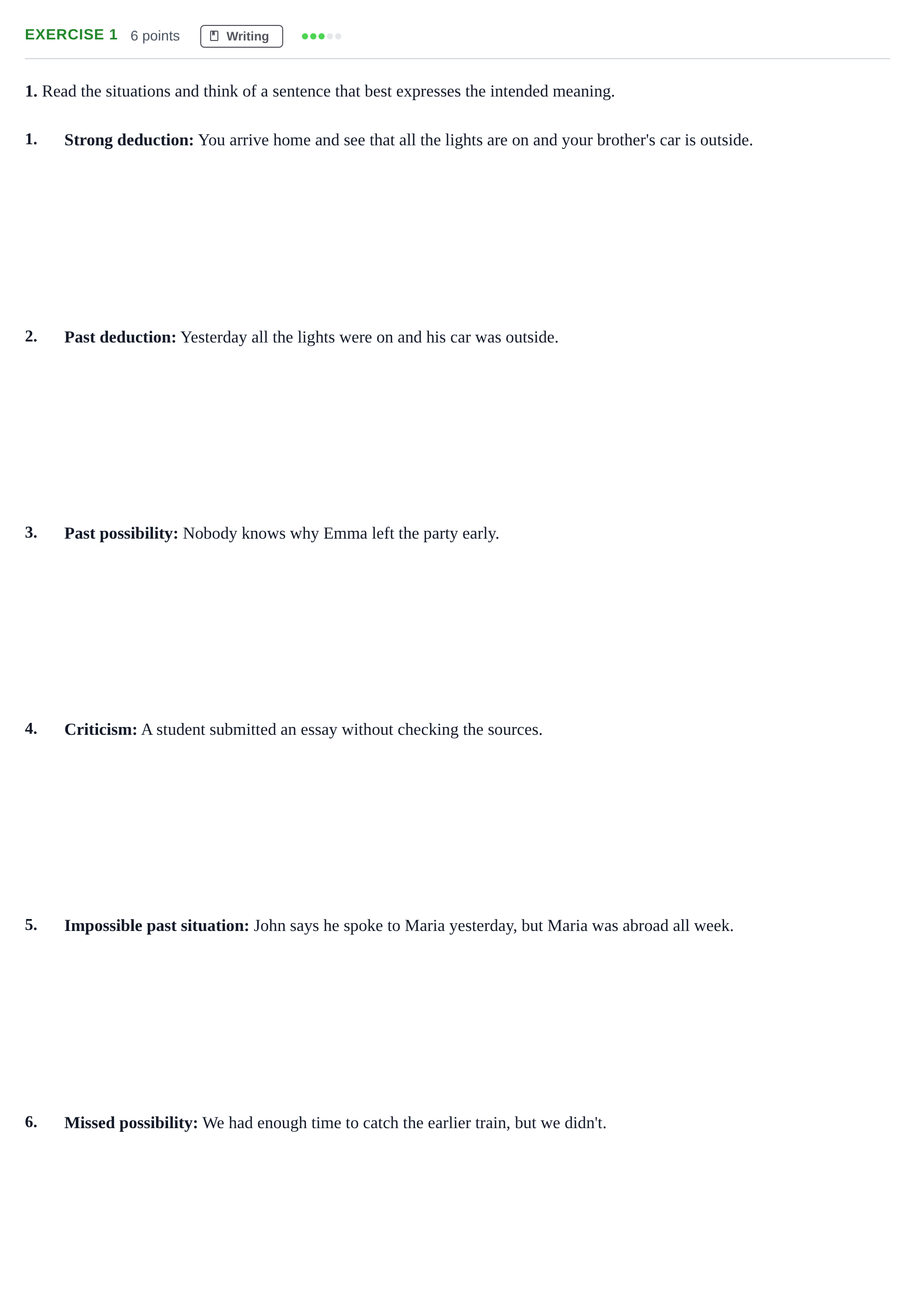
1. Read the situations and think of a sentence that best expresses the intended meaning.
1.
Strong deduction: You arrive home and see that all the lights are on and your brother's car is outside.
2.
Past deduction: Yesterday all the lights were on and his car was outside.
3.
Past possibility: Nobody knows why Emma left the party early.
4.
Criticism: A student submitted an essay without checking the sources.
5.
Impossible past situation: John says he spoke to Maria yesterday, but Maria was abroad all week.
6.
Missed possibility: We had enough time to catch the earlier train, but we didn't.
2. Completar set oracions triant el verb modal que millor s'ajusta al significat del context entre les tres…
Reading comprehension
2. In the following sentences, more than one modal may sometimes be grammatically possible. Choose the one that best fits the meaning.
.
______

3. Completar 10 oracions amb el verb modal adequat segons el context de deducció, possibilitat o retret.
Writing
3. Decide whether you need a present modal or a modal perfect.
1.
Tom isn't at school today. He
be ill.
2.
Tom wasn't at school yesterday. He
have been ill.
3.
Nobody knows why Laura left the party early. She
have felt uncomfortable.
4.
The lights are on and I can hear music. Someone
be at home.
5.
The lights were on when I arrived yesterday. Someone
have been at home.
6.
James says he spoke to Anna yesterday, but Anna was in Paris all week. He
have spoken to her.
7.
You didn't understand the instructions because you didn't read them carefully. You
have read them more carefully.
8.
We arrived too late to catch the train. We
have left home earlier.
9.
Sarah isn't answering her phone. She
be busy.
10.
Sarah didn't answer her phone yesterday. She
have been busy.