Ejercicio B.1 - B.2 · Inglés PAU Madrid Modelo 2022
Tema: Comprensión Lectora · Del examen Modelo (2022)
Enunciado
TEXTO B
Social Media and Mental Health
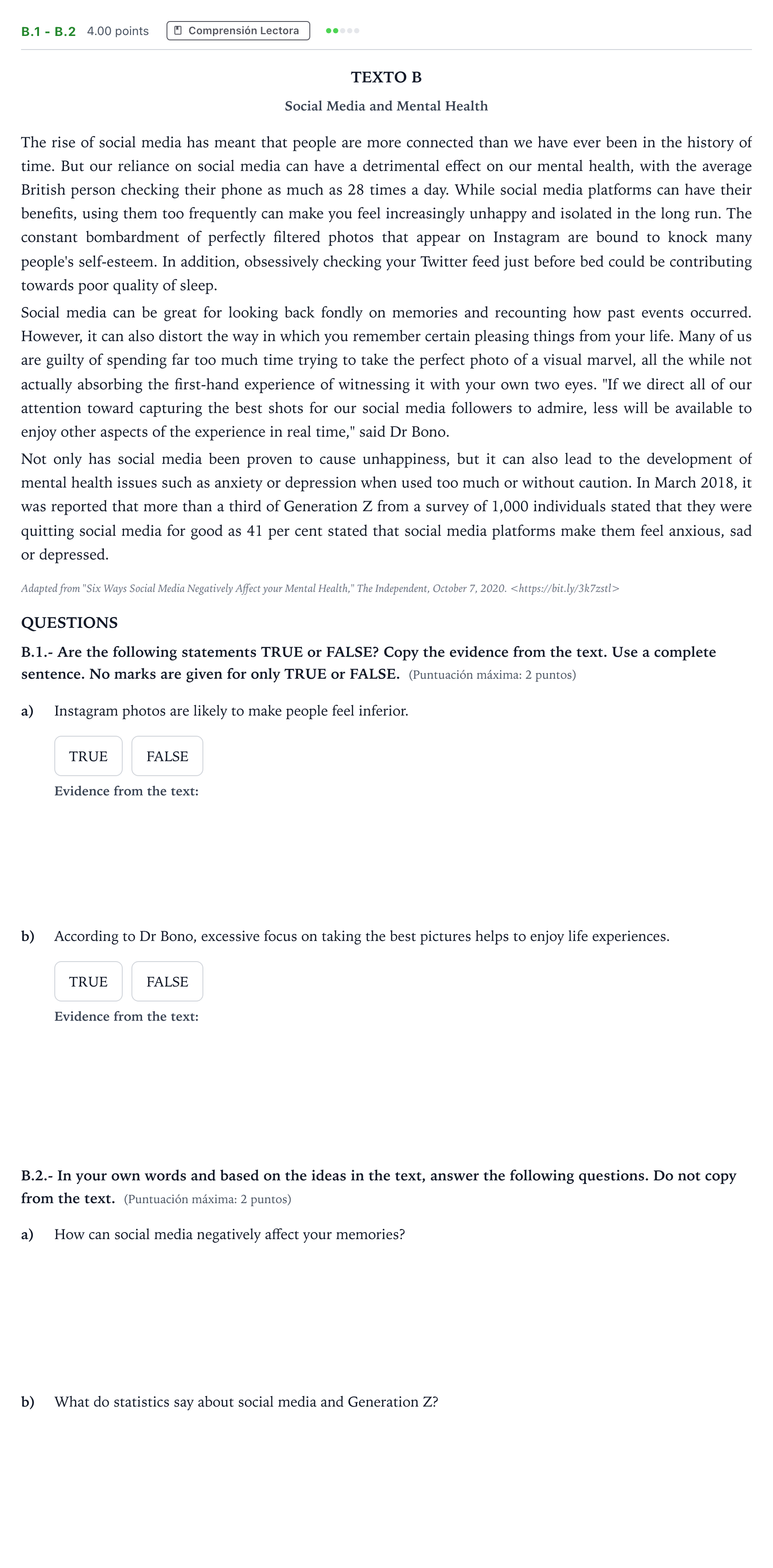
The rise of social media has meant that people are more connected than we have ever been in the history of time. But our reliance on social media can have a detrimental effect on our mental health, with the average British person checking their phone as much as 28 times a day. While social media platforms can have their benefits, using them too frequently can make you feel increasingly unhappy and isolated in the long run. The constant bombardment of perfectly filtered photos that appear on Instagram are bound to knock many people's self-esteem. In addition, obsessively checking your Twitter feed just before bed could be contributing towards poor quality of sleep.
Social media can be great for looking back fondly on memories and recounting how past events occurred. However, it can also distort the way in which you remember certain pleasing things from your life. Many of us are guilty of spending far too much time trying to take the perfect photo of a visual marvel, all the while not actually absorbing the first-hand experience of witnessing it with your own two eyes. "If we direct all of our attention toward capturing the best shots for our social media followers to admire, less will be available to enjoy other aspects of the experience in real time," said Dr Bono.
Not only has social media been proven to cause unhappiness, but it can also lead to the development of mental health issues such as anxiety or depression when used too much or without caution. In March 2018, it was reported that more than a third of Generation Z from a survey of 1,000 individuals stated that they were quitting social media for good as 41 per cent stated that social media platforms make them feel anxious, sad or depressed.
Adapted from "Six Ways Social Media Negatively Affect your Mental Health," The Independent, October 7, 2020. <https://bit.ly/3k7zstl>
QUESTIONS
B.1.- Are the following statements TRUE or FALSE? Copy the evidence from the text. Use a complete sentence. No marks are given for only TRUE or FALSE. (Puntuación máxima: 2 puntos)
a)
Instagram photos are likely to make people feel inferior.
TRUE
FALSE
b)
According to Dr Bono, excessive focus on taking the best pictures helps to enjoy life experiences.
TRUE
FALSE
B.2.- In your own words and based on the ideas in the text, answer the following questions. Do not copy from the text. (Puntuación máxima: 2 puntos)
a)
How can social media negatively affect your memories?
b)
What do statistics say about social media and Generation Z?
Solución
Según los criterios oficiales de corrección
B.1. a) Instagram photos are likely to make people feel inferior.
Solución: TRUE
B.1. a) Evidence from the text
Solución: "The constant bombardment of perfectly filtered photos that appear on Instagram are bound to knock many people's self-esteem."
B.1. b) According to Dr Bono, excessive focus on taking the best pictures helps to enjoy life experiences.
Solución: FALSE
B.1. b) Evidence from the text
Solución: "If we direct all of our attention toward capturing the best shots for our social media followers to admire, less will be available to enjoy other aspects of the experience in real time," said Dr Bono.
B.2. a) How can social media negatively affect your memories?
Solución: Social media can negatively affect our memories, since they can alter the way in which we remember enjoyable moments of our past life.
B.2. b) What do statistics say about social media and Generation Z?
Solución: The results of a survey carried out in March 2018 show that more than a third of Generation Z people were leaving social media, while 41 per cent said that social media provoked anxiety, sadness, or depression in them.
La explicación paso a paso, hecha con IA, es Premium. Premium
Resuélvelo aquí mismo: corrección automática, pistas y solución paso a paso.
‹ Ejercicio A.1 - A.2 · Modelo 2022 · Ejercicio A.1 - A.2 · Ordinaria (2ª lengua) 2022 ›
Más ejercicios de Comprensión Lectora
- Ejercicio A · Extraordinaria (2ª lengua) 2022
- Ejercicio B · Extraordinaria (2ª lengua) 2022
- Ejercicio A · Extraordinaria Coincidencias 2022
- Ejercicio B · Extraordinaria Coincidencias 2022
- Ejercicio A.1 - A.2 · Modelo 2022
- Ejercicio A.1 - A.2 · Ordinaria (2ª lengua) 2022
- Ejercicio B.1 - B.2 · Ordinaria (2ª lengua) 2022
- Ejercicio A.1 - A.2 - Comprensión Lectora · Ordinaria Coincidencias 2022
- Ejercicio B.1 - B.2 - Comprensión Lectora · Ordinaria Coincidencias 2022
- Ejercicio A.1 - A.2 · Ordinaria Lunes 2022