Pregunta 8 · Química PAU La Rioja Ordinaria 2022

Tema: Reacciones redox: ajuste ion-electrón, estequiometría, potenciales y pilas · Del examen Ordinaria (2022)

Enunciado

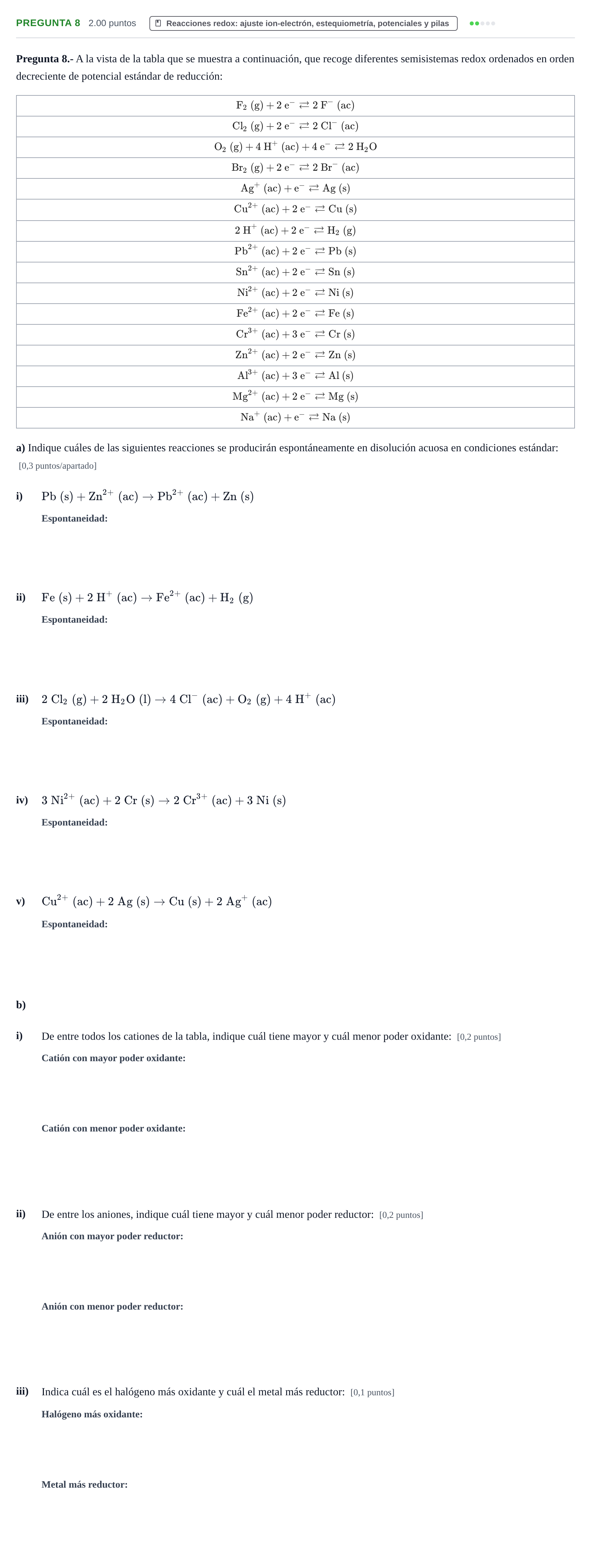
Pregunta 8.- A la vista de la tabla que se muestra a continuación, que recoge diferentes semisistemas redox ordenados en orden decreciente de potencial estándar de reducción:

F2 (g)+2 e−⇄2 F− (ac)\text{F}_2\text{ (g)} + 2\text{ e}^- \rightleftarrows 2\text{ F}^-\text{ (ac)}

Cl2 (g)+2 e−⇄2 Cl− (ac)\text{Cl}_2\text{ (g)} + 2\text{ e}^- \rightleftarrows 2\text{ Cl}^-\text{ (ac)}

O2 (g)+4 H+ (ac)+4 e−⇄2 H2O\text{O}_2\text{ (g)} + 4\text{ H}^+\text{ (ac)} + 4\text{ e}^- \rightleftarrows 2\text{ H}_2\text{O}

Br2 (g)+2 e−⇄2 Br− (ac)\text{Br}_2\text{ (g)} + 2\text{ e}^- \rightleftarrows 2\text{ Br}^-\text{ (ac)}

Ag+ (ac)+e−⇄Ag (s)\text{Ag}^+\text{ (ac)} + \text{e}^- \rightleftarrows \text{Ag (s)}

Cu2+ (ac)+2 e−⇄Cu (s)\text{Cu}^{2+}\text{ (ac)} + 2\text{ e}^- \rightleftarrows \text{Cu (s)}

2 H+ (ac)+2 e−⇄H2 (g)2\text{ H}^+\text{ (ac)} + 2\text{ e}^- \rightleftarrows \text{H}_2\text{ (g)}

Pb2+ (ac)+2 e−⇄Pb (s)\text{Pb}^{2+}\text{ (ac)} + 2\text{ e}^- \rightleftarrows \text{Pb (s)}

Sn2+ (ac)+2 e−⇄Sn (s)\text{Sn}^{2+}\text{ (ac)} + 2\text{ e}^- \rightleftarrows \text{Sn (s)}

Ni2+ (ac)+2 e−⇄Ni (s)\text{Ni}^{2+}\text{ (ac)} + 2\text{ e}^- \rightleftarrows \text{Ni (s)}

Fe2+ (ac)+2 e−⇄Fe (s)\text{Fe}^{2+}\text{ (ac)} + 2\text{ e}^- \rightleftarrows \text{Fe (s)}

Cr3+ (ac)+3 e−⇄Cr (s)\text{Cr}^{3+}\text{ (ac)} + 3\text{ e}^- \rightleftarrows \text{Cr (s)}

Zn2+ (ac)+2 e−⇄Zn (s)\text{Zn}^{2+}\text{ (ac)} + 2\text{ e}^- \rightleftarrows \text{Zn (s)}

Al3+ (ac)+3 e−⇄Al (s)\text{Al}^{3+}\text{ (ac)} + 3\text{ e}^- \rightleftarrows \text{Al (s)}

Mg2+ (ac)+2 e−⇄Mg (s)\text{Mg}^{2+}\text{ (ac)} + 2\text{ e}^- \rightleftarrows \text{Mg (s)}

Na+ (ac)+e−⇄Na (s)\text{Na}^+\text{ (ac)} + \text{e}^- \rightleftarrows \text{Na (s)}

a) Indique cuáles de las siguientes reacciones se producirán espontáneamente en disolución acuosa en condiciones estándar: [0,3 puntos/apartado]

i)

Pb (s)+Zn2+ (ac)→Pb2+ (ac)+Zn (s)\text{Pb (s)} + \text{Zn}^{2+}\text{ (ac)} \rightarrow \text{Pb}^{2+}\text{ (ac)} + \text{Zn (s)}

ii)

Fe (s)+2 H+ (ac)→Fe2+ (ac)+H2 (g)\text{Fe (s)} + 2\text{ H}^+\text{ (ac)} \rightarrow \text{Fe}^{2+}\text{ (ac)} + \text{H}_2\text{ (g)}

iii)

2 Cl2 (g)+2 H2O (l)→4 Cl− (ac)+O2 (g)+4 H+ (ac)2\text{ Cl}_2\text{ (g)} + 2\text{ H}_2\text{O (l)} \rightarrow 4\text{ Cl}^-\text{ (ac)} + \text{O}_2\text{ (g)} + 4\text{ H}^+\text{ (ac)}

iv)

3 Ni2+ (ac)+2 Cr (s)→2 Cr3+ (ac)+3 Ni (s)3\text{ Ni}^{2+}\text{ (ac)} + 2\text{ Cr (s)} \rightarrow 2\text{ Cr}^{3+}\text{ (ac)} + 3\text{ Ni (s)}

v)

Cu2+ (ac)+2 Ag (s)→Cu (s)+2 Ag+ (ac)\text{Cu}^{2+}\text{ (ac)} + 2\text{ Ag (s)} \rightarrow \text{Cu (s)} + 2\text{ Ag}^+\text{ (ac)}

b)

i)

De entre todos los cationes de la tabla, indique cuál tiene mayor y cuál menor poder oxidante: [0,2 puntos]

ii)

De entre los aniones, indique cuál tiene mayor y cuál menor poder reductor: [0,2 puntos]

iii)

Indica cuál es el halógeno más oxidante y cuál el metal más reductor: [0,1 puntos]
Enunciado: Pregunta 8 · Química PAU La Rioja Ordinaria 2022

Solución

Solución de AprenAI (no es la oficial)

a) i) Pb (s) + Zn²⁺ (ac) → Pb²⁺ (ac) + Zn (s)

Solución: No espontánea

a) ii) Fe (s) + 2 H⁺ (ac) → Fe²⁺ (ac) + H₂ (g)

Solución: Espontánea

a) iii) 2 Cl₂ (g) + 2 H₂O (l) → 4 Cl⁻ (ac) + O₂ (g) + 4 H⁺ (ac)

Solución: Espontánea

a) iv) 3 Ni²⁺ (ac) + 2 Cr (s) → 2 Cr³⁺ (ac) + 3 Ni (s)

Solución: Espontánea

a) v) Cu²⁺ (ac) + 2 Ag (s) → Cu (s) + 2 Ag⁺ (ac)

Solución: No espontánea

b) i) Catión con mayor poder oxidante:

Solución: Ag⁺

Las soluciones de los 5 apartados que faltan y la explicación paso a paso son Premium. Premium

Resuélvelo aquí mismo: corrección automática, pistas y solución paso a paso.

‹ Pregunta 2 - Reacciones redox · Ordinaria 2022 · Pregunta 7 · Extraordinaria 2021 ›

Más ejercicios de Reacciones redox: ajuste ion-electrón, estequiometría, potenciales y pilas